Master Competitive Marketing Intelligence
Our guide to competitive marketing intelligence breaks down the frameworks, data tools, and strategies you need to gain a real advantage over your rivals.

Darcy Cudmore
Professional Blog Writer
Darcy Cudmore is the founder of RepuLinks, a digital PR and SEO agency helping brands earn authoritative media coverage, backlinks, and visibility in search. He writes about PR strategy, content marketing, AI search, and how companies can build credibility through smarter online visibility.

Trying to market your brand without knowing what your competitors are doing is like driving blindfolded. You might think you have the most engaging content or the best product on the block, but without any context, you're really just guessing. This is where competitive marketing intelligence comes in.
Think of it less as spying and more like a sports team studying game film before a big match. It's the structured process of gathering and ethically analyzing information about your direct competitors to get a real strategic edge. You're looking at their marketing strategies, product launches, and customer engagement to figure out why they do what they do, so you can inform your own game plan.
Understanding Your Competitive Landscape
In marketing, assumptions are the fastest way to fail. Competitive intelligence swaps out those dangerous assumptions for a concrete playbook, turning raw data about your rivals into actionable insights for your brand.
It's a much deeper process than just occasionally scrolling through a competitor's TikTok feed. A solid competitive intelligence routine involves:
Identifying who your key competitors are and what makes them tick.
Analyzing their entire marketing mix—from their TikTok video strategy all the way to their email campaigns.
Predicting their next moves based on past behavior and signals in the market.
Applying those insights to spot gaps, sidestep risks, and jump on new opportunities.
The Goal is More Than Just Collecting Data
Ultimately, the whole point is to make smarter, faster, and more confident decisions. When you know a rival is about to launch a similar product, you can prep a counter-campaign. If you see their ads are consistently crushing yours on a certain platform, you can shift your budget or rethink your creative.
The core idea is to move from reactive tactics to proactive strategy. Instead of just responding to what your competitors do, you start anticipating their moves and positioning your brand to win before the battle even begins.
A Growing Strategic Must-Have
More and more businesses are catching on. The global competitive intelligence industry was valued at roughly $8.2 billion in 2023 and is on track to more than double by 2030. This kind of investment shows that keeping a close eye on the competitive environment isn't a luxury anymore—it's a fundamental part of modern marketing.
To dig deeper into the core principles of this practice, we recommend exploring this great guide on What Is Competitive Analysis In Marketing.
Proven Frameworks for Analyzing Competitors
Gathering data without a plan is like trying to build a LEGO set without the instruction booklet. You’ll end up with a pile of colorful pieces, but you won't have a coherent strategy. This is where structured frameworks come in—they are the instruction manual for competitive marketing intelligence, turning random data points into a clear strategic map.
These models give you a systematic way to make sense of the competitive landscape. Instead of just reacting to a competitor's latest TikTok video, you can place their actions into a bigger picture, helping you predict their next moves and spot real opportunities.
This flow chart breaks down how raw data gets transformed into a true strategic advantage. It’s a journey from basic collection to high-level analysis and, finally, to game-changing insights.
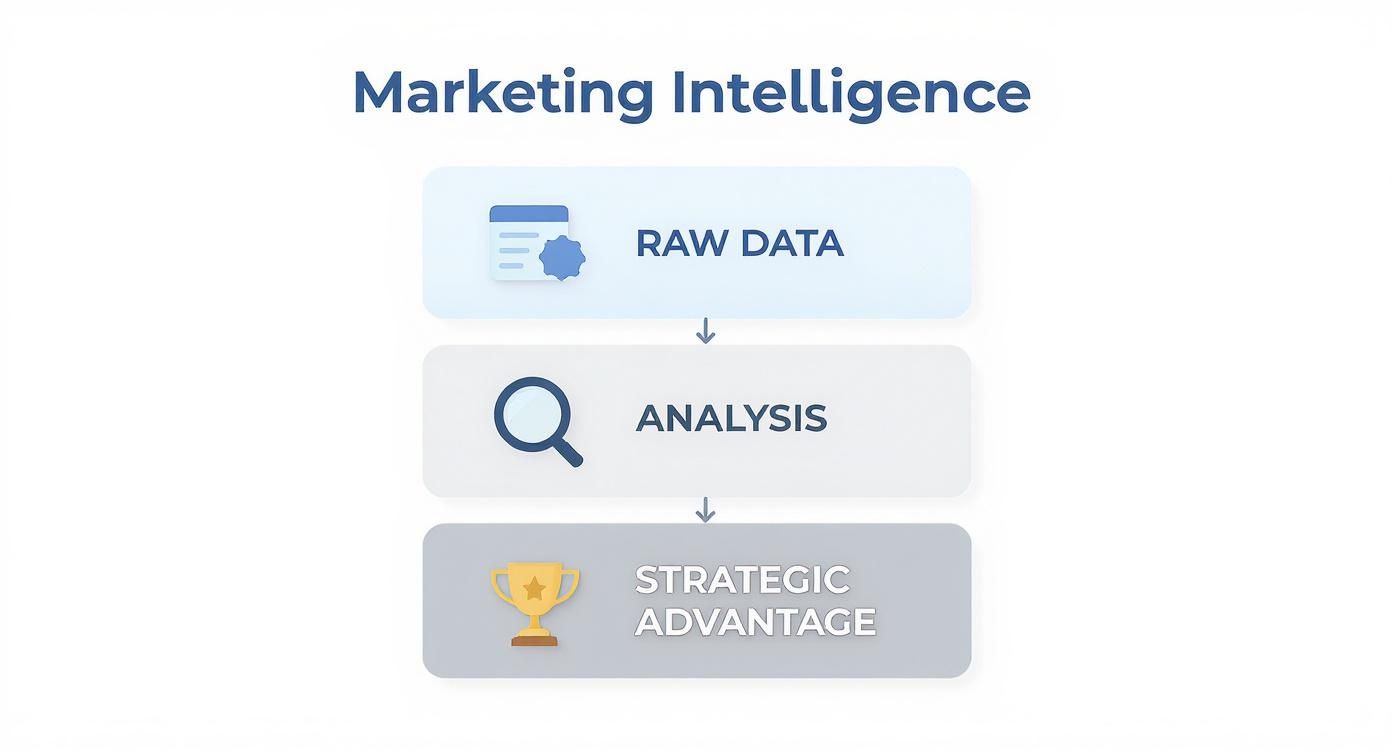
As you can see, winning isn't about having the most data. It's about having the sharpest process to make that data work for you.
The Classic SWOT Analysis
One of the most trusted and straightforward frameworks is the SWOT Analysis. It’s the perfect starting point that forces you to look at your competitors (and yourself!) through four critical lenses:
Strengths: What are their core advantages? Think strong brand loyalty, viral content, or a massive email list.
Weaknesses: Where are they dropping the ball? This could be anything from slow customer service to an ignored YouTube channel.
Opportunities: What outside factors could they use to their advantage? A new trending TikTok sound or a shift in consumer behavior are perfect examples.
Threats: What external challenges are they up against? This might include new industry regulations or a scrappy new startup entering the scene.
By mapping these four areas, you get a quick, high-level snapshot. You can instantly see where a competitor is dominant and, more importantly, where their weak spots create an opening for you.
Porter’s Five Forces for Industry Dynamics
While SWOT zooms in on a single competitor, Porter's Five Forces zooms out to give you a 30,000-foot view of your entire industry. It's a powerhouse for figuring out just how competitive your market is and where the real power lies.
It analyzes five key pressures:
Competitive Rivalry: How cutthroat is the competition among the brands already in the game?
Threat of New Entrants: How easy is it for a new player to set up shop and start competing?
Bargaining Power of Buyers: How much leverage do customers have to demand lower prices or better features?
Bargaining Power of Suppliers: How much control do your suppliers have over your costs?
Threat of Substitute Products: How likely are customers to find a completely different way to solve the same problem?
Getting a handle on these forces helps you understand the structural challenges and opportunities in your niche that go way beyond simple one-on-one rivalries.
Modern Digital Footprint Analysis
In today's world, a competitor's digital presence is their main arena. A Digital Footprint Analysis is a framework for systematically auditing everything they do online. This is where you roll up your sleeves and investigate their key channels:
SEO and Content: What keywords are they owning in search results? What kind of content are they creating, and how often?
Social Media: Which platforms are they focusing on? What’s their engagement rate and content velocity looking like, especially on fast-moving platforms like TikTok and Shorts?
Paid Advertising: What ads are they running on platforms like Meta and Google? What offers and messaging are they testing?
To really dig deep here, our guide on the best social media competitor analysis tools can help automate a lot of this legwork. And to get the most out of these frameworks, smart marketers are increasingly using advanced Competitor AI Analysis Tools to process data and pull out insights much faster.
Choosing the right framework depends entirely on what you're trying to achieve. Are you looking for a quick gut check or a deep dive into the market's structure?
Comparing Competitive Intelligence Frameworks
Here's a quick breakdown of these three core frameworks, what they're best for, and the critical questions each one helps you answer.
Framework | Best For | Key Questions Answered |
|---|---|---|
SWOT Analysis | Quick, high-level assessments of a single competitor or your own brand. | "Where are they strong?" |
Porter's Five Forces | Understanding the overall profitability and power dynamics of an entire industry. | "How competitive is this market?" |
Digital Footprint Analysis | Auditing a competitor's online marketing activities and tactical execution. | "What's their digital strategy?" |
Ultimately, these frameworks give you the structure you need. They turn chaotic data into a clear plan of action, forming the foundation of a powerful competitive intelligence program.
How to Gather Competitor Data Ethically
Let’s get one thing straight: gathering competitive intelligence isn't about shady backroom deals or corporate espionage. It’s about being a good detective—systematically collecting publicly available information to build a crystal-clear picture of what everyone else is doing.
Think of it like this: your competitors are constantly leaving a trail of digital breadcrumbs across the internet with every campaign they launch and every piece of content they post. Your job is to follow that trail, piece together their strategy, and do it all without crossing any ethical lines.

This process is all about examining different data points to form a cohesive analysis, not just hoarding a pile of random facts.
Uncovering SEO and Content Strategies
Some of the best intel you can find is sitting right on your competitor's website and hidden within their search engine presence. SEO tools are your secret weapon here, letting you peek behind the curtain of their organic search performance without any of the guesswork.
Platforms like Ahrefs or Semrush let you essentially reverse-engineer their entire content strategy. With a few clicks, you can identify:
Top Keywords: Pinpoint the exact search terms that are driving the most traffic to their site.
Highest-Performing Content: See which blog posts, landing pages, or guides are attracting the most backlinks and organic visitors.
Backlink Profile: Analyze who is linking to them. This is a dead giveaway of their PR strategy and authority in the market.
This kind of analysis immediately shows you which content pillars are actually working for them, giving you a roadmap of topics you can target and create something even better for.
Deconstructing Short-Form Video Performance
In the blink-and-you'll-miss-it world of TikTok, Reels, and YouTube Shorts, trying to track everything manually is a fool's errand. Instead, you need to focus on spotting patterns and analyzing the metrics that actually matter.
Look past the vanity metrics like simple view counts. The real story is in these data points:
Content Velocity: How often are they posting? A sudden spike might signal a new campaign or a big strategic push.
Trending Audio Usage: Are they jumping on viral sounds early, or are they late to the party? This tells you a lot about their agility.
Video Formats and Hooks: What styles of video do they lean on (talking heads, tutorials, skits)? Pay very close attention to the first three seconds of their most-viewed videos to figure out their hook formula.
Engagement Patterns: Compare likes, comments, and shares. A video with unusually high shares is a goldmine—it means the content provided massive value or was incredibly entertaining.
Key Takeaway: Analyzing these elements gives you a formula for what works on these platforms. You can then model their successful formats with your own unique brand spin instead of just throwing content at the wall and hoping it sticks.
Leveraging Social Listening and Analytics Tools
It’s not just about what competitors post themselves; you also need to know what other people are saying about them. This is where social listening comes in. By setting up alerts for competitor brand names, products, or even key executives, you can tap into the real-time public conversation.
This is where you'll find raw, unfiltered customer feedback. You’ll see complaints about their products, praise for their customer service, and everything in between. You can also monitor their brand sentiment over time to see how a big campaign or company news impacts public perception.
To do this effectively, you need the right tools. Our guide on social media analytics tools is a great place to start your search for a platform that can automate this for you.
The demand for this kind of insight is exploding. The competitive intelligence tools market is on track to grow by nearly $28 billion between 2024 and 2029. This growth is largely fueled by AI-powered platforms that make sophisticated data collection accessible to everyone, not just massive corporations. You can dive deeper into this by exploring the latest competitive intelligence trends.
Turning Data Into a Strategic Advantage
Collecting competitor data is just the first step. By itself, raw information is mostly noise—a jumble of isolated facts that don’t point you in any real direction. The magic of competitive marketing intelligence happens when you start connecting those dots to uncover patterns, motivations, and strategic openings you couldn't see before.
Think of yourself as a detective standing in front of a corkboard covered in clues. One photo or a single note won't solve the case. But once you start grouping them together—linking suspects to locations, motives to actions—a clear story begins to form. That's exactly how you turn a pile of data into a real strategic advantage.
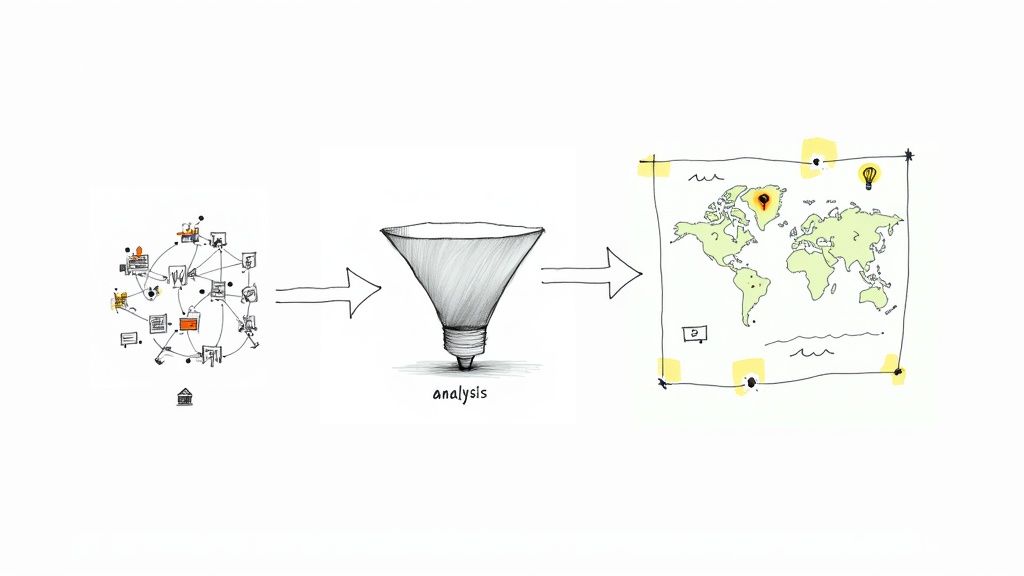
This process is all about moving from simple observation to powerful insight. It’s the difference between saying, "Competitor A is active on Instagram," and realizing, "Competitor A’s user-generated content campaigns are driving their highest engagement, which means there's an opportunity for us to build a stronger community."
From Observation to Actionable Insight
To start connecting the dots, you need to sort your raw data into strategic buckets. This structure helps you spot patterns way more effectively instead of getting lost in a massive spreadsheet of metrics.
A great way to start is by organizing your findings into these key areas:
Content and SEO Performance: Group everything related to their keyword rankings, top-performing blog posts, backlink sources, and video content themes.
Product and Offer Positioning: Collect intel on their pricing, unique selling propositions (USPs), customer reviews, and any promotional tactics they’re running.
Customer Voice and Feedback: Pull together mentions from social media, review sites, and forums to get a clear picture of what customers love and hate about them.
Audience Engagement Strategy: Analyze how they interact with their community, which social platforms get the most love, and what kind of content actually sparks a conversation.
With these buckets in place, you can start asking the right questions. For instance, if a competitor’s blog posts on a certain topic consistently attract backlinks, what content gap can you fill? Or if customers are always complaining about their shipping times, how can you make your brand’s faster fulfillment a key selling point? This systematic approach is a cornerstone of any good data-driven marketing strategies.
A Practical E-commerce Scenario
Let's walk through a real-world example. Imagine you run an e-commerce brand that sells sustainable activewear, and you're digging into a key competitor.
Your initial data sweep might turn up these observations:
They post three TikTok videos a day.
Their most-viewed videos all feature customer testimonials.
Their website has a big, splashy "Community" page.
Negative reviews on Trustpilot often complain about poor material quality.
Individually, these are just random facts. But when you piece them together, a powerful strategic insight jumps out.
Insight: Your competitor has built a loyal community around their brand, but their product quality is a major weakness. They're using social proof to hide a fundamental product flaw. This gives your brand a clear opening.
This single insight hands you a specific, actionable game plan. You can now build a marketing campaign that hammers home your superior material quality, showcases authentic customer reviews, and directly speaks to the pain points their customers are already feeling. You’ve moved beyond just watching them to crafting a targeted strategy designed to win over their unhappy audience.
That is the real power of competitive marketing intelligence.
How to Apply Your Competitive Insights
Intelligence without action is just trivia. After all the hard work of gathering and organizing data, this is where the rubber meets the road. It’s time to turn those strategic insights into real marketing results, moving from analysis to actual growth.
The goal isn't just to know what your rivals are doing. It's about using that knowledge to make smarter, faster decisions across your entire marketing funnel—from the content you create to the products you build and the ads you run.
Execute a Content and SEO Gap Analysis
One of the most immediate wins you can get from competitive intelligence is spotting content gaps your competitors are completely ignoring. By analyzing their top articles and the keywords that drive their traffic, you can find proven topics and then create something way better.
Find their winners: Use an SEO tool to pull the keywords sending the most organic traffic to your top three competitors.
Analyze the content: Go read their top-ranking articles. What’s the format? How deep do they go? More importantly, what questions do they leave unanswered?
Create something 10x better: Your mission is to build a more comprehensive, more engaging, and more visually appealing piece of content targeting those exact keywords.
This isn't about guesswork. It’s a methodical approach to capturing traffic for topics you already know people are interested in, saving you from the "what should we create next?" headache.
Refine Your Product and Offer Positioning
Want to know what the market really wants? Go read your competitors' customer reviews. They are an absolute goldmine of raw, unfiltered feedback that can help you sharpen your own product and messaging.
Scour review sites, social media comments, and forum threads for recurring complaints about a competitor's product. These weaknesses are your strategic openings to highlight your brand's strengths and directly address market needs.
For instance, if a rival’s customers constantly complain about terrible customer support, you can make responsive, high-quality service a core pillar of your marketing. Just like that, their biggest weakness becomes your key differentiator.
Optimize Paid Media Campaigns
Why burn through your ad budget testing copy from scratch? Your competitors have already spent thousands figuring out what hooks and offers work in your market. Monitoring their paid campaigns gives you a direct look into their winning ad creative, keyword targets, and landing page strategies.
Look for the ads they’ve been running the longest. An ad with a long lifespan is almost always a profitable one. Analyze the hooks, calls-to-action, and visuals they use, then adapt those proven elements for your own campaigns.
This kind of strategic tracking is becoming standard practice. In fact, North America held over 43.6% of the competitive intelligence tools market share back in 2019, an investment driven by the rise of sophisticated platforms that make this kind of analysis easier than ever. You can learn more about the growth of these valuable CI solutions and how they’re shaping the market.
Frequently Asked Questions
Even with a solid game plan, diving into competitive marketing intelligence can bring up a few lingering questions. Let's clear the air on some of the most common ones so you can build a smart, sustainable intel program with confidence.
How Often Should I Run a Competitor Analysis?
There’s no magic number here—it really depends on how fast your industry moves. If you're in a fast-paced space like social media or e-commerce, a monthly check-in is a good rule of thumb. It’s enough to catch new campaigns, content trends, and messaging shifts before they leave you in the dust.
For more traditional or stable industries, a quarterly deep dive will probably do the trick. The most important thing is consistency.
Think of it this way: you want to turn competitor analysis from a dreaded one-off project into a regular, integrated part of your marketing rhythm. This ongoing awareness is what keeps you from getting blindsided by a competitor's sudden pivot.
Is Competitive Intelligence Actually Ethical?
This is a big one, and the answer is a clear and simple yes, as long as you’re playing by the rules. Ethical competitive intelligence is all about being a sharp researcher, not a spy. It means analyzing the data that companies have already put out there for the world to see.
What's Fair Game (Ethical Practices):
Digging into their public website, blog content, and SEO strategy.
Keeping tabs on their social media profiles, ad campaigns, and press releases.
Reading through public financial reports and customer reviews.
What Crosses the Line (Unethical Practices):
Trying to get your hands on private or proprietary information.
Posing as someone else to get intel from a competitor's employees.
Using any kind of industrial espionage or hacking.
The line is pretty bright: if the information is out in the open for anyone to find, it’s fair game for analysis.
What Are The Best Free Tools for Getting Started?
You don't need a massive budget to get started. In fact, some of the most powerful tools for gathering initial insights are completely free. They're perfect for uncovering high-level strategies and tracking key activities without spending a dime.
Here are a few essentials to get you going:
Google Alerts: This is your most basic listening tool. Set up alerts for your competitors' brand names, and you'll get an email whenever they pop up in the news or on a new webpage. It’s a dead-simple way to monitor their PR and content footprint.
Native Social Media Analytics: Platforms like TikTok, Instagram, and YouTube all have their own analytics. While you can't peek behind the curtain at a competitor's data, you can manually track things like their posting frequency, engagement rates, and content formats to spot patterns over time.
Google Trends: This one is fantastic for a bird's-eye view. You can compare the search interest for your brand against your competitors. It's a great way to gauge brand awareness and see how major campaigns or events affect public interest.
These tools are more than enough to build a strong foundation for your competitive intelligence program from the ground up.
Ready to turn competitive insights into viral growth? Virlo is the data-driven platform designed to help you analyze trends, deconstruct what works for top creators, and produce winning short-form videos faster. Stop guessing and start growing. Discover how Virlo can accelerate your content strategy today.
See What's Trending Right Now
- Social listening for TikTok, Reels & Shorts
- Spot viral trends before they peak
- Turn insights into ads, scripts & briefs
The Signal Newsletter
Weekly trend breakdowns, creator insights, and social listening tips — straight to your inbox.
Subscribe FreeSee Virlo in action

See What's Trending Right Now
- Social listening for TikTok, Reels & Shorts
- Spot viral trends before they peak
- Turn insights into ads, scripts & briefs
The Signal Newsletter
Weekly trend breakdowns, creator insights, and social listening tips — straight to your inbox.
Subscribe FreePut this into practice with Virlo
Turn what you just read into real research. These are the tools creators, agencies, and brands use to find what's working on short-form video.
Content Research Agent
Run your short-form research on autopilot — outliers, creators, and sounds across TikTok, Reels, and Shorts.
Tracking Center
Monitor breakout creators, videos, and competitors with daily snapshots and deep AI analysis.
Free Data
Explore free viral hooks, trending niches, breakout products, and more — no account required.
Get The Signal
Join creators, marketers, and agencies getting weekly trend breakdowns and social listening insights delivered free.
Subscribe to the Newsletter
Stop Guessing. Start Knowing.
Join thousands of digital entrepreneurs using data to take the guesswork out of capitalizing on trends.