competitive product analysis: Boost Your Market Edge
Learn competitive product analysis techniques to uncover gaps, seize opportunities, and accelerate your e-commerce growth.


If you're in e-commerce, competitive product analysis isn't just a quarterly report you dust off for meetings. It’s an active, ongoing strategy that helps you understand your market and make way smarter business decisions. Think of it as strategic learning, not spying. It’s all about digging into your competitors' products, pricing, marketing tactics, and customer feedback to find gaps, catch trends before they peak, and build something better.
Why Competitive Product Analysis Is Your E-commerce Superpower

Forget about static reports and outdated spreadsheets. In today's e-commerce world, where trends on platforms like TikTok can blow up literally overnight, competitive analysis has to be dynamic. It's the key to survival and growth, and it goes way beyond just checking a rival’s prices.
You're essentially decoding their entire playbook—from the new features they’re launching and the customer problems they're solving to the exact video formats that are going viral for them. Modern brands have to keep a constant pulse on the competition to stay ahead of the curve.
Uncover Untapped Market Gaps
When you systematically study what other brands are doing, you start to see exactly what they aren't doing. This is where the gold is. You’ll find underserved customer groups, missing product features, and content angles your competition has completely overlooked.
For example, maybe your top competitor has a fantastic product, but a quick scan of their reviews shows everyone complaining about slow shipping. Boom. That's a massive opportunity for you to stand out by offering faster, more reliable delivery and shouting it from the rooftops in your marketing. To really capitalize on this, running through an ecommerce SEO audit checklist can give you a solid framework for sizing up these opportunities and making sure your own site is optimized to catch those unhappy customers.
Make Data-Driven Decisions
Guesswork is expensive. A structured competitive analysis process swaps out risky assumptions for hard data, letting you make sharper, more confident decisions across the board. Instead of just reacting to what the market throws at you, you can start anticipating what's next.
This data-first approach sharpens everything you do:
Product Development: Prioritize features that directly counter a competitor's weakness or fill a known gap in the market.
Content Strategy: Create videos and blog posts that answer the questions your competitors are ignoring, positioning you as the authority.
Pricing Strategy: Set prices that aren't just competitive but actually reflect the superior value you're offering.
Marketing Campaigns: Write copy that speaks directly to the frustrations customers have with other brands in your space.
By understanding a competitor's strengths and weaknesses, you learn what makes their product a success and which features need improvement. This allows you to capitalize on their areas of weakness and avoid repeating their blunders.
The Growing Importance of Competitive Intelligence
The value of this kind of strategic thinking is blowing up. The global competitive intelligence (CI) market, which includes product analysis, hit $50.9 billion in 2024. It’s projected to nearly double to a staggering $122.8 billion by 2033, all thanks to intense digital competition and the rise of AI-powered analysis platforms.
This explosive growth signals a major shift: real-time insights are no longer a nice-to-have for massive corporations. They're a necessity for any e-commerce business—big or small—that wants to win.
Finding the Competitors That Actually Matter
Before you can really dig into a competitive product analysis, you first need to know who you’re actually up against. It's almost never just the obvious industry giants. A classic mistake I see all the time is brands fixating on the biggest names in their space while completely ignoring the smaller, scrappier players who are quietly stealing their customers.
The point isn't to just rattle off a list of companies that sell similar stuff. The real work is in building a strategic map of your competitive world, understanding that not every rival carries the same weight. Getting this right from the start saves you from chasing irrelevant data and helps you focus your energy where it'll actually move the needle.
Broaden Your Definition of a Competitor
Your true competitors aren't always the ones selling a carbon copy of your product. They are anyone—or anything—solving the same core problem for your customer.
If you sell sustainable activewear, another eco-friendly apparel brand is your direct competitor. But what about a wellness app promoting at-home yoga? Or an eco-lifestyle subscription box? Those are your indirect competitors. They're all fighting for the same slice of your customer's attention and budget, just coming at it from a different angle. If you ignore them, you're missing a massive piece of the puzzle.
To get the full picture, you need to sort your rivals into a few buckets:
Direct Competitors: These are the brands offering a very similar product to the same audience. Think apples-to-apples. When a customer is choosing between you and them, it’s a direct comparison.
Indirect Competitors: They solve the same problem but with a totally different product. For an e-commerce coffee brand, this isn't just other coffee beans—it could be energy drinks, high-end teas, or even productivity apps.
Aspirational Competitors: These are the brands you admire. They might operate in a slightly different market, but their branding, content, or community is something you want to emulate. Analyzing them is for inspiration, not for a head-to-head battle plan.
Your real competition is any company your customer might choose instead of you. This forces you to think from the customer's perspective, which is the only one that truly matters in a competitive product analysis.
To help visualize this, I use a simple framework to categorize competitors. This ensures you're applying the right level of analysis to each type, saving time and sharpening your focus.
Competitor Categorization Framework
Competitor Type | Definition | Example (For a DTC Coffee Brand) | Primary Analysis Focus |
|---|---|---|---|
Direct | Offers a nearly identical product to the same target customer. | Another DTC brand selling single-origin specialty coffee beans. | Product features, pricing, ad creative, customer reviews, content strategy. |
Indirect | Solves the same core problem with a different product or service. | A brand selling high-caffeine energy drinks or premium loose-leaf tea. | Marketing messaging, customer pain points, brand positioning, audience overlap. |
Aspirational | A brand you admire for its strategy, often in another industry. | A high-end skincare brand known for its amazing community and branding. | Brand voice, content aesthetic, community-building tactics, customer experience. |
This table isn't just a classification exercise; it's a strategic tool. It tells you what to look for and why it matters for each category, ensuring your analysis is both efficient and actionable.
Practical Tactics for Competitor Discovery
Okay, now that you know what you’re looking for, it's time to put on your detective hat. Don’t just rely on a lazy Google search for "[your product] alternatives." You need to go deeper.
Start by digging into social media hashtags in your niche. If you sell custom phone cases, don't just search #phonecases. Dive into related communities like #techtok, #desksetup, or #edc (everyday carry). You'll quickly see which brands are consistently popping up in creator content. It's a goldmine for spotting emerging players before they hit the mainstream. For a more detailed guide, our post on performing a TikTok competitor analysis has specific strategies for this.
Another fantastic source is the "customers also bought" section on marketplaces like Amazon and Etsy. This is pure behavioral data showing you exactly who your customers are considering alongside you. You’ll almost certainly uncover competitors you've never even heard of.
Finally, fire up your favorite SEO tool and see who is actually competing for your target keywords. If a brand consistently ranks for the same search terms you’re going after, Google already sees them as a direct competitor—and so should you. This data-driven approach takes the guesswork out of the equation and shows you who's winning the fight for visibility online. The demand for these skills is exploding; the competitive analysis market is set to grow significantly through 2033, with huge adoption in Asia-Pacific. You can read more about this growing market on archivemarketresearch.com. That growth alone shows just how essential these discovery tactics have become.
Gathering Intelligence on Products and Viral Content
Alright, you've mapped out your competitive landscape. Now for the fun part: the detective work. This is where we move from theory to practice, digging into the real-world data that shows what’s happening right now. In the world of short-form video, last quarter's data might as well be from the stone age. Your intel needs to be fresh to be useful.
The goal here is to build a living, breathing dataset that tracks both product moves and content performance. This means keeping a close eye on everything your competitors do, from tiny price tweaks to their latest viral hit. This constant flow of information is what will ultimately fuel your smartest decisions.
This flowchart gives you a high-level look at how to categorize competitors to guide your intelligence gathering.

As you can see, a structured approach helps you focus your energy where it matters most, tracking different things for your direct, indirect, and aspirational competitors.
Monitoring Viral Content and Social Channels
First things first, you need to be where the action is: short-form video platforms like TikTok and Instagram Reels. This is the modern-day epicenter for e-commerce trends, where products blow up overnight and brand stories are told one 15-second clip at a time. Your mission is to figure out the formula behind their wins and losses.
Start by setting up a simple monitoring system. Don't overcomplicate it—a well-organized spreadsheet is perfect. For your top 3-5 direct competitors, commit to tracking their content output daily.
Here are the key metrics to jot down for every video they post:
Performance Data: Grab the views, likes, comments, and shares after 24 hours, 72 hours, and one week. This tells you how fast a video is gaining traction.
Content Format: Get specific. Is it a tutorial, a behind-the-scenes look, a user-generated content (UGC) feature, or are they just jumping on a trending sound?
Key Message: What’s the hook? What core value proposition are they pushing?
Comment Sentiment: Do a quick scan of the top comments. Are people loving it, hating it, or asking a million questions? This is pure, unfiltered customer feedback.
This process quickly reveals what’s working. If you want to get even more granular, our guide on how to find viral videos breaks down specific techniques for spotting high-potential content before it peaks.
By systematically documenting content, you move beyond just scrolling and start building a real, quantitative understanding of what your shared audience loves. You’ll quickly see which hooks, visuals, and calls-to-action are actually moving the needle.
Gathering Critical Product and Sales Intelligence
Viral content tells you a lot about marketing, but you also need the hard data on their products and sales tactics. This is the other half of the story, revealing their business priorities and overall health.
Think about the smartphone wars. Giants like Apple and Samsung are absolutely obsessive about analyzing each other's camera specs, battery life, and pricing. You need to adopt that same ruthless mindset, even if you’re selling niche cosmetics.
Your product intel-gathering should zero in on these areas:
Pricing Adjustments: Use a price tracking tool or just do it manually. Log every single price change, discount code, or promotion. This shows you their sales rhythm and how they respond to market pressure.
New Feature Launches: Get on their email list and set up Google Alerts for their brand name. You want to be the first to know when they drop a product update or a new feature.
Customer Review Trends: Block out 30 minutes once a week to read their latest product reviews—on their site and on third-party platforms. Hunt for recurring complaints or praises. These are literal instructions on how to beat them.
Promotional Calendars: Keep a running log of their major sales events, like Black Friday deals or seasonal campaigns. This helps you anticipate their big pushes and plan your own counter-moves.
To take it a step further, dig into methods like analyzing competitor website traffic. This can show you which products are getting the most eyeballs and where that attention is coming from. When you pair this with your social media data, you get a powerful, multi-dimensional view of their entire strategy. It’s this comprehensive data that grounds your analysis in reality and gives you the clarity to make your next big move.
Turning Raw Data into Strategic Insights
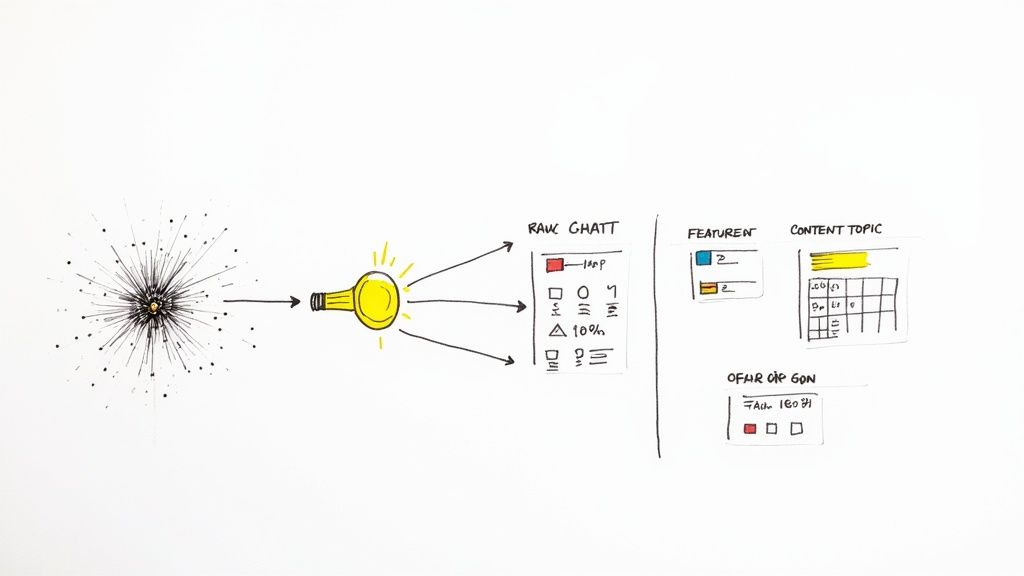
You've done the heavy lifting. Your spreadsheets are probably overflowing with pricing data, viral video metrics, and snippets from customer reviews. But a pile of data on its own is just noise. The real magic happens when you start turning that raw information into a clear, strategic game plan.
This is the part where you connect the dots. The goal is to move beyond a simple list of facts and start telling a story about the market. You need a few practical frameworks to help you make sense of it all—and to present it in a way your team can actually get behind and use.
Uncover Opportunities with Feature Gap Analysis
One of the most powerful tools for any e-commerce brand is a Feature Gap Analysis. It's a surprisingly simple way to visually map what your product offers versus your competitors, immediately shining a spotlight on where the market is being ignored.
Think of it like this: if you and two competitors all sell blenders, you might track features like "ice-crushing power," "pre-programmed settings," or a "self-cleaning mode." By laying this out in a table and marking who offers what, you create a powerful visual summary at a glance.
Maybe you find that while everyone has a strong motor, nobody offers a truly portable, battery-powered option. That's not just an interesting tidbit; it's a potential market-defining opportunity staring you in the face.
A Feature Gap Analysis isn’t about playing copycat. It's about finding the empty spaces on the shelf where a new, valuable solution can thrive. It turns competitive analysis from a reactive chore into a proactive innovation tool.
To see this in action, here’s a sample comparison table for a hypothetical fitness app. It makes the next steps crystal clear.
Feature Gap Analysis Comparison
Feature | Our Product | Competitor A | Competitor B | Market Opportunity |
|---|---|---|---|---|
Live Classes | Yes | Yes | No | Competitor B's users may be looking for live engagement. |
Personalized Plans | Yes | Yes | Yes | This is a standard feature; we must excel here. |
Wearable Integration | No | Yes | Yes | A major gap. Users expect this integration. High priority. |
Community Forum | Yes | No | No | Our key differentiator. We can own the community angle. |
This simple chart instantly shows that "Wearable Integration" is a critical weakness that needs to be addressed, while the "Community Forum" is a unique strength to double down on in marketing. This is a perfect example of how to build effective data-driven marketing strategies directly from your analysis.
Find Your Niche with a Content-Topic Matrix
Just like you can find gaps in product features, you can find massive opportunities in content, too. A Content-Topic Matrix helps you map out the topics your competitors are covering and the formats they're using, which often reveals underserved angles your audience is dying to see.
For a skincare brand, your topics might be "acne treatment," "anti-aging," and "sun protection." The content formats could be short-form tutorials on TikTok, deep-dive scientific breakdowns, or user-generated testimonials.
You might find that every competitor is pumping out scientific breakdowns on anti-aging, making it a red ocean. But maybe no one is featuring authentic, user-generated video testimonials about acne treatments for sensitive skin. That insight becomes your roadmap for creating content that actually gets noticed.
This method lets you make decisions based on evidence. You can confidently say, "Competitor X owns educational tutorials, but their community engagement is weak. We can build a more loyal following with UGC." This is exactly how raw data gets sharpened into a powerful action plan.
Ultimately, these frameworks are more than just organizational tools; they're sense-making machines. They take your messy spreadsheets and turn them into simple, visual stories that your team can rally behind. This synthesis is the most critical step in turning competitive analysis into a real engine for growth.
From Insight to Action That Drives Growth
You’ve done the heavy lifting—gathering intel, wading through data, and pulling out clear insights. This is a huge milestone, but it's also where a shocking number of brands hit a wall. The final and most important step is closing the gap between knowing what to do and actually doing it.
Raw data and brilliant insights don't mean a thing if they just sit in a folder. This is where you turn your research investment into real business results, whether that’s more views, higher engagement, or a jump in sales. It’s all about moving from passive observation to a concrete game plan.
Building Your Content Strategy Action Plan
Your content analysis probably lit up a few key areas—specific trends, formats, or topics where your competitors are either crushing it or leaving a wide-open opportunity. Your job now is to turn those observations into a structured content plan.
For this, the SMART framework is your best friend. It’s a classic for a reason. It forces you to turn a vague idea like, "Competitor X is doing well with 'day-in-the-life' videos," into a direct command your team can execute.
Here's how that fuzzy insight gets sharp and actionable:
Specific: We will launch a four-part creator-led 'day-in-the-life' video series on Instagram Reels and TikTok.
Measurable: The series will aim for 250,000 cumulative views and a 10% increase in website clicks from our social profiles.
Achievable: We have the budget for two micro-creators and the internal team to manage the campaign.
Relevant: This directly tackles the content gap we found and uses a format we know resonates with our audience.
Time-bound: The entire campaign will launch and be completed within Q4.
An action plan without clear metrics and deadlines is just a wish list. The SMART framework forces you to think through the execution, making your team accountable for real outcomes.
Following this process means every piece of content you ship is a direct response to a data-backed opportunity. You're no longer guessing what might work; you're strategically executing on what the market data is already telling you.
Developing Your Product Roadmap Action Plan
The exact same thinking applies to your product. Your feature gap analysis and all that customer review research you did should feed directly into your product roadmap. The insights you found are basically your customers telling you exactly what they want you to build or fix.
Let's imagine your analysis showed that 30% of your competitor's one-star reviews all mention a "confusing setup process" and a "lack of integration with key tools." That's not just feedback; it's a massive opportunity screaming at you.
Here’s how you turn that into a product action plan:
Prioritize the Initiative: Make "Streamlined Onboarding & New Integrations" a top priority for the next development sprint. This isn't just a bug fix; it’s a strategic play to win over their unhappy customers.
Define Key Results:
Objective 1 (Onboarding): Slash the number of setup steps from seven to three by the end of Q2. We’ll measure success by seeing a 40% drop in setup-related support tickets.
Objective 2 (Integrations): Launch the top two most-requested third-party integrations from customer feedback within Q3. We’ll call it a win if we hit a 15% adoption rate among new users.
Assign Ownership: Put a specific product manager and engineering lead on this. They'll own it, with weekly check-ins to track progress against our timeline.
This is how you connect your competitive research directly to what the engineering team is working on day-to-day. The analysis doesn't die in a report; it becomes a set of tasks that addresses real market weaknesses and builds a stronger product. By putting your insights to work this way, you ensure your analysis fuels real, sustainable growth.
Common Questions About Product Analysis
Jumping into competitive product analysis always kicks up a few questions. It’s a pretty detailed process, and it's totally normal to wonder about the best timing, tools, and tactics. Let's walk through some of the most common questions I hear so you can get started with confidence.
How Often Should I Run an Analysis?
For fast-moving spaces like e-commerce and short-form video, I recommend doing a major, deep-dive analysis every quarter. This cadence is the sweet spot—it gives you enough runway to spot real trends without letting the market run away from you.
But you can't just set it and forget it for three months.
A weekly "pulse check" on your top one to three direct competitors is non-negotiable. This is just a quick, 30-minute scan of their social feeds, new product drops, and any big promos they're running. This keeps you agile enough to react to small shifts and stay in sync between your bigger, more formal reviews.
What Are the Best Free Tools to Start With?
You can get an incredible amount of insight without spending a single dollar on fancy software. Some of the most effective tools are completely free—they just require a little bit of your time to set up and monitor.
Google Alerts: This is your early warning system. Set it up to track your competitors' brand names, key products, and even their CEO. You’ll get an email digest of any new mentions online, which is gold for tracking PR and content.
BuiltWith: Ever wonder what platform a competitor's store is running on? This browser extension tells you the entire tech stack behind any website—from their e-commerce platform (Shopify, BigCommerce, etc.) to their analytics tools. It gives you a peek under the hood of their operations.
Manual Social Tracking: Honestly, just following your competitors on TikTok and Instagram is one of the most powerful things you can do. A simple spreadsheet where you log their best-performing posts, hooks, and formats will give you invaluable qualitative data that no automated tool can.
The best insights rarely come from a flashy, expensive dashboard. They come from the simple, consistent act of paying attention. Free tools, used with discipline, will always beat a sophisticated platform that you only check once in a while.
How Do I Analyze a Completely New Market?
So, you're launching something brand new where direct competitors don't really exist yet? That’s a fantastic position to be in, but it means you need to think a little differently. Instead of looking for direct rivals, your job is to understand existing behaviors.
First, look at indirect competitors. These are companies solving the same core problem for your customer, just with a different solution. If you’re launching a new type of kitchen gadget, you shouldn't just analyze other gadget companies. You need to see how people are currently using products from places like Williams Sonoma or even the DIY hacks they're sharing on Pinterest.
Next, study aspirational brands in adjacent markets. If you're in the beauty space, what can you learn from the way a top-tier, direct-to-consumer fashion brand built its community? You’re looking for proven business models and customer behaviors that you can adapt and apply.
How Can My Small Brand Compete with Huge Rivals?
Listen, trying to out-spend or out-produce a massive, established brand is a losing game. You just can't win. Your competitive analysis should be laser-focused on finding their weaknesses—which, funny enough, are often a direct result of their size.
Big companies are usually slow, impersonal, and too generalized to serve niche communities well. That's your opening.
Your strategy is to be everything they can't be:
Be faster and more agile in jumping on new trends.
Offer ridiculously good, personal customer service that makes people feel seen.
Build a real community around shared values, not just transactions.
Hyper-focus on a specific audience that they’re completely ignoring.
Your size is actually your greatest advantage. A sharp analysis will show you exactly where to aim that advantage to win over the customers the giants have left behind.
Ready to turn competitive insights into viral growth? Virlo analyzes millions of videos daily to surface the trends, creators, and product opportunities you need to dominate short-form video. Stop guessing and start growing. Discover your next viral move at Virlo.ai.
See What's Trending Right Now
- Social listening for TikTok, Reels & Shorts
- Spot viral trends before they peak
- Turn insights into ads, scripts & briefs
The Signal Newsletter
Weekly trend breakdowns, creator insights, and social listening tips — straight to your inbox.
Subscribe FreeSee Virlo in action

See What's Trending Right Now
- Social listening for TikTok, Reels & Shorts
- Spot viral trends before they peak
- Turn insights into ads, scripts & briefs
The Signal Newsletter
Weekly trend breakdowns, creator insights, and social listening tips — straight to your inbox.
Subscribe FreePut this into practice with Virlo
Turn what you just read into real research. These are the tools creators, agencies, and brands use to find what's working on short-form video.
Content Research Agent
Run your short-form research on autopilot — outliers, creators, and sounds across TikTok, Reels, and Shorts.
Tracking Center
Monitor breakout creators, videos, and competitors with daily snapshots and deep AI analysis.
Free Data
Explore free viral hooks, trending niches, breakout products, and more — no account required.
Get The Signal
Join creators, marketers, and agencies getting weekly trend breakdowns and social listening insights delivered free.
Subscribe to the Newsletter
Stop Guessing. Start Knowing.
Join thousands of digital entrepreneurs using data to take the guesswork out of capitalizing on trends.