How to Find Dropshipping Products That Actually Sell
Learn how to find dropshipping products using data-driven research, social media trend analysis, and supplier vetting to build a profitable ecommerce business.

Darcy Cudmore
Professional Blog Writer
Darcy Cudmore is the founder of RepuLinks, a digital PR and SEO agency helping brands earn authoritative media coverage, backlinks, and visibility in search. He writes about PR strategy, content marketing, AI search, and how companies can build credibility through smarter online visibility.

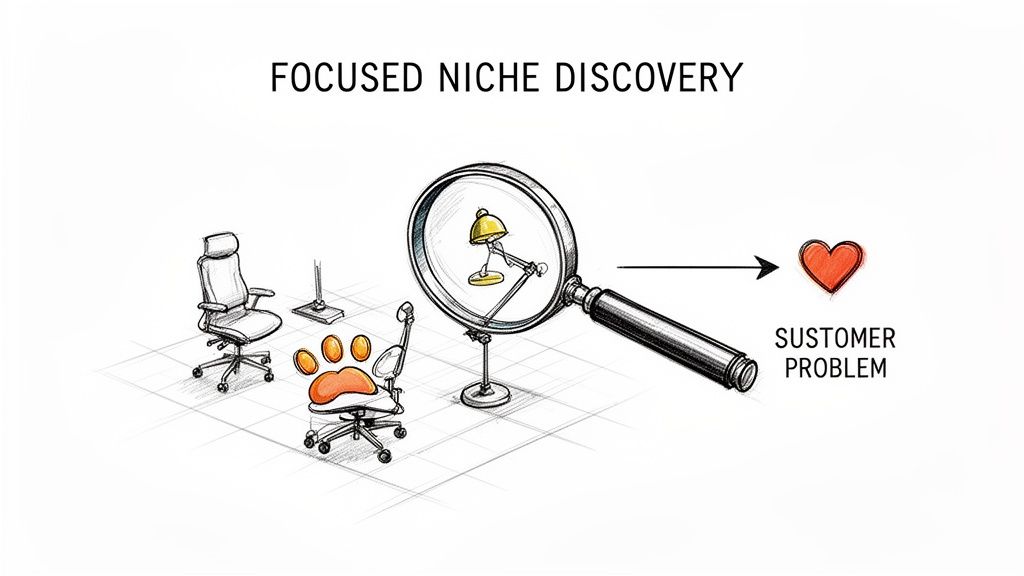
Forget trying to find one "winning product." The real secret to successful dropshipping is shifting your focus from broad, saturated markets to specific, problem-solving sub-niches.
It's about finding a dedicated audience with a clear need. Think less about generic "electronics" and more about "ergonomic home office gear" for the millions of people now working from home. This simple change in perspective is what lets you sidestep the competition and build a profitable business that actually lasts.
Laying the Groundwork for Product Discovery
Before you even start looking at products, you need to get your mindset right. The dropshipping world is enormous, and just diving into a popular category because you've seen others do it is a fast track to burning through your ad budget with nothing to show for it.
The goal isn't just to sell a thing; it's to solve a real problem for a specific group of people. This subtle but crucial shift is what separates the struggling stores from the seven-figure brands.
Think like a specialist, not a general store owner. Instead of "women's fashion," drill down to "eco-friendly activewear for yoga enthusiasts." Ditch "pet supplies" for "orthopedic beds for senior dogs." This sharp focus is how you build a brand that connects with people and earns their loyalty.
This is the basic flow: start broad, find your sub-niche, and then find the profit.
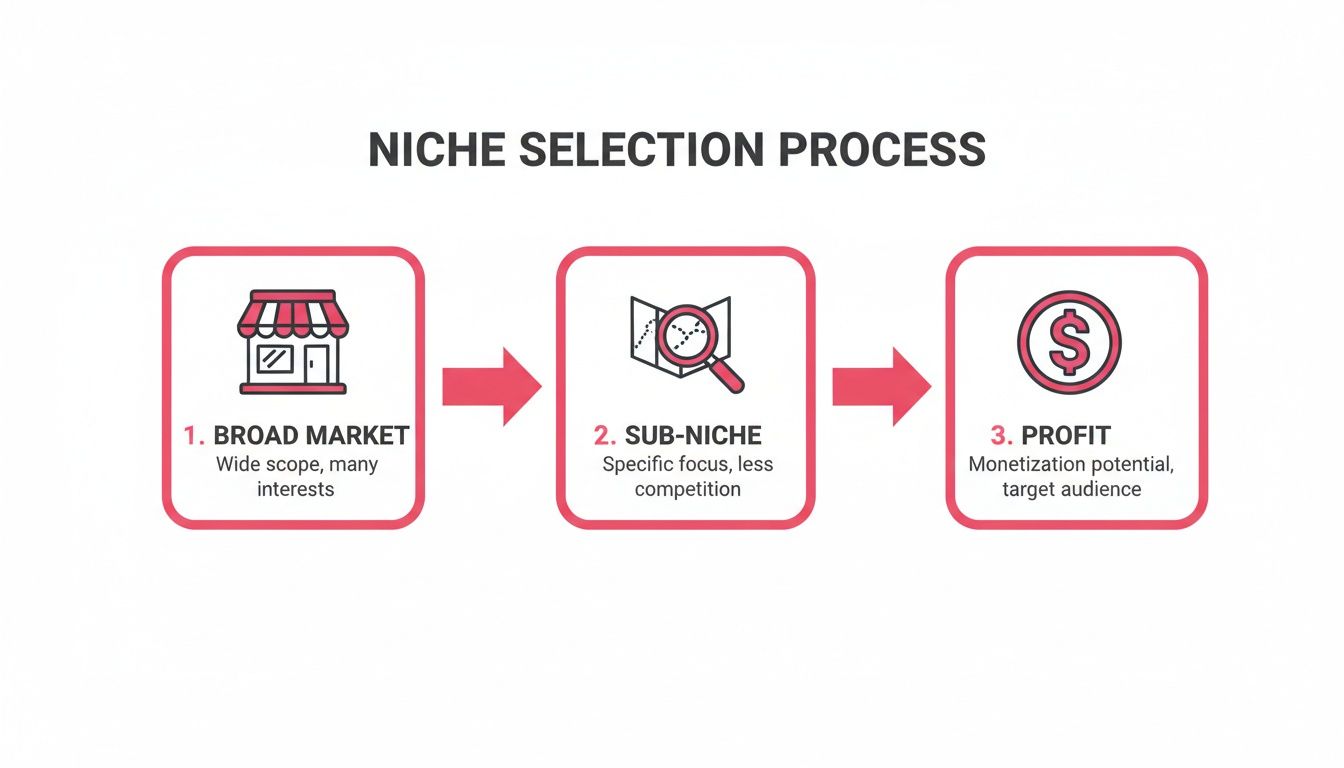
As you can see, the real money is made when you move past the obvious, crowded markets and into a focused sub-niche.
Why Niche Selection Matters
The global dropshipping market is absolutely massive, projected to hit USD 331.1 billion in 2024. Fashion might dominate with over 30% of that pie, but it's also a bloodbath of competition, leaving you with razor-thin profit margins.
On the flip side, categories like electronics and home goods often have much higher average order values (AOVs). This gives you more breathing room for ad spend and, most importantly, more profit. That’s why a smart, data-driven approach means finding profitable sub-niches inside these bigger, proven categories.
The most successful dropshippers don't find a product and then look for a customer. They find a customer group first and then identify the products that will solve their problems.
To illustrate, let's look at how you can reposition from a crowded market to a high-potential one.
High-Potential Product Categories vs Saturated Markets
This table breaks down the difference between diving into a "red ocean" of competition versus finding a "blue ocean" of opportunity within the same general market.
Saturated Category | High-Potential Sub-Niche Example | Key Advantage |
|---|---|---|
General Pet Supplies | Orthopedic beds for senior dogs | Solves a specific pain point (joint pain) for a caring owner. |
Women's Fashion | Sustainable maternity activewear | Targets two strong values: eco-consciousness and pregnancy needs. |
Home & Kitchen | Smart kitchen gadgets for small apartments | Addresses the unique challenges of modern urban living. |
Outdoor Gear | Ultralight backpacking equipment | Appeals to a dedicated hobbyist community willing to pay for quality. |
See the pattern? Each high-potential niche speaks directly to a passionate audience with a specific problem, making your marketing infinitely easier and more effective.
Before you commit to anything, it's critical to do your homework, including analyzing competitor strategies to spot gaps you can fill. A focused niche strategy gives you some serious advantages:
Less Competition: You aren't battling Amazon and Walmart for generic keywords.
Higher Conversion Rates: Your ads and store copy speak directly to your audience's pain points.
Real Brand Loyalty: Customers feel like you "get" them, and they'll come back for more.
This first step is, without a doubt, the most important one you'll take. If you need a more detailed walkthrough, our guide on how to find your niche breaks down the entire process. Getting this right from the start will save you countless hours and thousands of dollars down the road.
Using Data to Uncover Winning Product Ideas
Guesswork is the fastest way to kill your dropshipping business. Instead of going with your gut, we need to get practical and use real data to find products that have proven, measurable demand. The pros don't gamble; they make calculated moves based on hard numbers that signal a product’s potential.
This data-first mindset is your safety net. It makes sure you’re investing your time and, more importantly, your money into products people are already looking for. This massively lowers your risk and boosts your odds of finding a true winner.
Tapping into Search Demand with Google Trends
One of the best free tools in your arsenal is Google Trends. It gives you a direct window into what the world is searching for, showing you the ebbs and flows of consumer interest over time. Honestly, it's an essential first check for validating any product idea you have.
You're not just looking for what's popular right now. The real goal is to find products with a stable, or even better, an upward trajectory. A sudden, massive spike can be a red flag for a fleeting fad, but consistent, growing interest points to a sustainable market you can build on.
Take a look at the search interest for "air fryer" over the last five years.
This graph is a perfect example. It shows seasonal peaks around the holidays, sure, but the overall baseline interest is steadily climbing. That's how you know you're looking at an evergreen product category with real, long-term potential.
When you're digging through trends, keep an eye out for these patterns:
Steady Upward Growth: This is the gold standard. It tells you the market is expanding.
Stable Demand: A flat line isn’t a bad thing. It represents a consistent, reliable niche.
Seasonal Peaks: If you spot predictable spikes (like "pool floats" in summer), you can plan your marketing campaigns to hit right when demand is highest.
Whatever you do, steer clear of products with a sharp spike followed by an immediate, dramatic crash. That’s the classic signature of a fad that has already died out. You're too late to the party.
Analyzing Competitor Sales Data
While search trends show interest, sales data shows commitment. You can do some ethical spying on your potential competitors to see what's actually selling by digging into major marketplaces like AliExpress, Amazon, or even TikTok Shop.
This is where the numbers game gets real. A good rule of thumb I've seen work time and again is to look for products with a consistent global monthly search volume above 10,000 searches. Pair that with rising year-over-year interest, and you have something much more scalable than a one-off viral item.
When I’m vetting on platforms like AliExpress, I use a baseline of 1,000+ orders and a solid bank of recent, positive reviews as my first filter. It's a quick way to confirm real-world demand.
A product with thousands of orders isn't a sign of saturation; it's proof of concept. It confirms people are willing to pull out their wallets for that item, validating the market for you before you spend a dime on ads.
Start by checking out the "best-seller" or "trending" sections on these platforms. When something catches your eye, don't just stop at the total order count. Dig deeper.
Recent Orders: Are people buying it now? Look for orders and reviews from the last week or month.
Review Quality: Actually read the reviews. Are customers happy? Or are there recurring complaints about shipping times or product quality?
Supplier Rating: Check the seller's store rating and history. A reliable supplier is just as crucial as a winning product.
This research puts you in a powerful position. You're not just finding a product; you're confirming its demand, checking its price point, and identifying potential headaches all at once. If you want to automate some of this grunt work, our Virlo Niche Analyzer is built to streamline this exact discovery phase using hard data: https://virlo.ai/features/niche-analyzer.
Combining Data for a Clearer Picture
No single data point ever tells the whole story. The real magic happens when you pull insights from multiple sources to build a rock-solid case for your product. A true winning product usually sits at the intersection of several positive signals.
Think of it like building a case file for every potential product:
Google Trends: Is search interest stable or growing?
Marketplace Data: Are there thousands of recent orders and happy customers?
Social Media Buzz: Is the product popping up on TikTok or Instagram? (We'll get more into this in the next section).
When a product checks all three boxes, you've got a high-confidence candidate that’s ready for testing. For a deeper dive into using technology for this, there's a great article on how to find winning products for your dropshipping store using AI that shares some valuable insights.
By cross-referencing these data sources, you stop hoping a product will sell and start knowing it has a proven track record.
Finding Untapped Potential in Social Media Trends
Solid, data-driven research gives you a great foundation, but let's be real—modern dropshipping moves at the speed of social media. Platforms like TikTok, Instagram Reels, and even Pinterest aren't just for killing time anymore. They're massive discovery engines where millions of people find their next "I need that" purchase.
Learning to spot trends on these platforms isn't about getting lucky. It’s about training your eye for what’s about to pop.
You have to make a mental shift from being a passive scroller to an active trend hunter. That means you stop just watching videos and start asking why a certain product is blowing up. This skill is your ticket to finding products that are perfect for cheap, high-impact social media ads.
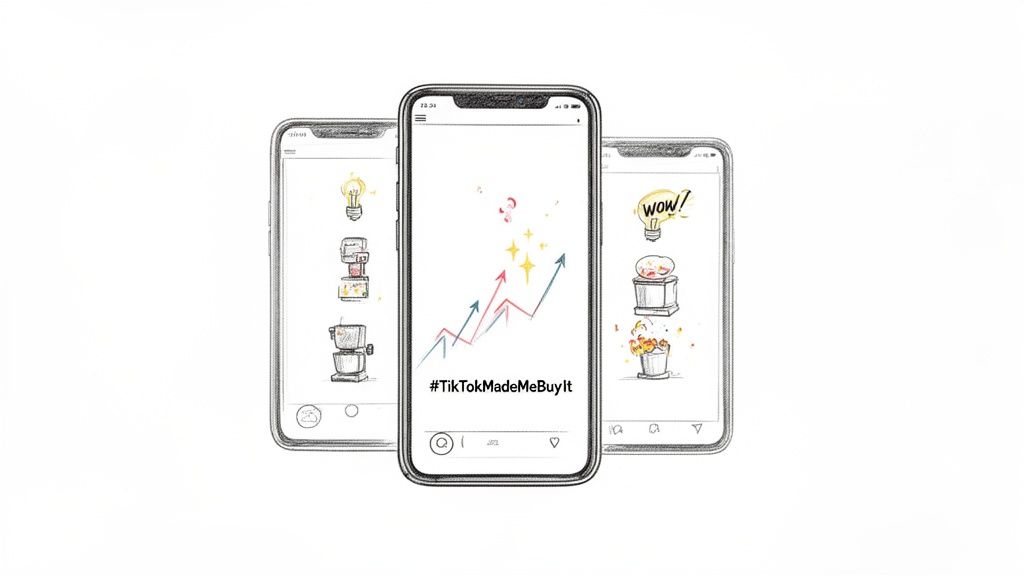
Decoding the #TikTokMadeMeBuyIt Phenomenon
Sure, hashtags like #TikTokMadeMeBuyIt and #AmazonFinds are goldmines, but they're also incredibly crowded. The real trick is to spot the signals buried in all that noise. Don't just chase what's viral today. Look for the products that are just starting to bubble up with organic traction.
These are the products that solve a nagging problem in a super satisfying way, have an undeniable "wow" factor, or can show off their magic in less than 30 seconds. That’s the basic DNA of a viral product, and getting a feel for it is how you find your next winner.
Think about those viral portable blenders or the sunset lamps. They all hit the same notes:
Insane Visual Appeal: The product just looks good on camera and makes you stop scrolling.
Simple Demo: You can see exactly what it does and why you need it, often without a single word of explanation.
Relatable Problem-Solving: It fixes a small, everyday annoyance that a huge audience immediately gets.
The best social media products don’t need a complicated sales pitch. Their value is obvious in a 15-second clip, which is exactly why they spread like wildfire through shares and tags.
By actively digging through these hashtags and analyzing the content, you’ll start to see what makes people tick. For a more structured way to tackle this, our guide on how to find social media trends breaks it down even further.
What Makes a Product Virally Viable?
Just because something is trending doesn't automatically make it a good dropshipping product. You have to put on your business hat and filter everything through a commercial lens. A product might get millions of views, but if you can't source it or the margins are paper-thin, it’s a dead end.
As you hunt, run your potential products through this quick checklist. A real winner will tick most, if not all, of these boxes.
Unique "Wow" Factor: Does it make you stop mid-scroll? Products that are clever, novel, or offer a surprising fix have a huge built-in advantage.
Solves a Real Problem: The product should target a specific pain point. Think about gadgets that make cleaning easier, organizers for messy spaces, or anything that simplifies a daily routine.
Demonstrable Results: Can you show a clear "before and after" or a satisfying result in a quick video? Visual proof is your most powerful sales tool.
Creates an Emotional Spark: The best products trigger feelings—satisfaction, surprise, or just plain desire. That ASMR-vibe of a cleaning product or the cozy feeling from a unique home gadget can be incredibly persuasive.
Once you find a product that fits this profile, your very next move is to do a quick gut check on supplier sites like AliExpress. You're looking for multiple suppliers with solid ratings and a price that leaves you with a healthy profit margin. This simple check saves you from wasting time on a product that you can't even source reliably.
Vetting Suppliers and Protecting Your Profit Margins
Finding a product with viral potential is an amazing feeling, but that's just the starting line. Now comes the real work: finding a supplier who won't let you down.
Think of your supplier as your silent business partner. They're the ones who dictate shipping speed, product quality, and ultimately, your customers' happiness. A bad supplier can kill a winning product with slow shipping and poor quality, turning a potential success story into a nightmare of refunds and chargebacks.
This is where you shift from being a product hunter to a business operator. It's time to dig into the numbers and scrutinize the operational backbone of your potential partners. This is the stuff that separates a fleeting side hustle from a scalable, profitable business.
Non-Negotiable Supplier Metrics
When you're scrolling through platforms like AliExpress or CJDropshipping, it's easy to get mesmerized by huge order numbers. But seasoned dropshippers know to ignore the flash and focus on a few key metrics that tell the real story of a supplier's reliability.
These aren't just suggestions—they are my absolute minimums for even considering a supplier.
Store Rating: I look for a seller rating of 95% or higher. This is a direct measure of their service quality and track record with other sellers just like you.
Time in Business: A supplier should have been operating for at least 2-3 years. Longevity is a strong signal of stability and experience in navigating the chaos of international logistics.
Response Rate: A high response rate (over 90%) is crucial. It means they're communicative and available to solve problems, which is a lifesaver when a customer's order goes missing.
A supplier who hits these marks is far more likely to be a partner you can count on when the orders start flooding in.
The Critical Role of Logistics
Let's be honest: shipping is the biggest headache in dropshipping. Your customers are conditioned by Amazon to expect delivery in two days, so managing expectations is a constant battle. This is precisely why a supplier's logistics capabilities are just as important as the product itself.
Always prioritize suppliers who offer multiple shipping options, especially premium lines like ePacket, YunExpress, or 4PX. Yes, they might cost a dollar or two more, but they dramatically cut down shipping times and provide reliable tracking. It's a small price to pay for a happy customer.
A product that arrives in 10 days gets you a positive review. The exact same product arriving in 30 days gets you a chargeback. The only difference is the supplier's shipping efficiency.
Even better, hunt for suppliers with warehouses in your target markets, like the US or Europe. Shipping from a local warehouse can slash delivery times from weeks to just a few days. This gives you a massive competitive edge and allows you to justify a higher price point.
Calculating Your True Profit Margin
This is the exact spot where most new dropshippers trip up. They see a product for $5, list it for $20, and assume they're pocketing $15 profit. That's a dangerously simple calculation that ignores the real costs of doing business.
You need to focus on your landed cost—the total cost to get that product into your customer's hands. This isn't just the product cost; it includes the shipping fee you pay the supplier. That $5 product might have an $8 shipping fee, making your true cost $13 before you've spent a dime on ads.
Smart dropshipping is a numbers game. You should be targeting suppliers with on-time dispatch rates above 95% and order defect rates below 1%. For the product itself, a healthy gross margin should be at least 30–40%. This gives you enough breathing room to cover advertising, platform fees, and payment processing while still making a profit. For a deeper dive into the market's financial side, you can explore detailed reports on the global dropshipping industry data.
To make this crystal clear, let's walk through a real-world example.
Profit Margin Calculation Example
Let's say you've found a promising smart pet feeder. Before you build a single ad, you need to break down the numbers to see if it's actually viable.
Here’s a quick table showing how to calculate your real profit on a single sale.
Metric | Example Value (USD) | Description |
|---|---|---|
Retail Price | $59.99 | The price you charge the customer on your store. |
Product Cost | -$15.00 | What you pay the supplier for the item itself. |
Shipping Cost | -$8.00 | What you pay the supplier for shipping to the customer. |
Landed Cost | $23.00 | Your total cost for the product and shipping. |
Gross Margin | $36.99 | Retail Price minus Landed Cost (Profit before ads & fees). |
Estimated Ad Cost | -$15.00 | Assuming a 25% ad spend relative to your retail price. |
Transaction Fees | -$2.40 | Around 4% for payment processors like Shopify Payments & PayPal. |
Net Profit | $19.59 | Your actual profit after all major expenses. |
In this scenario, your net profit margin is 32.6% ($19.59 / $59.99). This is a solid margin. It gives you enough cash to handle returns, reinvest in scaling your ads, and, most importantly, actually pay yourself. If my calculations ever show a net margin below 20%, I know the product is probably not worth scaling with paid ads.
Validating Your Product Choice With Smart Testing
You’ve done the legwork. You found a promising product that actually solves a problem, dug into the data, and lined up a supplier you can trust. Now for the moment of truth—it’s time to see if real people will pull out their wallets for it.
This is the validation phase, and honestly, it’s the most important part of this whole game. The goal isn’t to strike gold on day one. It’s to risk a tiny bit of cash to get priceless data, confirming you have a real market before you even think about scaling up.
Smart, low-budget testing is your ultimate safety net. It lets you kill off dud ideas fast and cheap, so you can double down on the ones that show actual, measurable promise. This is what separates the pros from the gamblers.
Launching Your First Test Campaign
Forget about building a perfect, beautiful store right now. Your only job is to get a simple, functional product page live as fast as you can. The real test happens on platforms like TikTok and Facebook Ads, where you'll put your product in front of a cold audience and see how they react.
The key here is to start small and stay lean. I always recommend a conservative daily ad budget of around $15 to $25 per day. That’s more than enough to gather the initial feedback you need without blowing your bank account. Think of this budget as tuition, not profit.
Your first ads need to be dead simple and laser-focused on showing off the product’s main benefit.
Create Simple Video Ads: Grab your phone and shoot 3-5 short, UGC-style videos. They should feel raw and authentic, not like a polished corporate ad.
Nail the Hook: The first three seconds are everything. Open with the problem your product solves or the most visually satisfying part of it in action.
Show, Don't Tell: Demonstrate the product making someone's life easier. If it's a kitchen gadget, show it slashing prep time. If it’s an organizer, show the chaotic "before" and the serene "after."
You’re not trying to win an Oscar here. You’re just trying to clearly communicate value and see if anyone bites.
The Metrics That Matter Most
Once your ads are live, it’s easy to get lost in a sea of data. For now, ignore vanity metrics like likes and shares. In this initial testing phase, only a few key performance indicators (KPIs) tell the real story. These are the signals that whisper, "Hey, you might have a winner here."
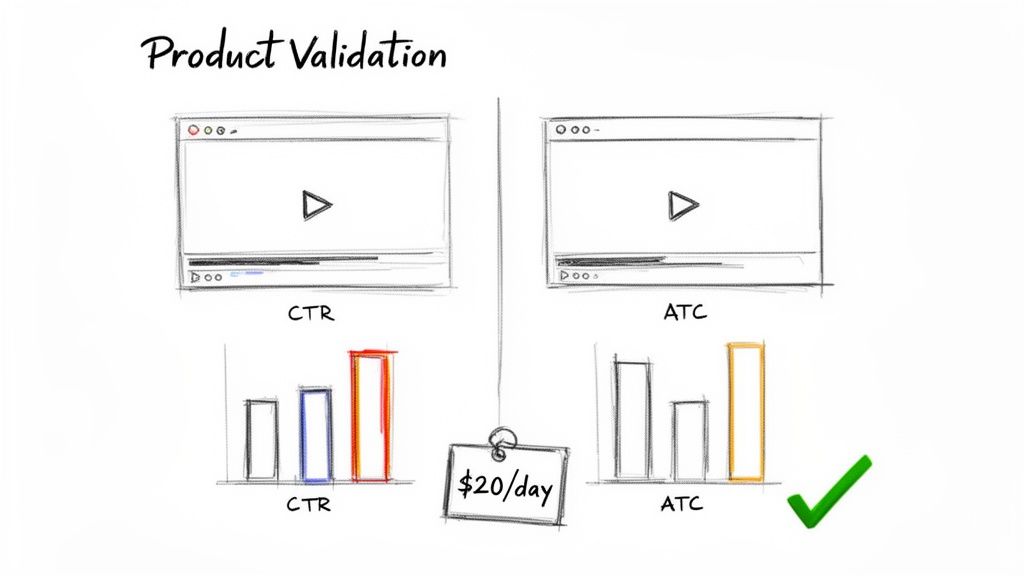
A high Click-Through Rate (CTR) proves your ad creative is grabbing attention. A high Add-to-Cart (ATC) rate proves your price and product page are doing their job. You need both to win.
Focus all your energy on these two data points. They give you the clearest picture of what potential customers are thinking.
Metric | What It Measures | What a "Good" Signal Looks Like |
|---|---|---|
Click-Through Rate (CTR) | The percentage of people who see your ad and actually click on it. | For TikTok or Facebook, anything above a 1.5% CTR on a cold audience is a fantastic sign that your product idea is resonating. |
Add to Carts (ATCs) | The number of people who add your product to their cart after landing on your site. | If you're consistently getting ATCs on a tiny budget, you've proven people not only like the product but are also okay with your price. |
Don't freak out if you don't get sales on the first day. With a small budget, your mission is just to confirm that the core interest exists. If you're spending $20 and seeing a 2% CTR and a few add-to-carts, you're on the right track. That’s the market giving you a green light to keep pushing.
On the flip side, if your ads have been running for three days with a CTR below 0.5% and zero add-to-carts, that's an equally clear signal. Something’s off—it could be the ad, the targeting, or the product itself. This isn't failure; it's data telling you to cut your losses and move on to the next idea. This is the disciplined, data-first approach that uncovers products with real scaling potential.
Frequently Asked Questions About Product Research
Let's be real—diving into product research can feel like trying to find a needle in a haystack, especially when you're starting out. You're going to have questions as you figure out how to find dropshipping products that actually have a shot at selling.
Don't worry, that's normal. Here are some of the most common questions I hear from new sellers, answered with straightforward, no-fluff advice.
How Much Money Do I Need to Start Testing Dropshipping Products?
You don't need a huge bankroll to get in the game. A solid starting point for a testing budget is around $150 to $300 for a single product.
That's enough cash to run ads with a small daily spend—think $20 to $30 a day—for about a week. That gives you just enough time to collect the data you need without breaking the bank.
Remember, the goal here isn't to get rich overnight. It's about validation. You're hunting for positive signals: a good click-through rate, a decent number of add-to-carts, and real comments or shares. If you see those signs, you can double down with confidence. If not, you walk away with a cheap lesson learned.
Should I Sell Trendy Products or Evergreen Products?
Ah, the classic debate. Honestly, the smartest play is to use a mix of both. It's a critical decision when you're figuring out how to find dropshipping products that align with your long-term goals.
Trendy Products: These are the TikTok sensations. They can generate a massive amount of sales very quickly, but their lifespan is often brutally short. You have to be ready to jump on them fast, ride the wave, and get out before it crashes.
Evergreen Products: Think pet supplies, kitchen gadgets, or home organization tools. These products have steady, year-round demand. They're the foundation for building a sustainable brand with predictable income.
My advice? Build your store around a core evergreen niche. Then, strategically sprinkle in trendy products to juice your cash flow, bring in new customers, and test out fresh ad ideas. It's the perfect blend of stability and opportunity.
This balanced approach is your best defense against risk. Your evergreen products keep the lights on with consistent sales, while the trendy items give you shots at hitting those big, exciting revenue spikes.
What Are the Biggest Mistakes When Choosing a Product?
The most expensive mistakes almost always happen when sellers let their gut feelings or excitement cloud their judgment. If you want to last in this business, you need to avoid these common traps.
Here are the top errors I see people make over and over:
Chasing passion over profit. Just because you love a certain hobby doesn't mean it's a profitable niche. You have to check the data for market demand first.
Ignoring the real profit margin. A high selling price is meaningless if ad spend, shipping, and transaction fees eat up all your profit. Do the math—all of it.
Picking logistical nightmares. Avoid products with complicated sizing like clothing, or fragile items that are a pain to ship and lead to high return rates.
Skipping supplier vetting. This one is a killer. A bad supplier means poor quality, insane shipping delays, and a flood of angry customers that will absolutely torch your brand's reputation.
Always let the numbers do the talking. Data-driven decisions are the bedrock of any successful dropshipping store. Following a clear process for how to find dropshipping products will save you from these costly emotional mistakes.
Finding and validating viral trends is the core of modern dropshipping. At Virlo, we analyze millions of videos daily to surface the fastest-growing niches and products before they saturate. Our platform turns hours of manual research into minutes of actionable insight, helping you find your next winner faster. Discover what's trending with Virlo today.
See What's Trending Right Now
- Social listening for TikTok, Reels & Shorts
- Spot viral trends before they peak
- Turn insights into ads, scripts & briefs
The Signal Newsletter
Weekly trend breakdowns, creator insights, and social listening tips — straight to your inbox.
Subscribe FreeSee Virlo in action

See What's Trending Right Now
- Social listening for TikTok, Reels & Shorts
- Spot viral trends before they peak
- Turn insights into ads, scripts & briefs
The Signal Newsletter
Weekly trend breakdowns, creator insights, and social listening tips — straight to your inbox.
Subscribe FreePut this into practice with Virlo
Turn what you just read into real research. These are the tools creators, agencies, and brands use to find what's working on short-form video.
Content Research Agent
Run your short-form research on autopilot — outliers, creators, and sounds across TikTok, Reels, and Shorts.
Tracking Center
Monitor breakout creators, videos, and competitors with daily snapshots and deep AI analysis.
Free Data
Explore free viral hooks, trending niches, breakout products, and more — no account required.
Get The Signal
Join creators, marketers, and agencies getting weekly trend breakdowns and social listening insights delivered free.
Subscribe to the Newsletter
Stop Guessing. Start Knowing.
Join thousands of digital entrepreneurs using data to take the guesswork out of capitalizing on trends.