Case Study: How Orbit Turns Narrative Into Measurable Insight
This post showcases a real experiment using Virlo’s Content Studio to demonstrate the impact of Orbit data on content creation. The same blog prompt was run twice to show the difference in data between the two, and the impact it can have.

Case Study: How Orbit Turns Narrative Into Measurable Virality Insight
Over the last few weeks, Virlo has shipped faster than at any point in our history. These releases mark a meaningful shift in how we think about short-form video data, content intelligence, and how creators and operators understand attention online. Three weeks ago, we released Virlo Orbit alongside our public APIs. One week ago, we updated Virlo’s Content Studio. Yesterday, we shipped Custom Niches. While each update may look incremental in isolation, together they represent a deliberate move toward a clearer goal: making Virlo the number one source of virality data from short-form video.
Our ambition is not limited to helping people make better videos. We want creators, operators, researchers, and strategists to leverage attention data far beyond content production. Specifically, Virlo is being built to support decisions across:
Writing and editorial content
Research, strategy, and analysis
Product development, investing, and creative direction
This direction required a conscious product decision. We moved away from AI video and image generation as our primary output, not because those tools lack value, but because we believe the more interesting future lies in what happens after users understand how attention actually behaves across platforms like TikTok, YouTube Shorts, and Instagram Reels. As a co-founder, the most honest way to test that belief is to use the product exactly the way our users would. This post documents one of those experiments.
The Experiment: Testing Orbit’s Impact on Content Quality
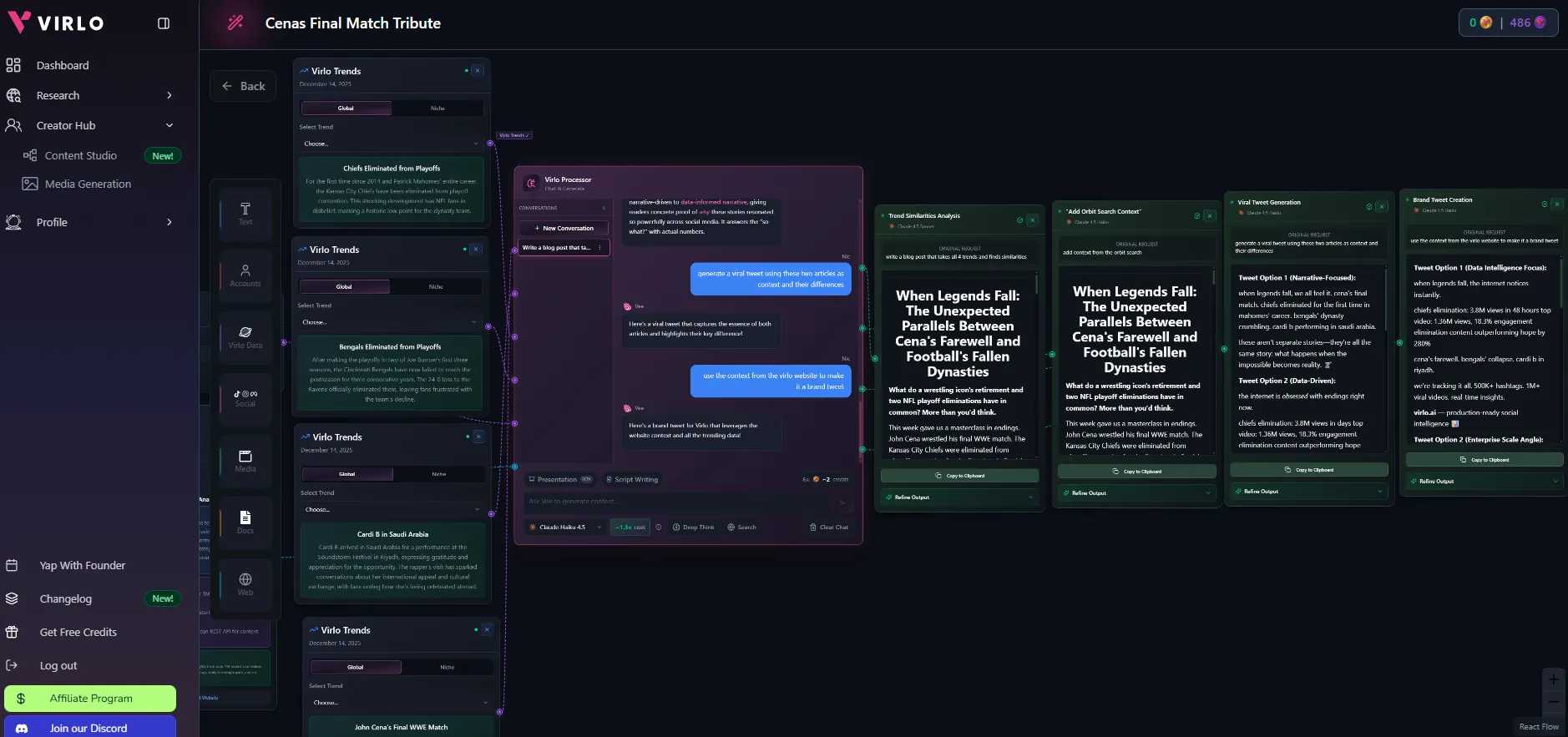
The goal of the experiment was to isolate the impact of Orbit’s virality data on content quality without changing anything else. Inside Virlo’s updated Content Studio, I configured the system using the following setup:
Four trend input nodes
One Orbit Search input node
I then ran two prompts in sequence. The process looked like this:
Prompt one: “write me a blog.”
Prompt two (after connecting Orbit Search): “now write another blog using the Orbit context I just gave you.”
There was no prompt engineering, no manual editing, and no rewriting at any point in the process. Above is the content studio layout used.
The system produced two complete blog posts covering the exact same cultural moments: John Cena’s retirement, the Kansas City Chiefs’ playoff elimination, the Cincinnati Bengals’ collapse, and Cardi B’s performance in Saudi Arabia. The first article relied purely on narrative intuition. The second layered in quantified audience behavior from Orbit. Both outputs were generated automatically and remain completely untouched.
What Changed When Orbit Context Was Added
What became immediately clear is that the difference between the two outputs was not stylistic, but structural. The first article reads like a traditional cultural essay, connecting themes of impermanence, dominance, and reinvention through storytelling and interpretation. This is the type of analysis most writers and strategists are trained to produce, and it often feels convincing. However, it ultimately relies on assumption.
The Orbit-enabled article replaces those assumptions with observable behavior. Orbit automatically surfaced concrete signals from short-form platforms, including:
3.8 million combined views on Chiefs elimination content and a 280 percent engagement lift compared to playoff hope narratives
410 percent above-average views on rival celebration content tied to dynasty collapse moments
67 percent of total views coming from sub-30-second videos despite those videos representing a minority of uploads
Nothing about the underlying facts changed. What changed was confidence in why the story mattered and how audiences actually responded.
Why This Matters for Content Strategy and Virality
This experiment exposed a broader issue in modern content strategy: even experienced writers and operators routinely misjudge what actually drives engagement and virality. Without data, intuition fills the gap, and intuition is often wrong. Left to my own assumptions, I would have expected longer clips to perform better because they provide context, official accounts to dominate attention, and hopeful narratives to outperform collapse narratives.
Orbit corrected those assumptions automatically by grounding the writing in behavior observed at scale. At a product level, this reinforces what Virlo is building toward. We are not trying to replace creativity or intuition. We are trying to constrain intuition with reality. The Content Studio provides structure, Orbit provides behavioral truth, and the user decides how that data is applied.
The Broader Direction of Virlo
All of these recent releases, including Content Studio updates, Custom Niches, Orbit, and our APIs, converge on a single belief: virality is not magic, it is a dataset. Once you have access to that dataset, outputs are no longer limited to videos. They can extend into:
Blogs, editorial analysis, and long-form writing
Market research, academic work, and exploratory analysis
Investment theses, creative strategy, and new product ideas
This case study is a small but concrete example of that future. As we continue building Virlo, I’ll keep sharing experiments like this, not as marketing, but as proof that understanding attention fundamentally changes what you build on top of it.
The Outputs: Same Prompt, Same Facts, Different Truth Density
Both articles below were generated inside Virlo’s Content Studio using the exact same setup, facts, and source material. The only difference was whether Orbit context was connected.
Article Example Without Orbit Context
When Legends Fall: The Unexpected Parallels Between Cena's Farewell and Football's Fallen Dynasties
What do a wrestling icon's retirement and two NFL playoff eliminations have in common? More than you'd think.
This week gave us a masterclass in endings. John Cena wrestled his final WWE match. The Kansas City Chiefs were eliminated from playoff contention for the first time in Patrick Mahomes' career. The Cincinnati Bengals watched their postseason hopes die in a brutal 24-0 shutout. And somehow, in the middle of all this, Cardi B landed in Saudi Arabia to perform at Soundstorm Festival.
At first glance, these stories seem unrelated. But look closer, and you'll find they're all chapters in the same book: the story of what happens when the impossible becomes reality.
The End of Invincibility
John Cena's final match against Gunther wasn't just the retirement of a 16-time world champion—it was the closing of an era where one man seemed larger than the sport itself. For nearly two decades, Cena was WWE to millions of fans. His catchphrase "You can't see me" became ironic in its truth: he was so omnipresent, so dominant, that imagining wrestling without him felt impossible.
The Chiefs' playoff elimination carries the same weight. Since 2014—Patrick Mahomes' entire professional career—Kansas City has been a postseason lock. They weren't just good; they were inevitable. Two Super Bowl victories. Multiple AFC Championship appearances. The kind of dynasty that makes you forget what "rebuilding" even means.
The Bengals' three-year playoff drought tells a similar story, just on a compressed timeline. After reaching the Super Bowl and making back-to-back playoff runs with Joe Burrow, Cincinnati looked like the AFC's next great power. That 24-0 loss to the Ravens wasn't just a defeat—it was reality crashing through the door.
The common thread? All three stories force us to confront the uncomfortable truth that nothing lasts forever.
The Global Stage and Reinvention
Here's where Cardi B's arrival in Saudi Arabia fits perfectly into this narrative.
While Cena, the Chiefs, and the Bengals face endings, Cardi represents expansion—the idea that when one chapter closes, another opens elsewhere.
The Tribute Effect: How We Honor What We're Losing
The outpouring of tributes for John Cena reveals something profound about how we process endings.
The Lesson: Embrace the Cycle
What ties all four trends together is this: the cycle of rise and fall is the only constant in sports and entertainment.
Article Example With Orbit Context
When Legends Fall: The Unexpected Parallels Between Cena's Farewell and Football's Fallen Dynasties
What do a wrestling icon's retirement and two NFL playoff eliminations have in common? More than you'd think.
This week gave us a masterclass in endings. John Cena wrestled his final WWE match. The Kansas City Chiefs were eliminated from playoff contention for the first time in Patrick Mahomes' career. The Cincinnati Bengals watched their postseason hopes die in a brutal 24-0 shutout. And somehow, in the middle of all this, Cardi B landed in Saudi Arabia to perform at Soundstorm Festival.
At first glance, these stories seem unrelated. But look closer, and you'll find they're all chapters in the same book: the story of what happens when the impossible becomes reality.
The End of Invincibility
John Cena's final match against Gunther wasn't just the retirement of a 16-time world champion—it was the closing of an era where one man seemed larger than the sport itself.
The data tells the story: Chiefs elimination content generated 3.8 million combined views across platforms, with playoff elimination content outperforming playoff hope by 280 percent in engagement.
The Power of Short-Form Storytelling
Short-form content under 30 seconds generated 67 percent of all views despite representing only 31 percent of uploads.
The Audience That Demands Authenticity
Verified accounts averaged only 89,000 views while micro-creators hit over 1.3 million views.
What Happens When Inevitability Ends
The Orbit Search data confirms that audiences gravitate toward moments of collapse, chaos, and transition.
Closing Thought: From Intuition to Truth Density
These two articles cover the same facts, follow the same narrative arc, and were produced by the same system. The difference between them is not writing quality, but truth density. This is what Virlo is building toward: a world where creators, operators, and researchers no longer have to guess how attention works, where intuition is strengthened by data rather than overridden by it, and where virality becomes something you can study, measure, and apply far beyond just making videos. This is the future we are intentionally moving toward.
See What's Trending Right Now
- Social listening for TikTok, Reels & Shorts
- Spot viral trends before they peak
- Turn insights into ads, scripts & briefs
The Signal Newsletter
Weekly trend breakdowns, creator insights, and social listening tips — straight to your inbox.
Subscribe FreeSee Virlo in action
See What's Trending Right Now
- Social listening for TikTok, Reels & Shorts
- Spot viral trends before they peak
- Turn insights into ads, scripts & briefs
The Signal Newsletter
Weekly trend breakdowns, creator insights, and social listening tips — straight to your inbox.
Subscribe FreeRelated Articles

Instagram SEO - The Ultimate Guide to Ranking on Instagram Search
Instagram is a discovery algorithm with a lesser known search engine. Learn how Instagram SEO works in 2026: the ranking signals, keyword research, and how to optimize every post and Reel.

Mapping “Earn Money Online” Demand Through Social Signals
Virlo AI’s Orbit data shows that modern viral moments form as sharp, isolated explosions of attention, driven by platform-specific algorithms, creator trust, and rapid audience feedback loops. Instead of slow, multi-platform growth, trends now peak fast, expire quickly, and reward creators who move first and not those who scale widest.

How Comfrt Grew Into the #1 Hoodie on TikTok (and Hit $500M in Under 3 Years)
Comfrt launched in 2022 with $50,000 and three hoodie colors. Under three years later it's the #1 apparel brand on TikTok Shop with $500M+ in revenue. Here's the playbook, and how to run it without a decade of relationships.
Put this into practice with Virlo
Turn what you just read into real research. These are the tools creators, agencies, and brands use to find what's working on short-form video.
Content Research Agent
Run your short-form research on autopilot — outliers, creators, and sounds across TikTok, Reels, and Shorts.
Tracking Center
Monitor breakout creators, videos, and competitors with daily snapshots and deep AI analysis.
Free Data
Explore free viral hooks, trending niches, breakout products, and more — no account required.
Get The Signal
Join creators, marketers, and agencies getting weekly trend breakdowns and social listening insights delivered free.
Subscribe to the Newsletter
Stop Guessing. Start Knowing.
Join thousands of digital entrepreneurs using data to take the guesswork out of capitalizing on trends.