The Best Time To Post On Instagram (2026)
Generic best-time charts average everyone together and miss your audience. Here's the real data by day, plus how to find the exact windows that work for your niche.

Jaife Esienna
Co-Founder of Virlo
Jaife Esienna is a co-founder of Virlo, where he helps ecommerce brands, GTM teams, and marketing agencies turn viral short-form video data into seven-figure content strategies. He writes about short-form video, content strategy, and the data behind what actually goes viral.
Updated 07/07/2026
The best time to post on Instagram in 2026 is Tuesday through Thursday, between 6 AM and 9 AM or 6 PM and 9 PM in your audience's local time zone. Those windows consistently outperform the rest of the week across most niches - but the honest answer is that your niche has its own peak, and the only way to find it is to look at when the winning content in your space actually goes up.
Key takeaways
Tuesday, Wednesday, and Thursday lead. Mid-week posts get more early engagement, which signals the algorithm to push them further.
Morning (6-9 AM) and evening (6-9 PM) are the strongest windows. People check Instagram before work and after dinner - those are the two daily spikes.
Sunday is the weakest day overall. Engagement drops sharply; save your best content for mid-week.
Your time zone is the one that matters. Post in your audience's local time, not yours, if they're in a different region.
Day-of-week matters less than consistency. Posting at a predictable cadence trains the algorithm to expect your content.
Generic charts are averages - they flatten your niche. Virlo's marketing agent builds a posting-times heatmap from the actual viral videos in your niche, so you see the real peak windows, not a blended average of every industry at once.
The best time to post on Instagram, day by day
Here's a plain breakdown of what the data shows for each day. All times are local to your audience.
Day | Best windows | Notes |
|---|---|---|
Monday | 6 AM - 9 AM | People start the week in feed-check mode |
Tuesday | 9 AM - 11 AM, 6 PM - 8 PM | Consistently one of the top two days |
Wednesday | 7 AM - 9 AM, 6 PM - 9 PM | Peak mid-week; strong for Reels and carousels |
Thursday | 6 AM - 9 AM, 7 PM - 9 PM | Nearly as strong as Wednesday |
Friday | 7 AM - 9 AM | Engagement drops off mid-afternoon as people disconnect |
Saturday | 9 AM - 11 AM | Leisure scrolling; works for lifestyle and consumer content |
Sunday | 10 AM - 12 PM | Weakest day; reserve for lower-stakes posts |
Tuesday and Wednesday are your anchors. If you can only post twice a week with intention, those are the days to protect.
Is it better to post in the morning or at night?
Both windows work - they just work for different reasons.
Morning posts (6-9 AM) catch people before they open email. Engagement is fast but shallow - lots of views, moderate saves. The algorithm reads that early spike and decides whether to distribute further within the first 30-60 minutes.
Evening posts (6-9 PM) catch people after work or school. Engagement is slower to build but tends to run deeper - more comments, more shares, more time spent. For content that needs to be read or watched (carousels, longer Reels), evening often wins.
The honest answer: test both for 4 weeks, check your Instagram Insights, and let your own data decide. The generic charts give you a starting point; your account data gives you the answer.
Best time to post Instagram Stories vs. Reels
Stories and Reels behave differently, so they have different optimal windows.
Stories live for 24 hours and get consumed in real time. Post them during the morning commute window (7-9 AM) or just before the evening scroll (5-6 PM). They don't benefit from the algorithm the same way feed posts do - they need your followers to be actively online right now.
Reels get algorithmic distribution. A Reel posted at 7 AM on a Wednesday can still be pushed to new accounts at 11 PM. That means the initial posting window matters for the first-hour signal, but a strong Reel has a longer tail than a Story. Post Reels in the morning or early evening; post Stories whenever your audience is most active (check the "most active times" graph in your Insights).
How to find your own best time in Instagram Insights
Generic charts are a starting point. Your Insights are the real answer.
Go to your profile and tap the Professional dashboard (you need a Creator or Business account).
Tap Insights, then Total followers.
Scroll down to Most active times - you'll see a bar chart by hour for each day of the week.
Find the 2-3 windows where your followers are most active and post 15-30 minutes before those peaks (so your content is live when the spike hits).
Do this check once a month. Audience behavior shifts - especially if you run a campaign or your follower mix changes.
The niche problem with generic best-time charts
Every "best time to post" chart you've seen is an average across millions of accounts in every industry. A fitness creator's audience, a B2B SaaS account's audience, and a food blogger's audience all behave differently - and averaging them together produces a number that's accurate for no one in particular.
The fix is a niche-specific posting-times heatmap.
Virlo's marketing agent builds exactly that. It pulls the top-performing videos in your niche from its database, maps when each one was posted across a Monday-to-Sunday by hour-of-day grid, and surfaces the windows where the winning content in your space actually goes up.
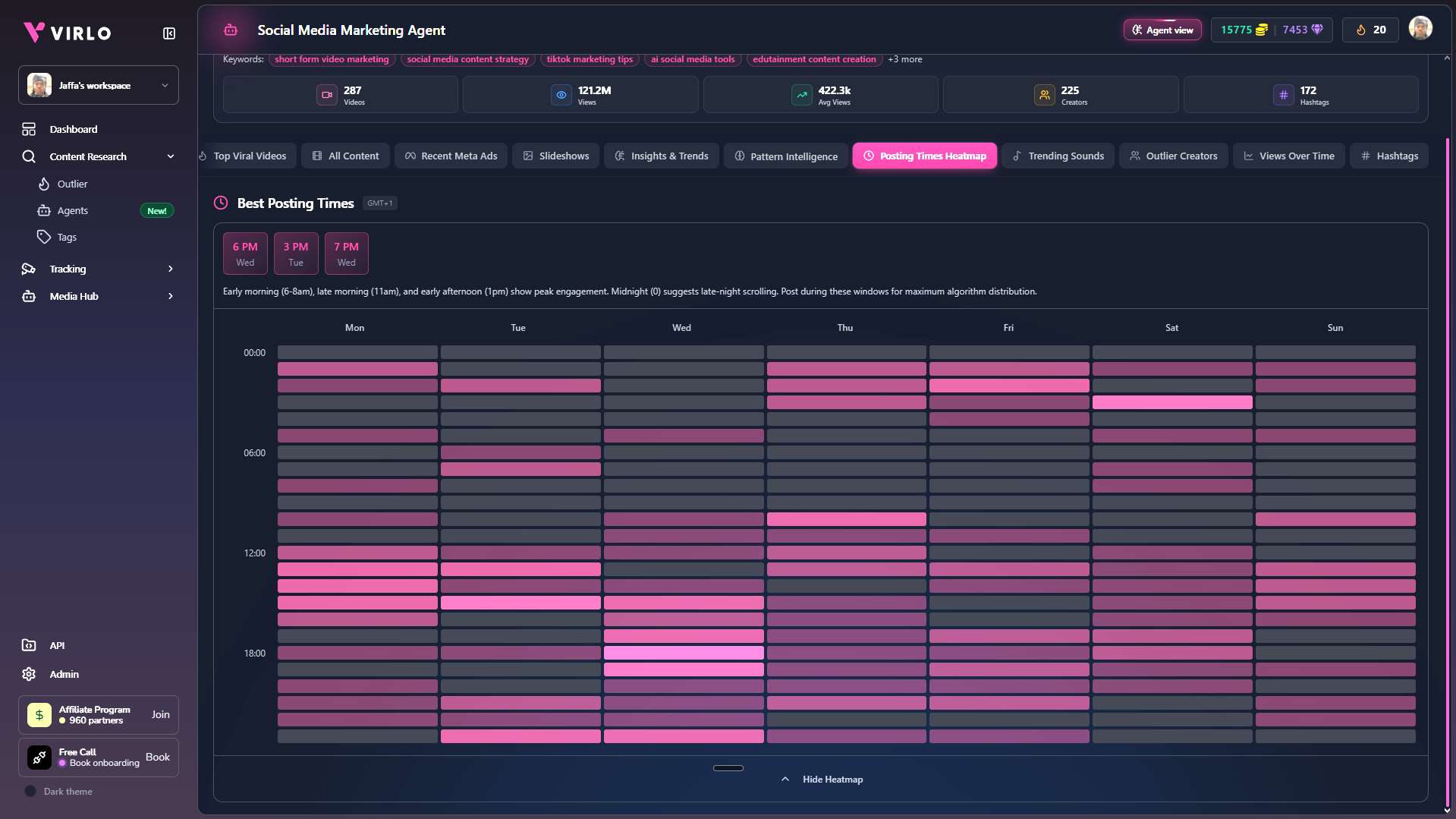
Virlo's Posting Times Heatmap for a social media niche - a Monday-to-Sunday by hour grid built from when the top videos actually posted, with the peak windows called out. See the heatmap for your niche.
One niche's heatmap, for example, surfaced peak windows at 6 PM Wednesday, 3 PM Tuesday, and 7 PM Wednesday - with early morning, late morning, and early afternoon also showing strong signals. A generic chart would have missed the Wednesday evening cluster entirely.
The whole point is that every niche reads differently. A DTC product account, a creator coach, and an AI tools page all have audiences with distinct daily rhythms. Reading your own heatmap - not a blended industry average - is what gets you from "decent reach" to posts that consistently hit outlier view counts.
See the posting windows where your niche's top content goes up.
Does posting time still matter in 2026?
Less than it used to for Reels, more than people think for everything else.
Instagram's algorithm now distributes Reels based on engagement signals, not just recency. A great Reel posted at an off-peak hour can still go wide if it gets strong engagement in its first hour. But "first hour" is the key phrase - you still need people online when you post to generate that initial signal.
For carousels and static posts, timing matters more. They don't get the same algorithmic push as Reels, so they live or die by how many of your followers see them early.
The honest test: if your content is genuinely good, a 2-hour timing miss won't kill it. But if you're posting great content at 2 AM on a Sunday in your audience's time zone, you're leaving real reach on the table.
What this means for you in 2026
Start with Tuesday-Thursday, 7-9 AM or 6-9 PM as your default posting windows. These are the safest starting points for any niche.
Check your Instagram Insights monthly and adjust your schedule to match when your specific followers are most active.
Treat Stories and Reels as separate schedules. Stories need real-time eyeballs; Reels need a strong first-hour signal.
Post 15-30 minutes before your audience's peak so your content is live and indexed when the spike hits.
Stop using global best-time charts as your final answer. They're a starting point, not a strategy.
Set up a marketing agent on your niche to see when the winning content actually posts. Start a $0 Virlo trial, point a marketing agent at your niche, and wake up to the breakout videos and posting patterns already surfaced.
Frequently asked questions
What is the 5-3-1 rule on Instagram? Post 5 pieces of value-driven content, 3 pieces of curated or shared content, and 1 promotional post per week. It's a content-mix ratio, not a posting-time rule.
What is the most active time on Instagram? Broadly, 6-9 AM and 6-9 PM in your audience's local time zone see the highest daily active users. Wednesday and Tuesday are the peak days across most account types.
What are peak posting hours? The two main peaks are the morning window (6-9 AM, heaviest around 7-8 AM) and the evening window (6-9 PM, heaviest around 7-8 PM). Both reflect real-world behavior - commute scrolling and post-work wind-down.
Is there a best time to post Instagram Stories? Post Stories 15-30 minutes before your audience's active peak so they appear at the top of the stack when followers open the app. Check the "most active times" graph in your Insights for your specific window.
How do I find the best posting time for my own niche? Start with Instagram Insights, then go deeper: Virlo's marketing agent maps when the top-performing videos in your niche were posted and surfaces the exact windows where winning content goes up - not a global average, but your actual niche.
Timing is one lever, not the whole game - but it's an easy one to get right once you stop relying on generic charts and start reading your own data.
→ Start a $0 Virlo trial and find the exact posting windows where your niche's top content is going viral.
About the author. Jaife Esienna is Co-founder of Virlo, a marketing agent that surfaces the viral videos, hooks and formats winning in any niche across TikTok, Instagram Reels and YouTube Shorts. He writes about short-form video distribution, AI marketing workflows, and the real plays behind viral content.
See What's Trending Right Now
- Social listening for TikTok, Reels & Shorts
- Spot viral trends before they peak
- Turn insights into ads, scripts & briefs
The Signal Newsletter
Weekly trend breakdowns, creator insights, and social listening tips — straight to your inbox.
Subscribe FreeSee Virlo in action
See What's Trending Right Now
- Social listening for TikTok, Reels & Shorts
- Spot viral trends before they peak
- Turn insights into ads, scripts & briefs
The Signal Newsletter
Weekly trend breakdowns, creator insights, and social listening tips — straight to your inbox.
Subscribe FreeRelated Articles
The 2026 Instagram Reels Algorithm Decoded: What Actually Decides Reach Now
The 2026 Instagram Reels algorithm is not a black box. It is a ranked set of signals. Here is the official version from Adam Mosseri, the data view from real 2026 viral Reels, and the small-account playbook the recycled posts skip.
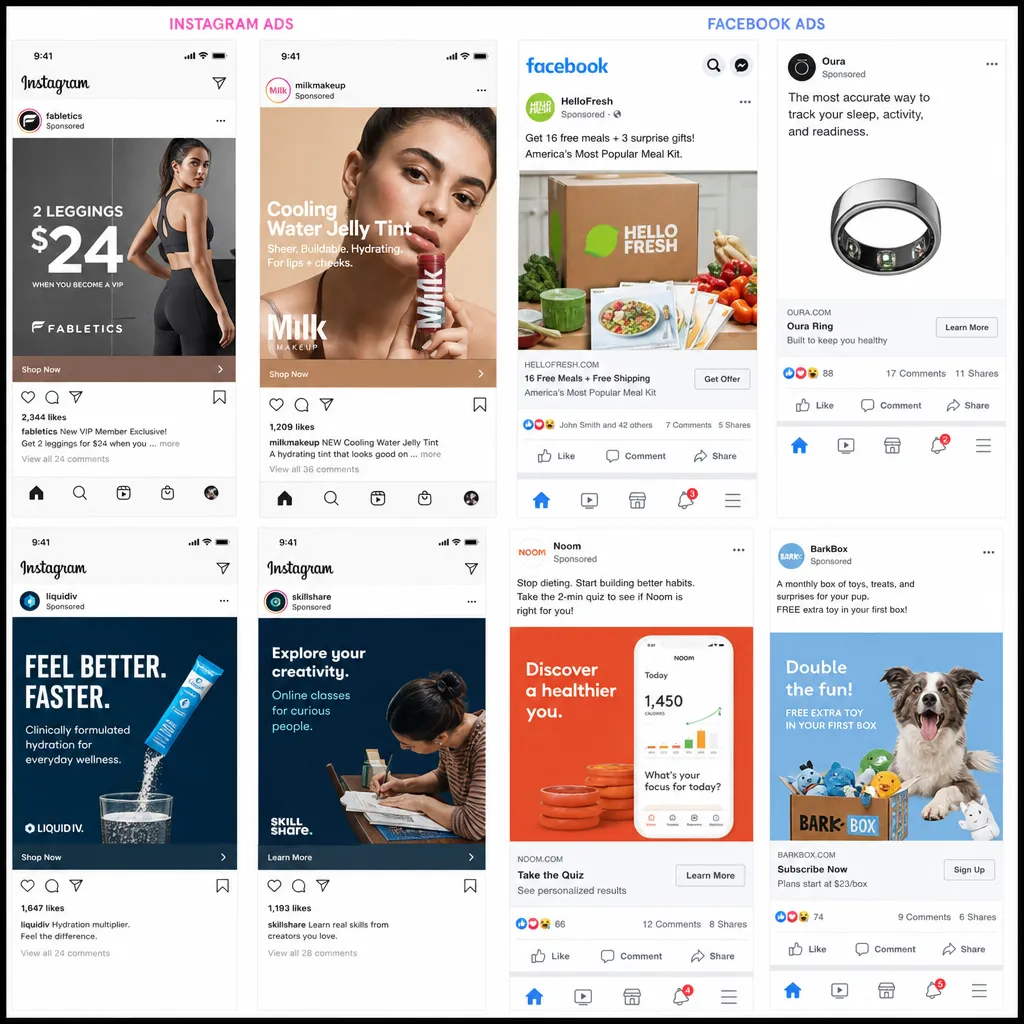
Facebook Ads vs Instagram Ads in 2026: Which One Deserves Your Budget
The real cost gap between Facebook ads and Instagram ads and which wins for ecommerce, leads, and B2B, and a starting budget split for your business type.

64% of Gen Z Uses TikTok Instead of Google—Here’s How to Make Sure They Find You
More Gen Z users are bypassing Google, turning to TikTok and Instagram for answers. Surveys show short-form video platforms are becoming Gen Z’s go-to search engines.
Put this into practice with Virlo
Turn what you just read into real research. These are the tools creators, agencies, and brands use to find what's working on short-form video.
Content Research Agent
Run your short-form research on autopilot — outliers, creators, and sounds across TikTok, Reels, and Shorts.
Tracking Center
Monitor breakout creators, videos, and competitors with daily snapshots and deep AI analysis.
Free Data
Explore free viral hooks, trending niches, breakout products, and more — no account required.
Get The Signal
Join creators, marketers, and agencies getting weekly trend breakdowns and social listening insights delivered free.
Subscribe to the Newsletter
Stop Guessing. Start Knowing.
Join thousands of digital entrepreneurs using data to take the guesswork out of capitalizing on trends.