Facebook Ads vs Instagram Ads in 2026: Which One Deserves Your Budget
The real cost gap between Facebook ads and Instagram ads and which wins for ecommerce, leads, and B2B, and a starting budget split for your business type.

Himanshu Bisht
Professional Blog Writer
Himanshu Bisht is a digital community and content expert. With the strategies he shares, companies and creators have generated over 10 million dollars in combined sales. His views have been featured in the magazines like Forbes and Authority Magazine. Himanshu writes expert articles for creators on Virlo AI.
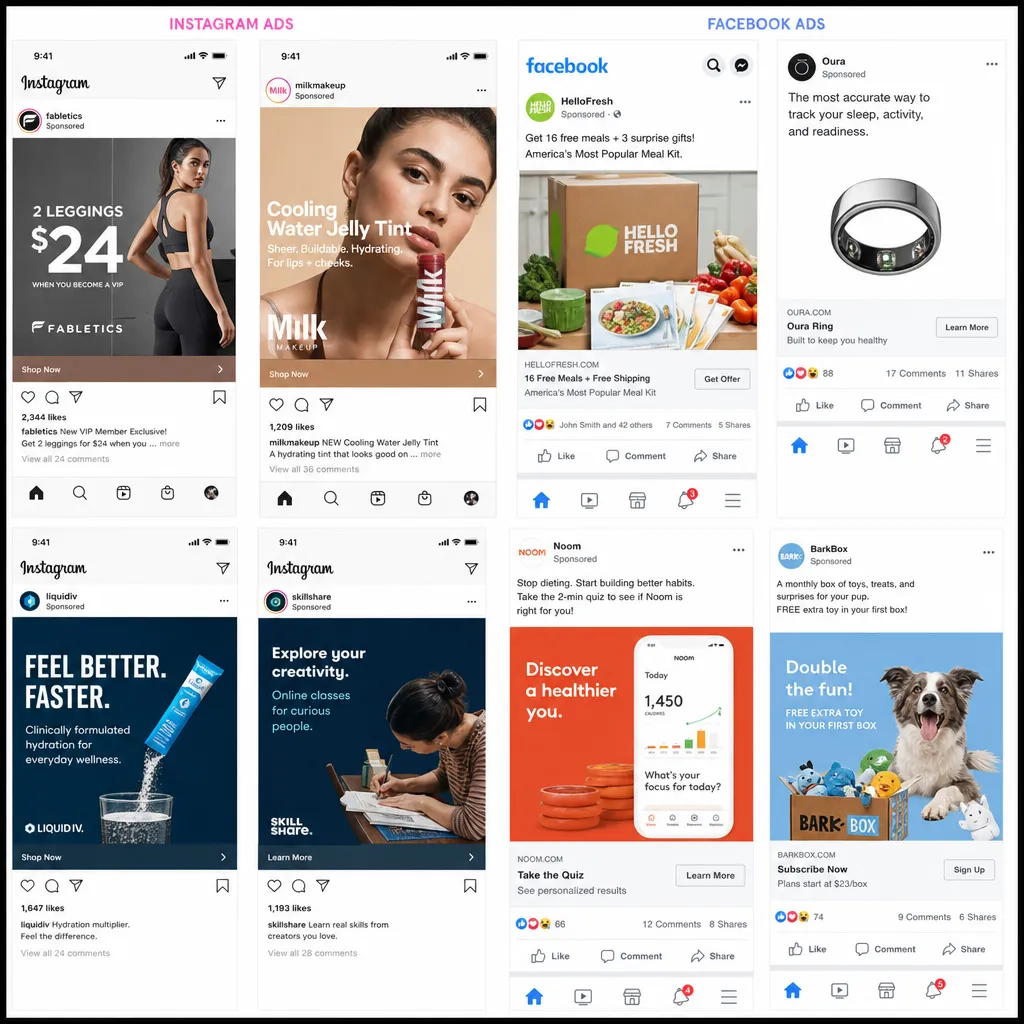
Meta now has option to run ads on Facebook and Instagram both with one click. It goes well beyond that with option of Threads, Messenger and other connected products like WhatsApp. However, highest ROI options are still Facebook and Instagram.
Facebook wins on cost per click and on lead generation. Instagram wins on engagement and on ecommerce conversion. Let's get into which one deserves your money on. Especially because it depends a lot on what you sell, who buys it, and which result you are paying for.
A service business selling to homeowners in their fifties will get cheaper leads on Facebook, and no amount of Instagram creative changes that. A skincare brand selling to 24-year-olds will get cheaper CPC (Cost per click) and CPL (Cost per lead) on Instagram, and Facebook will look better on paper only because its clicks are cheap and its buyers are absent.
Both platforms run through one advertising system, so the decision is not really about picking a side. It is about how much budget each placement earns, and that allocation should follow your product and your customer rather than an average pulled from somebody else's account.
TL;DR: Facebook delivers cheaper clicks (around 0.94 versus 1.17 average CPC in 2026), broader reach across age groups, and stronger lead generation, particularly for B2B and for buyers over 40. Instagram concentrates the 18 to 34 audience and delivers higher engagement and better ecommerce conversion for visual products. Reels and Stories are the cheapest placements on either platform at 4 to 8 dollars CPM. Run both through Advantage+ placements for two weeks, then shift budget toward whichever produces the cheaper cost per result in your account.
Meta Ads Manager manages both Instagram and Facebook...
You do not need to seperetely boost your Ads on Instagram and Facebook. Facebook and Instagram ads run through the same Meta Ads Manager. You build one campaign, one ad set, one piece of creative, and you choose where it appears. The pixel is shared, the audiences are shared, the conversion data is shared, and the learning phase draws on results from both platforms at once.
So the decision is not which advertising platform to use. It is how to allocate placements inside a system you are already using. Nothing stops you from running both simultaneously and letting real performance data settle the argument in your account.
But Facebook is a feed of friends, groups, Marketplace listings, news, and long text posts, browsed by an audience that skews older and reads more. Instagram is a visual stream of Reels, Stories, and images, browsed faster by an audience that skews younger and engages more.
This is why the same ad behaves differently in each environment, and that behavioral difference is the source of every cost and performance gap between the two platforms.
To understand this deeply, we need to look at the audience classification... aka who is actually spending time on Facebook and on Instagram.
Who is actually on each platform in 2026
The common shorthand is that Facebook is for older people and Instagram for younger ones. But this is only half right, and the half that is wrong leads advertisers to abandon a platform where their buyers are actually present.
The largest single age group on both platforms is 25 to 34. That cohort makes up about 26 percent of Facebook's US audience and roughly 34 percent of Instagram's global audience, so the core buyer is present on both in force.
The difference is in how the rest of the audience is distributed. Instagram concentrates heavily in the younger brackets, with 18 to 34 accounting for around 62 percent of users worldwide. Facebook spreads more evenly, with substantial share in the 35 to 44, 45 to 54, and 55 and older groups that Instagram reaches thinly.
For an advertiser this means two things...
A product aimed at 25 to 34 year olds can perform on either platform, and the choice comes down to behavior and creative rather than reach. A product aimed at buyers over 40 will find far more audience density on Facebook, while a product aimed at 18 to 24 year olds will find it on Instagram.
Behavior differs as much as age does. Facebook sessions involve more reading: text posts, group discussions, Marketplace listings, and event pages. Ad copy with detail and a considered offer gets consumed there.
Instagram sessions are faster and visual. Reels play in rapid succession, Stories get tapped through in seconds, and captions get skimmed. An ad that requires reading to work starts at a disadvantage regardless of targeting quality.
Most people use both, and the platform they happen to be on shapes their mindset in that moment. The same person scrolls Instagram for entertainment and opens Facebook to check a group or a listing, so your ad meets a different version of them in each place.
The cost difference on Facebook and Instagram Ads
Published cost figures for Instagram and Facebook advertising vary widely depending on the placement, the period, and the metric being measured.
Start with the broad averages. Facebook runs around 0.94 dollars per click against 1.17 on Instagram, and Facebook Feed CPMs land between 6 and 11 dollars while Instagram Feed sits between 8 and 14.
Those numbers make Facebook look cheaper on both measures, and at the feed level it is. The more revealing figure comes from placement-level data. In Q2 2026, Instagram Feed cost about 3.5 times as much per click as Facebook Feed, yet only 43 percent more per thousand impressions.
So if impressions cost 43 percent more but clicks cost 250 percent more, then people on Instagram Feed are clicking far less often per view. Instagram users see the ad and keep scrolling. Facebook users see the ad and tap.
That is not a flaw in Instagram...
It reflects the browsing behavior described above, where Instagram is consumed passively and Facebook with more intent. A click-optimized campaign will report better numbers on Facebook as a result. The conclusion that Facebook is cheaper follows from that, and it stops being true the moment you measure what happens after the click.
Now the placement that changes the picture entirely. Reels and Stories carry CPMs of 4 to 8 dollars, cheaper than either feed. Vertical video is where Meta holds surplus inventory and where competition for attention is lower. Advertisers who can produce vertical creative find their cheapest reach on Instagram for exactly this reason.
Seasonality applies to both platforms equally, and it is severe. The global median CPM reached about 25 dollars in November 2025 and fell below 16 by January 2026, a swing above 60 percent between the priciest and cheapest quarters. Any figure quoted without its time period is not comparable to any other.
In our work with creators and business owners at Virlo, the pattern that repeats is that the cost comparison flips depending on which metric a team chooses to look at. Teams watching CPC pick Facebook, teams watching cost per purchase for a visual product pick Instagram, and both are reading their own data correctly.
Where Facebook Ads Win
Facebook earns the budget in five situations, and each has a specific mechanism behind it.
Lead generation. Facebook's instant lead forms open inside the app with contact fields prefilled from the user's profile, which removes nearly all friction from the submission. Combined with an audience that reads offers and acts on them, this gives Facebook the stronger cost per lead across service categories. Instagram supports the same forms, but a person mid-scroll through Reels is far less inclined to stop and fill one in.
B2B and professional services. Facebook holds the 35 and older professional audience in a density Instagram does not match, and that audience uses the platform with a reading mindset. Longer copy explaining a considered purchase, a webinar, or a consultation offer gets consumed. The same copy on Instagram gets skipped before the second line.
Local businesses. Facebook's local infrastructure runs deeper: Pages with reviews, events, Marketplace, and neighborhood groups. An ad for a plumber, a dentist, or a restaurant lands beside content already about the area, and the viewer is in a practical mode rather than an entertainment one.
The Page itself carries weight here, because paid traffic frequently lands on it rather than on a website. A well-built Page ranks in Facebook's own search and gives that traffic somewhere credible to arrive, and this guide to Facebook SEO covers the fields that affect it.
Buyers over 40. For any product whose customer skews older, whether home improvement, financial services, health, or travel, Facebook is where the audience density sits. Instagram can reach them, at higher cost and with lower response, because they are a smaller slice of a younger platform.
Cheap traffic for content and retargeting pools. Sometimes the goal is simply a click at the lowest possible cost, whether to fill a retargeting audience or to drive readers to content. Facebook's lower CPC and higher click behavior make it the efficient choice for that job.
Where Instagram Outperform Facebook Ads
Instagram earns the budget in a different set of situations, and the reasons are equally concrete.
Ecommerce and DTC brands. Instagram's audience discovers and buys visually. Fashion, beauty, skincare, fitness, home decor, food and drink, and anything that photographs or films well converts better here. The platform has trained its users to shop through the feed, and shopping tags, product catalogs, and checkout sit natively inside the experience rather than bolted onto it.
The conversion advantage offsets the higher click cost. An advertiser paying more per click but converting a larger share of those clicks ends up with a better cost per purchase. That is the number that pays the bills, and the reason a click comparison alone points you the wrong way.
Buyers under 35. With 18 to 34 making up around 62 percent of Instagram's audience, any product aimed at this group finds both density and responsiveness here. Reaching them on Facebook is possible and increasingly expensive, since they spend less time there and arrive with a different purpose.
Engagement and brand building. Instagram generates more saves, shares, and comments per impression than Facebook, and that interaction compounds into organic reach. If the objective is building an audience, launching a brand, or generating social proof that later conversion campaigns can borrow, Instagram produces it faster.
Creator-led and UGC creative. Instagram is the native home of creator content, so ads built in that style feel like they belong in the feed rather than interrupting it. Our guide to UGC ads covers the production side, including the brief and testing structure that get creator content to convert.
Reels efficiency. With Reels CPMs at 4 to 8 dollars, any brand able to produce vertical video finds its cheapest reach here. Understanding how the Reels algorithm ranks content helps, since the signals that surface organic Reels also shape how paid ones are delivered.
The decision framework by business type
The splits below are the starting allocations we suggest at Virlo, based on how the cost and audience data line up for each business type. They are opening positions for the first fortnight of spend. Your placement breakdown will tell you how far to move from them, and in which direction.
Ecommerce and DTC. Start Instagram-heavy, around 60 to 70 percent, with the remainder on Facebook for retargeting and for any product line that skews older. Prioritize Reels and Stories for prospecting, since they combine Instagram's conversion advantage with the cheapest CPMs on either platform. Judge on cost per purchase, because cost per click will flatter Facebook and mislead you.
Lead generation and services. Start Facebook-heavy, around 70 percent, using instant forms. Keep 30 percent on Instagram to learn whether your specific offer resonates with a younger audience, and shift further toward Facebook if cost per lead confirms the expected pattern.
B2B. Facebook first, at 70 to 80 percent, with copy-rich creative that explains the offer properly. The Instagram share works for brand awareness among younger professionals and for founder-led personal content. Direct lead capture on Instagram in B2B is the exception, so do not plan around it.
Local businesses. Facebook, 70 percent or more, with tight geographic targeting and creative that references the area by name. Instagram earns its share for restaurants, salons, gyms, and anything visual where local buyers under 35 form a meaningful customer base.
Apps and digital products. The user's age decides this one. Consumer apps for a young audience belong on Instagram. Productivity, finance, and utility apps for a broader audience perform better on Facebook. Install intent is more deliberate there, and the audience is more willing to read what the app does before tapping.
Creators and personal brands. Instagram, heavily. The audience, the format, and the content style all align, and the engagement compounds into organic reach in a way Facebook does not deliver for individuals.
How to run both without wasting the split
Running both platforms is the right call for most businesses, and a split that is structured carelessly teaches you nothing. Two ad sets on trivial budgets produce two sets of noise, and the advertiser concludes the platforms perform about the same when neither had enough data to perform at all.
Let Advantage+ placements make the first allocation. Meta distributes spend across both platforms and every placement automatically, shifting toward whichever is producing the cheapest results as data arrives. That is the exact allocation decision you are trying to make, performed continuously by a system that sees every impression. Meta's placements documentation lists what is included.
Read the placement breakdown once results stabilize. In Ads Manager, break results down by placement and compare cost per result across Facebook Feed, Instagram Feed, Reels, Stories, and the rest. This report reflects your product, your offer, and your customers, which makes it the only Facebook vs Instagram advertising comparison that applies to your business.
Split ad sets by platform only when creative demands it. If you want long-copy static images on Facebook and vertical video on Instagram, they need separate ad sets so each placement receives creative built for it. A decisive cost gap you want to control manually is the other legitimate reason. Splitting for any other reason just fragments your learning data.
Fund the test so it can teach you something. Each side needs enough spend to reach real conversion volume before its numbers mean anything. Our walkthrough of how to advertise on Instagram covers the budget thresholds, the learning phase, and the campaign structure in detail if you are building the foundation now.
Creative is the variable that decides the comparison
Every cost and performance number above assumes creative that suits the placement, and that assumption fails constantly.
Facebook rewards ads that respect a reading audience. Longer primary text performs, static images with clear value propositions perform, and a carousel walking through features or testimonials gets swiped. Video works too, but square and landscape formats hold up here in a way they do not on Instagram.
Instagram punishes the same ads. Long text gets truncated and ignored, and static images get scrolled past in Reels and Stories. Anything that looks produced rather than native triggers the recognition that this is an ad. Vertical video with a hook in the opening seconds, sound-on design, and a creator-style delivery is what the platform rewards.
The consequence is that creative mismatch contaminates the comparison inside a lot of accounts. An advertiser runs one landscape video across both, sees Facebook win, and concludes Facebook is the better platform. What they measured is that their creative was built for Facebook.
At Virlo we track millions of short-form videos across Instagram, TikTok, and YouTube, and the formats that end up dominating paid creative on Instagram surface organically weeks beforehand. Building Instagram creative from what is currently breaking out, rather than adapting Facebook assets, is the adjustment that most changes how the comparison turns out.
If you are weighing a third platform, our breakdown of TikTok advertising covers how its costs and creative expectations differ from both.
See what your competitors decided
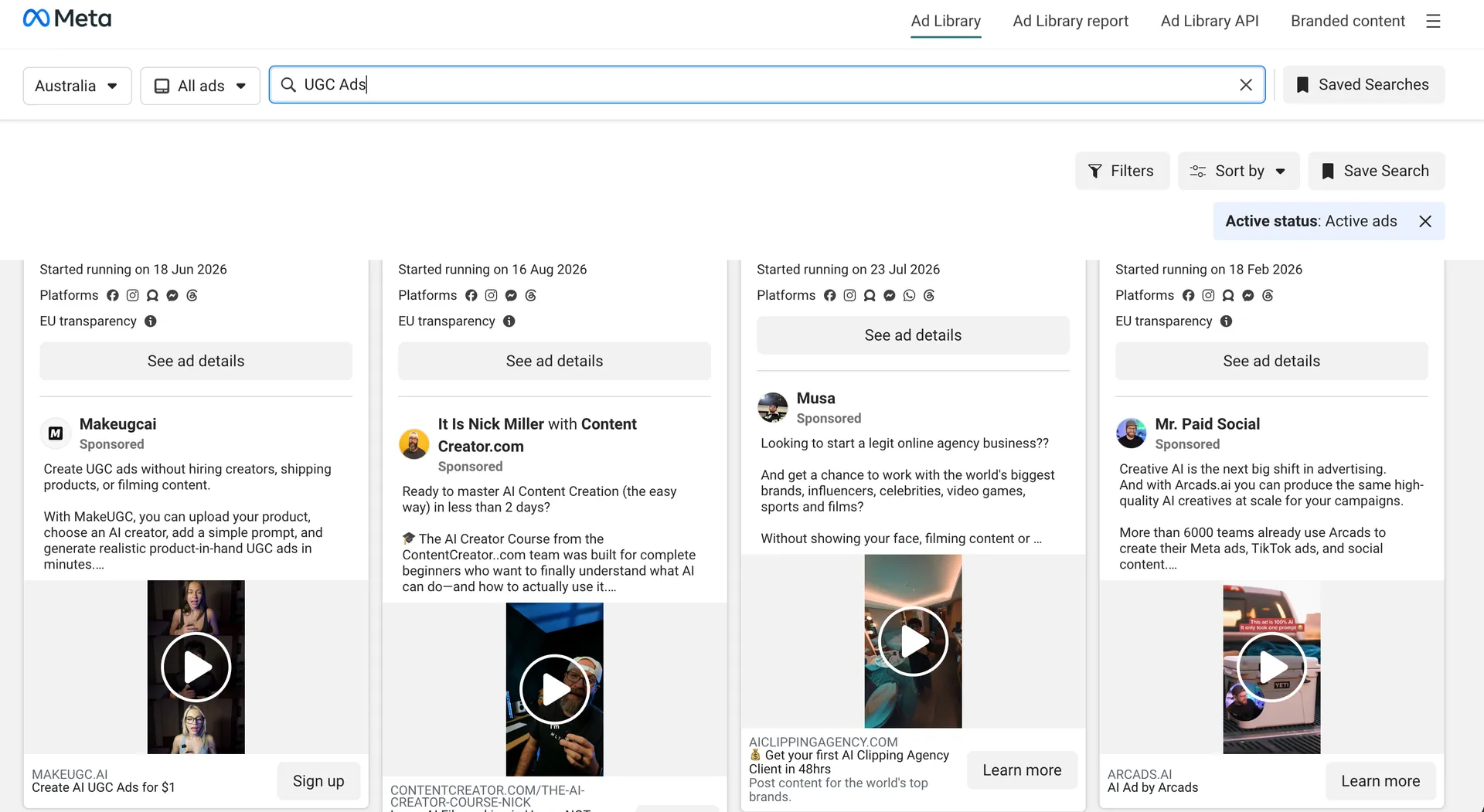
You can check which platform your competitors chose without asking them. The Meta Ad Library shows every active ad from any brand, including the platforms each one runs on, and our Meta Ad Library research guide covers how to read it.
The signal worth noting here is longevity by platform. A competitor whose Instagram-only ads have run for months while their Facebook ads rotate quickly has already answered this question with their budget, and the reverse is equally telling.
Frequently asked questions
Are Instagram ads more expensive than Facebook ads?
Per click, yes. Instagram averages around 1.17 dollars per click against 0.94 on Facebook, and Instagram Feed CPMs run higher than Facebook Feed. Reels and Stories are the exception at 4 to 8 dollars CPM, cheaper than either feed. Cost per purchase can still favor Instagram for visual products because its conversion rate is higher.
Is Facebook or Instagram better for ads in 2026?
Facebook for lead generation, B2B, local services, and buyers over 40. Instagram for ecommerce, visual products, brand building, and buyers under 35. Both run through the same Ads Manager, so the practical answer is to run both and let your placement breakdown decide the split.
Facebook vs Instagram advertising for small business: which wins?
It depends on what the business sells. Service businesses, local businesses, and anything selling to an older customer get cheaper leads on Facebook. Businesses selling visual products to a younger customer get cheaper purchases on Instagram.
Which is cheaper, Facebook ads or Instagram ads?
Facebook is cheaper per click and per thousand impressions at the feed level. Instagram Reels and Stories are cheaper than either feed at 4 to 8 dollars CPM. Cost per purchase or per lead depends on your product rather than the platform.
Should I run ads on Facebook or Instagram?
Both, through Advantage+ placements, for the first two weeks. Then break results down by placement in Ads Manager and shift budget toward whichever platform produces the cheaper cost per result for your specific offer.
Can you run the same ad on Facebook and Instagram?
Yes, one ad set can serve both platforms, and Meta will adapt the format automatically. Performance is better when creative is built for each placement, so separate ad sets with platform-specific creative usually outperform a single shared asset.
Which is better for ecommerce, Facebook or Instagram ads?
Instagram, for most visual product categories. Its audience discovers and buys products through the feed, the shopping integration is more native, and conversion rates run higher. Facebook still earns a share for retargeting and for products with an older buyer.
Which is better for lead generation, Facebook or Instagram ads?
Facebook. Instant lead forms combined with an audience that reads offers and responds produce a lower cost per lead across most service categories. Instagram can supplement for younger prospects but rarely matches Facebook on lead cost.
Do Instagram ads work for B2B?
For awareness and founder-led personal branding, yes. For direct lead capture, Facebook outperforms because the professional decision-makers are there in a reading mindset. Treat Instagram as a supporting channel in B2B rather than the primary one.
Which platform has better ROAS?
Facebook wins return on ad spend for leads, services, and older buyers. Instagram wins for ecommerce and younger buyers. Your own placement breakdown after running both is the only ROAS comparison that applies to your business.
Bringing it all together...
Facebook ads vs Instagram ads gets settled inside your account, by your product and your customers, more reliably than any published average could settle it. The averages tell you Facebook clicks are cheaper and Instagram engagement is higher, and both facts are true. However, this information is not fully useful without understanding the nuances we shared above.
What pays the bills is cost per lead or cost per purchase for your specific offer, in front of your specific buyer, with creative built for the placement it appears in. A fortnight of running both through Advantage+ placements, funded well enough to reach real conversion volume, produces that number.
So if you are unsure where to begin, look into Meta Ad library and pick the starting split for your business type from the framework above. Build separate creative for each platform, and let the placement breakdown correct you.
See What's Trending Right Now
- Social listening for TikTok, Reels & Shorts
- Spot viral trends before they peak
- Turn insights into ads, scripts & briefs
The Signal Newsletter
Weekly trend breakdowns, creator insights, and social listening tips — straight to your inbox.
Subscribe FreeSee Virlo in action
See What's Trending Right Now
- Social listening for TikTok, Reels & Shorts
- Spot viral trends before they peak
- Turn insights into ads, scripts & briefs
The Signal Newsletter
Weekly trend breakdowns, creator insights, and social listening tips — straight to your inbox.
Subscribe FreeRelated Articles
7 Best TikTok Competitor Analysis Tools in 2026
If you are managing TikTok content without a clear picture of what your competitors are doing, you are flying blind in one direction. You can see your own numbers. You cannot see what is working for the brands or creators competing for the same audience — which formats are driving their views, wh...
How to Find Trending TikTok Hashtags in 2026
Most "trending TikTok hashtags" lists are dead on arrival. Here's how to find the ones actually working in your niche right now, and how to tell which ones are worth using.
How the TikTok Algorithm Works in 2026
Every TikTok scroll is a decision the algorithm made for you. The For You Page (FYP) isn't chronological, isn't follower-based, and isn't random — it's a recommendation engine ranking millions of videos against signals about what you, specifically, are likely to watch to the end. For creators, th...
Put this into practice with Virlo
Turn what you just read into real research. These are the tools creators, agencies, and brands use to find what's working on short-form video.
Content Research Agent
Run your short-form research on autopilot — outliers, creators, and sounds across TikTok, Reels, and Shorts.
Tracking Center
Monitor breakout creators, videos, and competitors with daily snapshots and deep AI analysis.
Free Data
Explore free viral hooks, trending niches, breakout products, and more — no account required.
Get The Signal
Join creators, marketers, and agencies getting weekly trend breakdowns and social listening insights delivered free.
Subscribe to the Newsletter
Stop Guessing. Start Knowing.
Join thousands of digital entrepreneurs using data to take the guesswork out of capitalizing on trends.