How to Scrape TikTok Data in 2026 Without Getting Blocked
A plain request against a TikTok URL returns an empty shell, and rendering it properly gets you blocked within a few requests. Here are the methods that work in 2026, the TLS fingerprinting fix that solves most blocks.

Himanshu Bisht
Professional Blog Writer
Himanshu Bisht is a digital community and content expert. With the strategies he shares, companies and creators have generated over 10 million dollars in combined sales. His views have been featured in the magazines like Forbes and Authority Magazine. Himanshu writes expert articles for creators on Virlo AI.
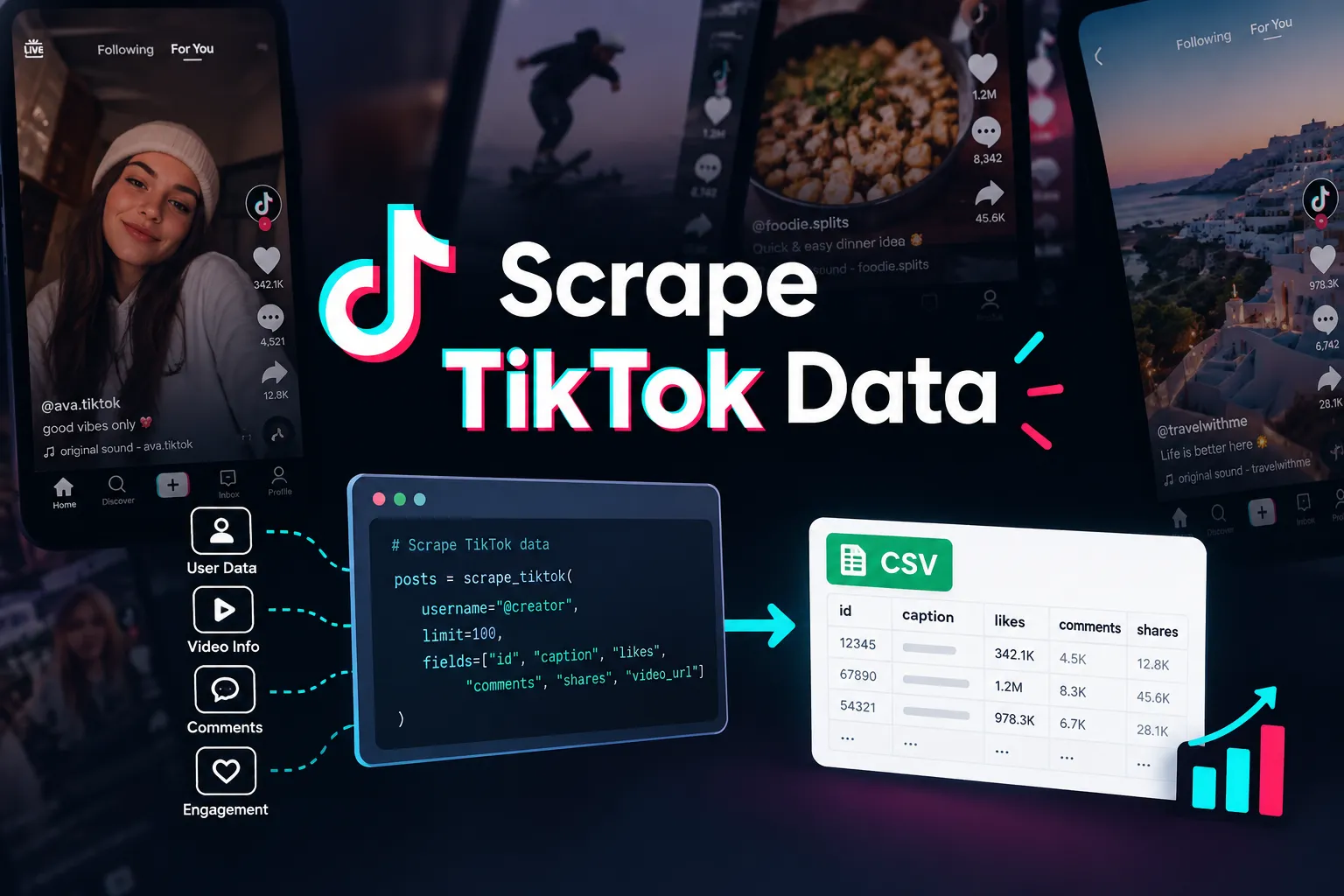
TikTok data is one of the most valuable public dataset in consumer marketing right now. Over 200 billion Shorts-style videos get viewed daily across short-form platforms, and TikTok sits at the centre of how products get discovered, how trends form, and how categories shift before any of it reaches a sales figure.
If you are using Tiktok for Ecommerce, you can use it to watch the signal for products, since a category taking off on TikTok tends to move wholesale prices before it moves retail ones. Also tiktok data can be used by Academic researchers study how narratives travel. A whole tier of agencies now sells reporting built on nothing but this data.
However, it is tricker than ever now to scrape Tiktok properly as of 2026 and 2027. But it doesn't mean you can not do it. Let's get into it...
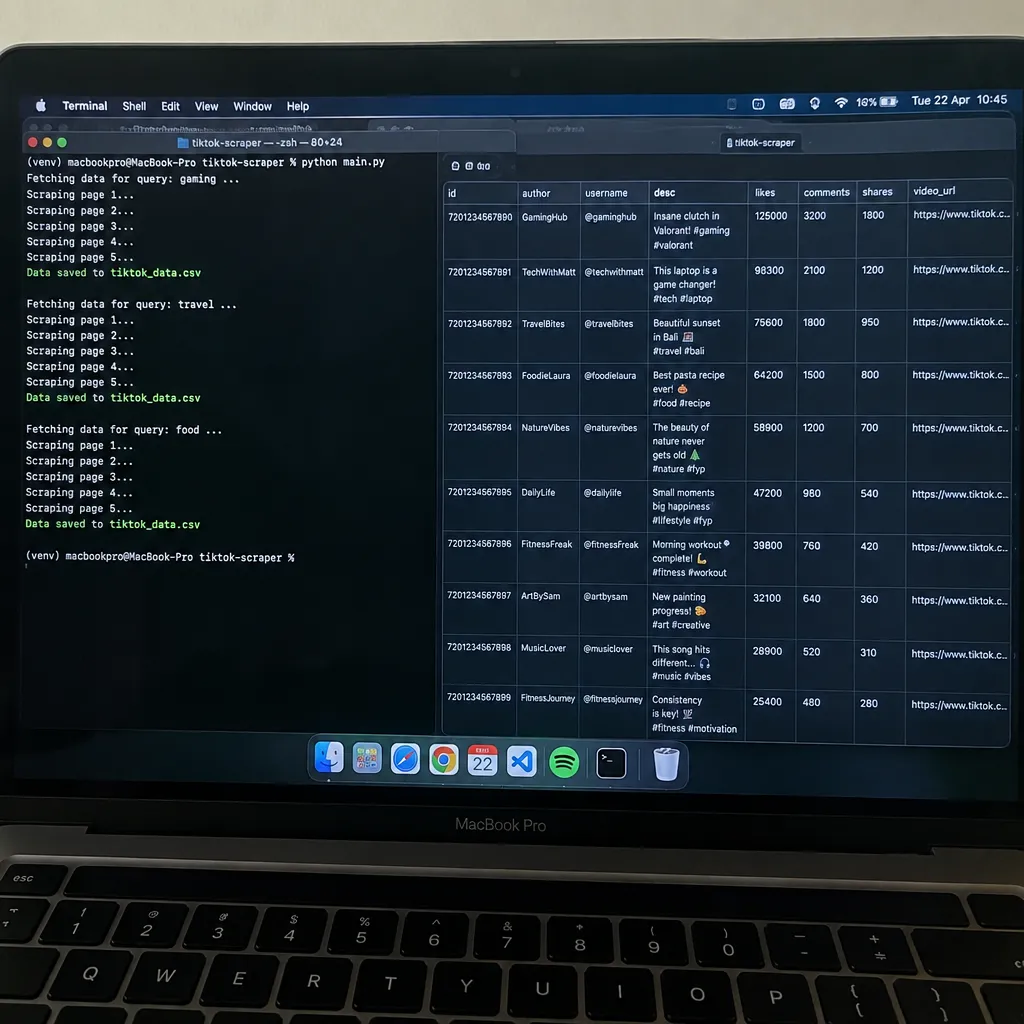
A plain requests.get() against a profile URL returns an HTML shell. Not as videos, or follower count and captions. Because everything you need will arrive later, through JavaScript. TikTok starts returning 403s and CAPTCHAs after a handful of requests, while the same pages load normally in your own browser.
Both walls have solutions. Neither solution holds permanently, which is the part that should shape how you build on top of them.
Quick Summary: TikTok renders content client-side, so scraping means either parsing the JSON embedded in the page or driving a headless browser and intercepting its internal API calls. Blocks come from rate limiting, TLS fingerprinting, and IP reputation. Scraping Tiktok data using Python libraries,
curl_cffican solve the TLS problem that stops most scrapers. But you might also require Residential proxies. These proxies cost $1 to $8 per GB, putting mid-scale collection at $200 to $500 monthly before engineering time.
Also, if you are using Tiktok scrapping to get Tiktok trends and other specific information, Virlo API is a powerful tool.
What Tiktok data you can Actually Scrape
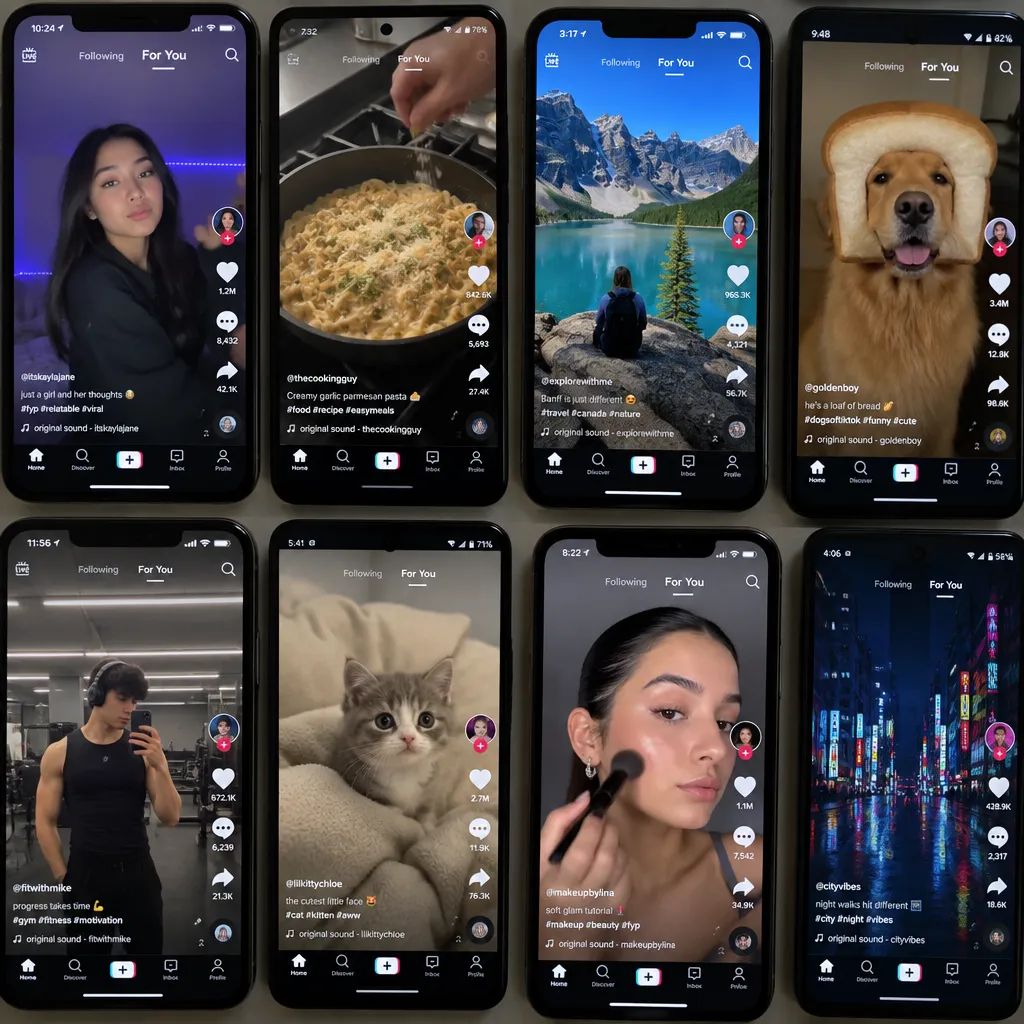
Scrapping data can be tricky from short form content websites. This difficulty varies enormously across data types, and picking the wrong tool for an easy target wastes days. Here are a few end points you can actually reach and scrape.
Profile data is the easiest. Username, display name, bio, follower and following counts, total likes, and verification status all sit in the initial page payload. One request per profile, no pagination.
Video metadata comes next. View count, like count, comment count, share count, caption text, hashtags, the sound used, duration, and upload timestamp are all available.
Hashtag and search results need pagination from the start. Each request returns a page of results plus a cursor for the next one. The depth available to anonymous requests stops well short of what the app shows a logged-in user.
Sound and music data behaves like hashtags. You can pull the videos using a given sound, which underpins most trend detection work.
Comments are the hardest common target. They load through a separate endpoint, they paginate aggressively, and they attract tighter rate limiting than anything else on the platform.
Several things stay out of reach entirely. Analytics for accounts you do not own, private accounts, exact ad spend, audience demographic breakdowns, and anything requiring an authenticated session belonging to someone else.
Why your TikTok scraper gets blocked
Knowing the defense layers saves you from the usual cycle of adding random delays and hoping something sticks.
TikTok evaluates each request across several dimensions simultaneously. A request can look correct at the HTTP level and still get refused because of how the underlying connection was established.
Rate limiting on anonymous access. Browsing without an account works, then gets limited quickly. Several requests in close succession from one address produce Rate Limit Exceeded or Access Denied responses. This layer is the one most people hit first.
Behavioral analysis. Real browsing has texture: mouse movement, scroll depth, dwell time, a mix of page types. A client requesting forty profile pages in sequence with no other activity does not resemble a person, however well-formed each individual request looks.
Device fingerprinting. The browser exposes screen dimensions, timezone, installed fonts, canvas rendering characteristics, hardware concurrency, and dozens of further signals. Default headless configurations leak their automation status through several of them.
TLS fingerprinting. This layer blocks people who have done everything else correctly, and it deserves the most attention because the failure is invisible.
During the HTTPS handshake, your client produces a signature derived from cipher suite ordering, supported extensions, and protocol version preferences. Python's requests and httpx produce signatures that no real browser produces. TikTok compares handshake fingerprints against known browser profiles. A request carrying a perfect Chrome user agent string still gets identified as automation before any HTTP data is exchanged.
IP reputation. Datacenter address ranges are catalogued and distrusted. AWS, Google Cloud, DigitalOcean, and Hetzner addresses get flagged quickly. Residential and mobile addresses carry considerably more trust, which is the reason the residential proxy market exists at all.
These layers compound. This is why scraper debugging feels like guesswork until you know what the layers are. So let's get into exect steps to Scrape Tiktok videos, meta information and other data for your business.
Method one: parse the embedded JSON
The lightest approach works because TikTok server-renders a JSON blob into the HTML for hydration. No browser required.
Look for a script tag containing __UNIVERSAL_DATA_FOR_REHYDRATION__ in current versions, or SIGI_STATE in older ones. Both hold structured data describing whatever the page shows.
The important choice here is the HTTP client. Using curl_cffi instead of requests or httpx solves the TLS fingerprinting problem, because it impersonates a real browser's handshake rather than announcing itself as Python.
import json
import re
from curl_cffi import requests as cffi_requests

PATTERN = re.compile(
    r'<script id="__UNIVERSAL_DATA_FOR_REHYDRATION__"[^>]*>(.*?)</script>',
    re.DOTALL,
)

def get_profile(username: str) -> dict:
    url = f"https://www.tiktok.com/@{username}"

    # impersonate makes the TLS handshake match real Chrome.
    resp = cffi_requests.get(url, impersonate="chrome", timeout=30)
    resp.raise_for_status()

    match = PATTERN.search(resp.text)
    if not match:
        raise ValueError("Hydration payload missing. Page structure likely changed.")

    scope = json.loads(match.group(1))["__DEFAULT_SCOPE__"]
    info = scope["webapp.user-detail"]["userInfo"]
    user, stats = info["user"], info["stats"]

    return {
        "id": user["id"],
        "username": user["uniqueId"],
        "nickname": user["nickname"],
        "bio": user.get("signature", ""),
        "verified": user.get("verified", False),
        "followers": stats["followerCount"],
        "following": stats["followingCount"],
        "likes": stats["heartCount"],
        "video_count": stats["videoCount"],
    }
A regex is appropriate here rather than an HTML parser. You are extracting one known script tag by id from a document whose structure you do not otherwise care about, and running a full parse over a large page costs time for no benefit.
This one returns profile fields only. The user-detail payload carries counts and metadata, not the video list, so pulling a creator's actual videos needs the next method.
Two other limits arrive quickly. The payload contains only what the initial render includes, so anything behind a scroll is absent. And curl_cffi fixes your TLS signature without fixing your IP reputation, so datacenter addresses still get blocked at volume.
For a one-off pull of a few hundred profiles from a residential connection, this is frequently enough.
Method two: headless browser with XHR interception
When you need data past the initial render, drive a real browser and capture the internal API calls it makes.
These internal endpoints get described as hidden APIs. They are the calls the TikTok web app makes to populate its own interface, carrying signed parameters generated by client-side JavaScript. Calling them directly from a script means reproducing that signing logic, which TikTok changes without notice.
Running a real browser sidesteps that work, because the page generates valid signatures for you.
import asyncio
from playwright.async_api import async_playwright

async def scrape_profile_videos(username: str, scrolls: int = 5) -> list:
    collected: list = []
    pending: list = []

    async with async_playwright() as p:
        browser = await p.chromium.launch(
            headless=True,
            args=["--disable-blink-features=AutomationControlled"],
        )
        # Leave the user agent alone unless you also match platform hints.
        context = await browser.new_context(
            viewport={"width": 1280, "height": 900},
            locale="en-US",
            timezone_id="America/New_York",
        )
        page = await context.new_page()

        async def handle(response):
            if "/api/post/item_list" in response.url:
                try:
                    body = await response.json()
                    collected.extend(body.get("itemList", []))
                except Exception as exc:
                    print(f"Failed parsing {response.url}: {exc}")

        # page.on takes a sync callback, so schedule the async work as a task
        # and keep a reference so nothing is dropped when the browser closes.
        page.on("response", lambda r: pending.append(asyncio.create_task(handle(r))))

        await page.goto(
            f"https://www.tiktok.com/@{username}",
            wait_until="domcontentloaded",
        )
        await page.wait_for_selector('[data-e2e="user-post-item"]', timeout=15_000)

        for _ in range(scrolls):
            await page.mouse.wheel(0, 3000)
            await page.wait_for_timeout(2000)

        if pending:
            await asyncio.gather(*pending, return_exceptions=True)

        await browser.close()

    return collected
There are 4 important details here...
The pending list exists to prevent a race that silently loses data. page.on expects a synchronous callback, so the async handler has to be scheduled as a task. Without gathering those tasks before closing the browser, in-flight response.json() calls raise "Target closed" and the final page of results disappears into the exception handler.
There is no navigator.webdriver override, deliberately. Overriding it to undefined is itself detectable, since real Chrome returns false and exposes no own-property getter on navigator. The --disable-blink-features=AutomationControlled flag removes the flag properly, making the script patch redundant and actively harmful.
wait_until="domcontentloaded" replaces networkidle, which Playwright's own documentation discourages. TikTok polls continuously, so a network-idle state may never arrive and your call times out after thirty seconds. Waiting for a specific selector is both faster and more reliable.
The user agent is left at the browser default. Setting a macOS user agent on Linux headless Chromium leaves navigator.platform and Sec-CH-UA-Platform reporting Linux, creating exactly the inconsistency that fingerprinting looks for.
One gap you can close here is your own implementation: this captures only the paginated batches from /api/post/item_list. The first page of videos arrives through the rehydration payload during the initial render, so combine this with method one or your dataset starts at video thirteen.
For harder targets, the current generation of stealth tooling means patchright, camoufox, or nodriver. The original playwright-stealth package is no longer maintained.
Method three: the open-source wrappers
Before building from scratch, look at what already exists. The most credible option is davidteather/TikTok-Api, maintained continuously and still active as of April 2026.
It automates a browser session, mimics TikTok's internal requests, and parses responses into Python objects. Setup requires Playwright, cookies and tokens, proxy configuration, and often custom session factories for anything past the basics.
It saves genuine time. It also introduces a dependency you do not control.
TikTok changes its frontend, internal endpoints, and anti-bot measures regularly. Each change breaks the library until a maintainer reverse-engineers a fix and publishes a release, which takes days to weeks. Your pipeline returns errors throughout that window.
For research, prototypes, or anything where a week of downtime is survivable, that trade is reasonable. For a product feature your customers depend on, the response time of an unpaid maintainer becomes a dependency in your uptime.
Evil0ctal/Douyin_TikTok_Download_API is the other widely used option, covering both TikTok and Douyin with more setup complexity.
Method four: the official TikTok APIs
Two official routes exist. Both are narrower than developers expect when they go looking.
The Display API returns data for accounts that authorize your application through OAuth. It fits a product where creators connect their own accounts. It does nothing for research about accounts you do not control, which is what most scraping questions are really about.
The Research API sounds correct and rarely is. Access requires affiliation with a non-profit academic institution in an eligible region, granted through a manual application reviewed over a period of weeks. Independent developers and commercial teams are routinely declined.
Approved researchers then meet the ceilings. The daily limit is 1,000 requests, yielding roughly 100,000 records. Collecting data across even a hundred creators can take several days. Most endpoints reach back only across a rolling 30-day window.
The coverage gap matters more than the quotas for most projects. Trending sounds, viral hashtags, and trending videos are not exposed through the Research API at all.
Anyone whose question is "what is taking off right now" cannot answer it through TikTok's official research tooling, whatever their credentials.
Method five: managed APIs and data providers
Buying access divides into two categories that get treated as one, and the distinction determines what remains your responsibility.
Scraping infrastructure handles transport. Bright Data, Oxylabs, ScraperAPI, Scrapfly, and Decodo rotate proxies, solve CAPTCHAs, and manage fingerprints. You still write parsers, absorb schema changes when TikTok restructures a payload, and own the pipeline. Pricing follows bandwidth or request count.
Structured data APIs return parsed, typed records against a stable schema, absorbing platform changes on their side. Apify's TikTok actors sit near the boundary, offering prebuilt scrapers you configure rather than code. Our comparison of TikTok APIs for developers covers specific providers in more depth.
Virlo's API offers a great solution for Structured Tiktok data. The difference relevant to trend work is coverage: trending sounds, hashtag analytics, and creator outlier detection arrive in one schema across TikTok, Reels, and Shorts.
Those are the fields the Research API omits, and the fields a self-built scraper reaches only by collecting enough volume to compute baselines yourself.
Whether that justifies the cost depends on your use case, which the next section should make easier to settle.
What scraping TikTok actually costs
Budget conversations tend to stop at proxy pricing, which is the smaller line.
Proxies. Residential addresses run $1 to $8 per GB. Small plans land around $3 to $4, and volume commitments bring it toward $1.50 to $3. The spread inside a single provider is wide, since low-volume tiers price well above their enterprise rates.
In monthly terms, light usage of 2 to 5 GB lands somewhere between $10 and $75. Push into mid-scale collection, around 50 to 100 GB, and you are looking at $200 to $500. Beyond 500 GB the figure climbs steeply, from $1,000 to $6,000 and upward depending on how much of it you commit to in advance.
Plan against cost per successful request, meaning price divided by success rate. A $2 per GB provider converting 60% of requests costs more per usable record than a $4 per GB provider converting 95%. Headline rates also hide plan minimums, monthly commitments, and traffic that expires unused.
Engineering time. This line dominates, and it rarely appears in the comparison.
Getting a reliable TikTok collector working takes a competent developer a couple of weeks. Keeping it working is the actual commitment. A frontend change breaks your parsers, an anti-bot update takes out session handling, and if an endpoint moves, everything downstream of it goes quiet at once.
At Virlo we run collection across TikTok, Instagram, and YouTube continuously, and the maintenance is not evenly distributed. Long quiet stretches get punctuated by a platform change that consumes an engineer for a day or more. Budgeting an average hides the shape of it, which is that the work arrives without warning and usually competes with something already scheduled.
The question is not whether your team can build this. It is whether TikTok collection is infrastructure your team should own indefinitely, or a dependency better bought so engineers stay on the product your users actually see.
A data company with scraping expertise already in-house should build. For a team of four shipping a marketing tool, the same decision usually goes the other way, and there is nothing embarrassing about that.
Is scraping TikTok legal?
Tiktok data scrapping legality depends on where you live. Data scrapping has existed as long as Internet has existed. Even now, companies like Bytedance (Seedance), Deepseek, Claude have been scrapping data for training their models. All businesses scrape data to some extent. However, scrapping private logged-in information of people without their consent is illegal in almost all cases.
The public data argument is real, and narrower than it gets repeated. In hiQ Labs v LinkedIn, the Ninth Circuit held in 2022 that scraping public pages likely does not violate the Computer Fraud and Abuse Act where no authentication gate is bypassed.
hiQ won the CFAA question, then was found to have breached LinkedIn's User Agreement, and the matter closed with a consent judgment in November 2022. Prevailing on hacking law did not protect them from the contract they had accepted.
In January 2024, the court granted summary judgment for Bright Data, finding that scraping public data without bypassing technical access controls does not violate the CFAA.
The reasoning carries the practical guidance. Bright Data had terminated its Facebook and Instagram accounts and scraped only logged-off public pages. Meta's terms govern "your use" of its products, and the court found Bright Data was not using Facebook in that sense.
Across both cases the operative distinction is consistent. Logged-out scraping of public pages is defensible. Logged-in scraping in breach of terms you accepted is not. Scraping while signed into a TikTok account puts you in the weaker position.
A newer theory applies more directly to TikTok than either of those cases. Reddit's litigation against Perplexity includes a claim under DMCA section 1201, alleging circumvention of rate limits and anti-bot systems.
Section 1201 prohibits circumventing technological measures controlling access to a protected work. It addresses the circumvention itself, not whether the underlying data was public. A defense resting on "this page was visible to anyone" does not respond to that claim.
Set that against what TikTok collection requires. Impersonating browser TLS signatures, masking automation flags, rotating residential proxies to evade IP reputation checks, and pacing requests beneath rate limits are all, descriptively, circumvention of technological measures.
No court has tested this theory against a TikTok scraper, and how anti-bot systems will be treated under section 1201 remains genuinely unsettled. Building on the assumption that public data equals permitted collection relies on precedent addressing a different question.
Personal data carries separate obligations regardless. Usernames, profile images, bios, and comment text relating to identifiable people fall under GDPR in the EU and CCPA in California.
Public availability grants no exemption. Collecting profile data on EU residents at scale creates duties around lawful basis, retention, and subject access requests, independent of collection method.
Commercial scraping, scraping at scale, or scraping data touching EU or California residents is the point to involve a lawyer rather than an article.
How to scrape TikTok without getting blocked
These practices separate collectors that survive months from ones that die on day two.
Match your TLS fingerprint to a real browser. For anyone doing TikTok scraping in Python, this single change fixes more blocks than everything else combined. Use curl_cffi with impersonate, or tls-client, rather than requests or httpx.
Pace requests deliberately. Two to five seconds between requests, randomized rather than fixed. Identical intervals form their own fingerprint, so add jitter.
Back off exponentially. On a 403 or CAPTCHA, wait rather than retrying immediately. Double the delay each time, cap it, then rotate identity before resuming. Retrying hard against a blocked endpoint deepens the block.
Rotate proxies per session rather than per request. A session changing IP mid-sequence looks stranger than one holding a consistent address. Bind an identity to a proxy, run a coherent batch, then cycle.
Keep every signal internally consistent. Timezone matching proxy geography, locale matching timezone, user agent matching the browser you are actually running. Mismatches across these are inexpensive to detect.
Limit concurrency. Ten parallel workers through one proxy pool produces a recognizable pattern. Two or three does not.
Cache aggressively. Requests you never make cannot be blocked. Profile bios change rarely, so refetching them hourly spends budget and raises your visibility for nothing.
Read robots.txt and respect its intent. Its legal weight is limited in most jurisdictions. Disregarding it entirely reads badly if your collection is ever examined.
Track success rate as a first-class metric. A collector degrading from 95% to 60% across a week is reporting a change you need to investigate. Alert on it rather than discovering gaps in your data three weeks later.
Choosing an approach
Match the method to the actual job.
A one-off dataset for research or a pitch. Embedded JSON parsing with curl_cffi from a residential connection. Free, functional, sufficient for hundreds of profiles.
A prototype or side project. TikTok-Api with a small proxy plan, accepting occasional breakage.
A recurring internal report. Headless browser with proper fingerprint handling, a modest proxy budget, monitoring on success rate, and time allocated for maintenance.
A production feature customers depend on. Buy it. A managed provider generally costs less than an engineer's maintenance hours plus the cost of broken features during breakage windows.
Trend detection specifically. Building this means collecting enough volume to compute baselines, then detecting deviation from them. The collection problem sits underneath a separate analysis problem. Our guide to finding TikTok trends early covers what that analysis looks like once the data exists.
Frequently asked questions
Is scraping TikTok legal?
Scraping publicly available TikTok data while logged out is defensible under US case law. hiQ v LinkedIn and Meta v Bright Data both held that public scraping without bypassing authentication does not violate the CFAA. Circumventing anti-bot measures raises separate exposure under DMCA section 1201, and personal data triggers GDPR and CCPA duties. This is not legal advice.
Can you get banned for scraping TikTok?
Your IP addresses can be rate limited or blocked, which is routine. Scraping while logged into a TikTok account risks suspension of that account for terms violations. Scraping logged out limits the consequence to blocked addresses.
How do I scrape TikTok without an API?
Two methods work. Parse the JSON embedded in the page under __UNIVERSAL_DATA_FOR_REHYDRATION__ for profile data, or drive a headless browser with Playwright and intercept internal XHR calls for anything requiring scroll or pagination.
Why does my TikTok scraper keep getting blocked?
Usually TLS fingerprinting or IP reputation. Python HTTP libraries produce handshake signatures no browser produces, and datacenter IP ranges are flagged regardless of request quality. Switching to curl_cffi with impersonate addresses the first problem, and residential proxies address the second.
How much does it cost to scrape TikTok?
Residential proxies run $1 to $8 per GB, putting light usage at $10 to $75 monthly and mid-scale collection at $200 to $500. Engineering maintenance typically costs more, since platform changes arrive unpredictably and consume developer time each occurrence.
Does TikTok allow scraping?
TikTok's terms of service restrict automated collection, and the platform actively deploys rate limiting, fingerprinting, and IP reputation checks against it. Public data scraped logged out has stronger legal footing than authenticated scraping, though terms restrictions still apply.
Is there a free TikTok scraper?
Open-source libraries including TikTok-Api are free to use, though running them at any scale requires paid residential proxies. The embedded JSON method costs nothing for small volumes from a residential connection.
Can you scrape TikTok without coding?
Yes, through no-code scraping platforms including Apify, which offers configurable prebuilt TikTok actors. Pricing follows usage, and you still own the output schema and any downstream processing.
How do I scrape TikTok hashtags?
Hashtag pages paginate through a cursor-based endpoint, so a headless browser intercepting those calls works better than parsing the initial payload. Anonymous access reaches meaningfully less depth than a logged-in session sees.
What is the best TikTok scraper library for Python?
davidteather/TikTok-Api is the most credible maintained open-source option. It needs Playwright, proxies, and token handling, and it breaks when TikTok ships changes until a maintainer publishes a fix.
Can I scrape TikTok comments?
Yes, through a separate paginated endpoint, and it is the hardest common target. Comment endpoints carry tighter rate limits than profile or video endpoints, producing lower success rates and higher proxy consumption per record.
Is it better to build or buy TikTok data collection?
You can build for prototypes, research, and teams with scraping expertise where downtime is acceptable. Howver, it is better to buy when the data feeds a customer-facing feature, since maintenance during platform changes becomes a reliability problem your users experience.
Where this leaves you
Scraping TikTok data is a solved problem technically. The methods above work, the code runs, and a competent developer has a functioning collector inside two weeks.
Ownership is the decision that deserves more thought than it usually gets. A TikTok scraper is not built once. It is a small recurring obligation that surfaces unpredictably, generally when TikTok ships a change and something downstream stops returning data.
For teams where that collection is the product, owning it makes sense. The practices above should extend a collector's working life considerably.
For teams where TikTok data feeds something else, the calculation usually favors buying, because the maintenance competes for the same hours as the work your users actually notice.
See What's Trending Right Now
- Social listening for TikTok, Reels & Shorts
- Spot viral trends before they peak
- Turn insights into ads, scripts & briefs
The Signal Newsletter
Weekly trend breakdowns, creator insights, and social listening tips — straight to your inbox.
Subscribe FreeSee Virlo in action
See What's Trending Right Now
- Social listening for TikTok, Reels & Shorts
- Spot viral trends before they peak
- Turn insights into ads, scripts & briefs
The Signal Newsletter
Weekly trend breakdowns, creator insights, and social listening tips — straight to your inbox.
Subscribe FreePut this into practice with Virlo
Turn what you just read into real research. These are the tools creators, agencies, and brands use to find what's working on short-form video.
Content Research Agent
Run your short-form research on autopilot — outliers, creators, and sounds across TikTok, Reels, and Shorts.
Tracking Center
Monitor breakout creators, videos, and competitors with daily snapshots and deep AI analysis.
Free Data
Explore free viral hooks, trending niches, breakout products, and more — no account required.
Get The Signal
Join creators, marketers, and agencies getting weekly trend breakdowns and social listening insights delivered free.
Subscribe to the Newsletter
Stop Guessing. Start Knowing.
Join thousands of digital entrepreneurs using data to take the guesswork out of capitalizing on trends.