Why Did My TikTok Views Suddenly Drop? (It's Probably Not a Shadowban)
TikTok views suddenly dropped? Here's how to tell if it's a shadowban or a normal swing, the 9 real causes, and the exact fix for each, in about 2 minutes.

Himanshu Bisht
Professional Blog Writer
Himanshu Bisht is a digital community and content expert. With the strategies he shares, companies and creators have generated over 10 million dollars in combined sales. His views have been featured in the magazines like Forbes and Authority Magazine. Himanshu writes expert articles for creators on Virlo AI.
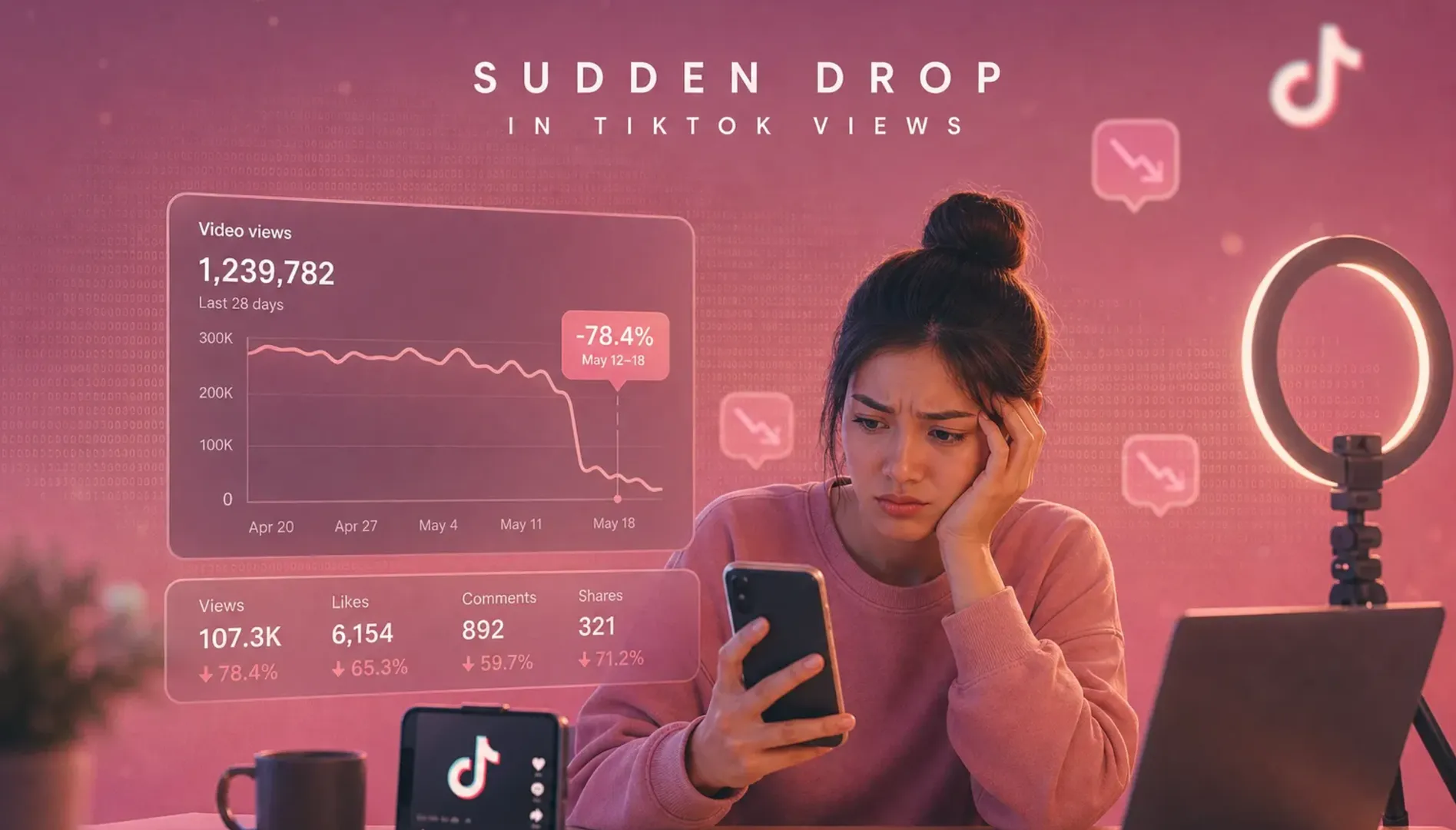
When your TikTok views suddenly drop, the cause is almost always one of three things: a normal swing in how TikTok distributes your video, a dip in engagement quality that the algorithm acted on before you noticed, or, least often, a flag on a specific post. At Virlo we analyze thousands of videos across hundreds of niches every day, and those three account for nearly every drop we see. In this post I am going to share everything from this information to help you understand Tiktok views drops. And we will also dig into how to diagnose and fix these problems.
Often times views dip that would have corrected on its own turns into a real problem because the creator panicked and changed everything, deleted posts, switched niches, tripled their upload rate, when the actual cause needed one small adjustment or none at all. So the order matters. Diagnose first, act second. The diagnosis takes about two minutes.
TL;DR: A sudden TikTok view drop is almost always one of three things, and rarely the shadowban people fear. Most often it is normal distribution variance after an outlier video, next most often an engagement dip like weak hooks or content fatigue, and least often a flag on a specific post. The fastest way to tell which is yours is your traffic source breakdown is if it still looks mixed, you have a fixable performance issue; if nearly everything comes from "Personal profile," a restriction is possible. Diagnose before you change anything, correct the single cause that is actually yours, and judge the result on your 30-day median rather than your best week. Most drops recover within one to two weeks of steady posting.
Let's get into the actual problem and diagnosis.
The 2-minute Views Drop Diagnosis
When your views crater, the instinct is to start fixing everything at once. Resist it for two minutes, because almost every drop leaves a distinct signature in your analytics, and that signature is what tells you which fix you actually need. A shadowban and a slow content-fatigue slide look nothing alike once you know where to look, and the wrong response to either one usually makes it worse.
This system will help you quickly understand what can potentially be wrong with your recent videos. Match your symptom to the branch below, then jump to that section. You can simply look at every point and compare your video against it to analyse better
Views at absolute zero on new posts. Not low. Zero. This is almost always a content flag holding the video in review, not the algorithm deciding it dislikes you. Go to cause 5.
Every post stuck around 200 to 400 views. You are watching the follower test pool, and your videos are not clearing it. Go to cause 2.
Hashtags and search no longer surface you, and your analytics show traffic coming almost entirely from "Personal profile." This is the one pattern where a restriction is genuinely worth considering. Go to the shadowban section.
Views down 30 to 70 percent, but your traffic sources still look mixed and normal. The most common case by far. A distribution swing or the start of content fatigue. Go to causes 1, 3, and 4.
A slow slide over several weeks rather than an overnight cliff. That shape is not a penalty. It is fatigue or niche drift. Go to causes 4 and 7.
Notice that the deciding clue in almost every branch is your traffic source breakdown. That single screen separates a penalty from a performance problem faster than any other signal, which is why it is worth understanding what those sources actually mean before you go further.
How TikTok decides who sees your video
You cannot diagnose a drop without a working model of the machine, so here is the version that matters, stripped to essentials.
TikTok shows every video to a small pool first, weighted toward your own followers, and watches how that pool responds. If the response clears a bar, the video is pushed to a larger, broader pool, and the test repeats. This is why reach on TikTok is nonlinear and lumpy rather than smooth. A video does not "get" a number of views, it earns its way through a series of gates, and it stops the moment a gate rejects it.
What the gates measure changed over the last two years, and the change explains most modern drops. Raw view count stopped being the signal that matters. Now the system leans hardest on watch time per impression and completion rate, how much of the video people actually watch, followed by the actions that signal real value: saves, and shares sent in DMs, which are weighted well above likes because a share is someone spending social capital on your behalf. Comments sit above likes too. Layered on top is relevance, because TikTok now works like a search engine, reading your caption, on-screen text, and spoken audio to decide which audiences a video belongs in front of.
Hold that model in your head and every cause below stops feeling mysterious. A drop is almost always a gate you stopped clearing, or a relevance signal that changed. Let us find yours.
Is it a shadowban? This is how you find out
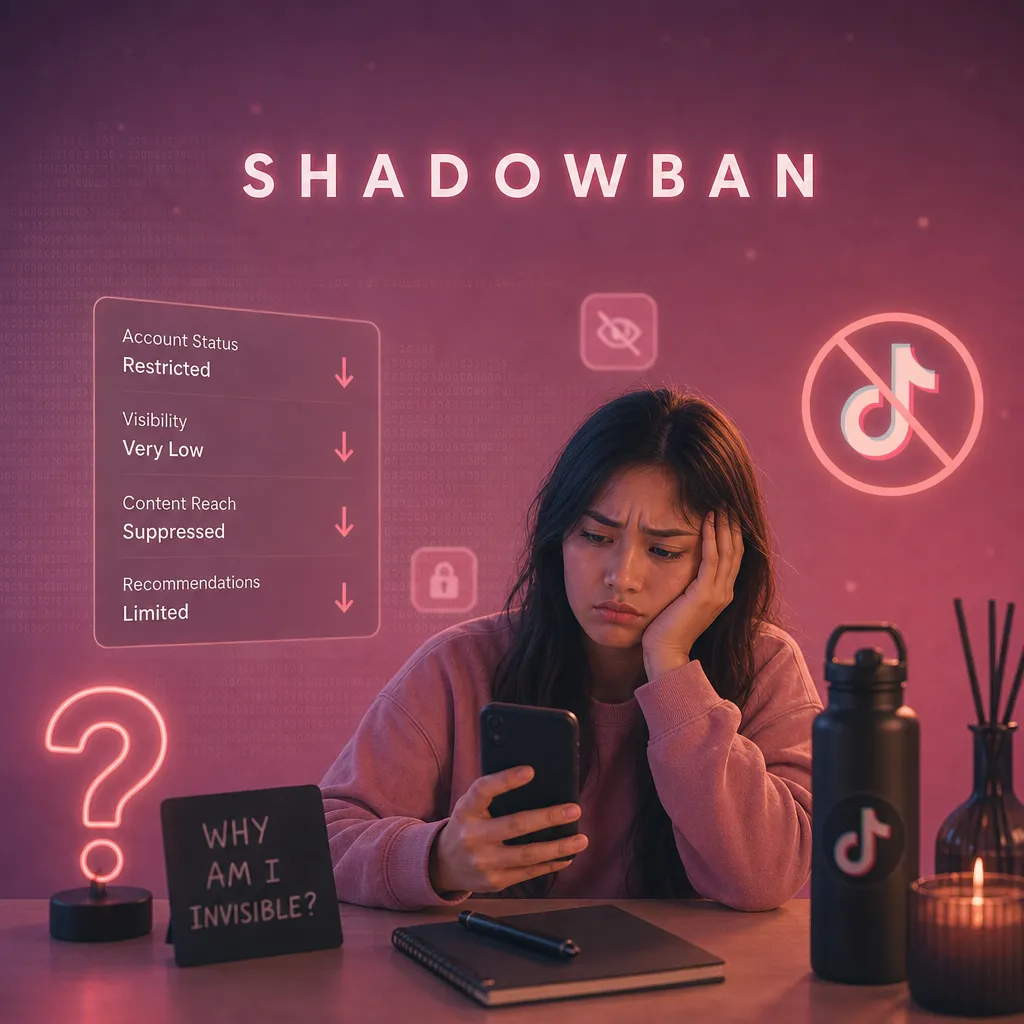
This is the word every creator reaches for first, so it deserves a precise answer rather than a reassuring one.
A shadowban, in the sense people mean, is TikTok quietly reducing a video's or an account's distribution without telling you and without a formal strike. TikTok does not officially acknowledge the term, which has a real consequence for you: every duration and rule you will read about it anywhere is community observation, not published policy. Treat confident numbers with suspicion.
What can be observed consistently are the signals, and they cluster. A genuine restriction tends to show engagement collapsing by 80 to 90 percent rather than dipping by a third, hashtags that stop surfacing your content when you search them, videos absent from the For You feed entirely, and, most tellingly, an analytics traffic breakdown where nearly everything comes from "Personal profile" and almost nothing from "For You." That last signal is the meaningful one, because it means the system has stopped pushing you outward and you are only being seen by people who went looking for you.
If those signs appear together, the commonly reported pattern is that minor, first-time cases ease within a few days to two weeks, while repeat or serious violations run longer. The response that actually helps is unglamorous. Read your recent posts honestly against TikTok's Community Guidelines, remove or appeal anything that sits in a gray area, stop posting for two or three days so you are not feeding a system that is already scrutinizing you, and return with clean, niche-consistent content that gives it easy signals to re-trust.
If those signs do not appear together, you are not shadowbanned. You have a performance issue. That is genuinely better news than it feels like, because performance issues are specific and fixable, and there are nine common ones.
The 9 real causes behind views drop to fix
1. Normal distribution variance
Start here, because this is the drop that is not a drop. TikTok's gated distribution is spiky by design, and the spikes compound. A single video that clears every gate can reach thirty or forty times your usual numbers, and it does not raise your account's floor when it does. The next video starts the test over from the same baseline as always. When you compare that ordinary next video against the memory of your outlier, it reads as a collapse, even though nothing regressed.
The trap is emotional more than analytical. Your best week rewires your expectations, and then every normal week feels like failure. The fix, then, is not a content change at all. It is a measurement change. Judge your account on a rolling 30-day median, the middle value of your recent posts, not the average and definitely not the peak. If that median is holding steady, the drop you are staring at is noise, and the correct action is to keep posting exactly as you were.
2. You are failing the follower test pool
When every post lands at a similar low ceiling, somewhere in the low hundreds, you are not failing everywhere at once. You are failing the first gate. TikTok now shows new videos to a slice of your existing followers before anyone else, and their reaction decides whether the video advances. If that slice scrolls past, distribution stops there, and the pattern repeats post after post because the same weak signal keeps hitting the same first gate.
There is a subtlety here that catches experienced creators. Your own followers are a harder audience than strangers, not an easier one. They have seen your openings before, so familiarity raises their skip rate, and a hook that would stop a new viewer gets swiped by someone who thinks they already know where it is going. The fix is to design for that. Open with something that breaks your own pattern, post when your followers are actually online rather than when it suits you, and check the "Following" versus "For You" split in your analytics so you can see the gate you are failing rather than guess at it.
3. Weak first seconds
Completion rate and watch time per impression are the heaviest signals in the system, and both are decided almost entirely in the opening moment. If viewers leave in the first two or three seconds, the algorithm never gets to learn whether the rest of your video was worth showing, because nobody stayed long enough to generate that data. A weak open does not just lose those viewers. It starves the system of the evidence it needs to push you wider.
So before you touch anything else, rework the start. Lead with the payoff or the tension, not a warm-up, a logo, or a slow "hey guys." The hook is not only your first line of speech, it is the whole first frame working together: the visual, the motion, the on-screen text, and the sound landing in the same instant. When we break down videos that overperform their baseline, the pattern is boringly consistent. The reason to keep watching is visible or spoken before the viewer's thumb has finished deciding, and the frame looks like a real person shot it on a phone, because native, unpolished footage keeps outperforming content that looks like an ad.
4. Content fatigue
This is the slow drop, and it is easy to miss precisely because it is gradual. Run the same format, angle, and rhythm long enough and your audience habituates to it. Their saves, shares, and rewatches decline quietly, the system reads those falling signals as falling value, and it narrows your distribution to match. You did not get worse at making videos. You got predictable, and predictable is what the algorithm quietly deprioritizes.
The reason fatigue is worth separating from a penalty is that the fix is almost pleasant by comparison. You do not need to overhaul your account or apologize to the algorithm. You need to rotate the shape while keeping the substance. Turn a talking-head explainer into a demonstration, a listicle into a single-story deep dive, a static setup into something with movement. The niche stays fixed so the algorithm never loses track of who you are for, but the pattern breaks, and broken patterns re-earn attention. If your drop arrived as a slide rather than a cliff, this is very likely your cause.
5. A flagged or under-review video
Zero views is a different species from low views, and it calls for a different response. A hard zero almost always means an automated system pulled the upload into review before distributing it, or marked it ineligible for the For You feed entirely. This happens most often in a few situations: a sudden spike in how frequently you are posting, which reads as spam-like behavior, content reposted from elsewhere or still carrying another platform's watermark, which is treated as unoriginal, and topics that brush against sensitive categories, which get held for a closer look.
The move here is patience plus precision, not volume. Open the video and check its status and your notifications, because TikTok often tells you when something is restricted or ineligible. If you believe a flag is wrong, use the in-app appeal, which TikTok's support pages document. What you must not do while a flag resolves is mass-delete old posts or mass-upload new ones. Both look like exactly the erratic behavior that draws more automated scrutiny, and you would be digging while standing in the hole.
6. Your posting rhythm broke
Consistency on TikTok is not a discipline slogan, it is a data supply problem. The system maintains a working model of who responds to you, and that model needs a steady stream of fresh signals to stay warm. Long silences let it go cold, so when you return after two weeks away, your next video is partly re-introducing you to an audience the algorithm had started to forget. Erratic bursts cause a milder version of the same thing, because the signal arrives too unevenly to build on.
The fix is a cadence you can actually sustain, which for most creators means three to five posts a week, held steady for at least two weeks before you judge anything. Note the two directions of the mistake, though. The problem is not only posting too little. Posting too much, several times a day, can split your own attention and your audience's across your videos, so each one enters its test pool weaker. Steady beats both frantic and absent.
7. You drifted off-niche
TikTok builds an interest model of your account, a sense of which audiences your content belongs to. Every video refines it. When you post something outside your usual lane, two things go wrong at once: the video reaches people the model picked based on your old topics, who are the wrong audience for this new thing and therefore do not engage, and that weak engagement then feeds back to blur the model itself. So a single off-topic post can underperform and make the next few on-topic posts a little worse while the algorithm re-finds its footing.
The fix is not to never experiment, because that is how you stagnate. It is to experiment inside your lane, where new angles still reach an audience primed for you, or to accept a clear-eyed temporary dip as the price of a genuine pivot you have decided to make. The behavior that quietly caps a lot of accounts is neither of those. It is bouncing between unrelated niches week to week, chasing whatever feels fun that day, so the model never stabilizes long enough to push anything far.
8. The trend moved and your format did not
This is the cause you cannot see from inside your own account, which is exactly why it catches good creators off guard. Formats, sounds, and angles have lifecycles. A format that carried you for two months reaches saturation, the audience's appetite for it fades, distribution starts favoring the fresher patterns replacing it, and your numbers slide even though your execution never changed. Nothing you did got worse. The ground moved under a video that stood still.
Because the change is external, no amount of staring at your own analytics will reveal it. The only way to catch it is to watch the niche itself: which formats are rising, which are peaking, which are quietly on the way down, and which sounds are still accelerating versus already stale. Study what is genuinely working in your space before you produce your next batch, and treat every format you rely on as having a shelf life you should be actively watching. Our guide on finding trending content before it peaks walks through how to do that systematically instead of by feel.
9. Low resolution, muddy audio, or no captions
This one is unglamorous, but it is measurable, which is more than you can say for most view-drop theories. TikTok treats production quality as a rough proxy for whether a video deserves a wider audience, and viewers confirm that judgment with their thumbs the instant something looks or sounds cheap. Two numbers make the point. Roughly a third of people watch with the sound off, so a video without captions loses that share in silence, and low-resolution uploads get swiped away faster in the opening seconds, which feeds straight back into the completion signal from the primer above. A quality problem is really a retention problem wearing a different costume.
The fix is one-time hygiene rather than ongoing effort. Export at 1080p or higher, light your face so the frame is not murky, capture clean audio, and burn captions into every video, not only for the reach but because they hold the muted third of your audience long enough to register as a view that counts. Good production does not make a weak idea travel. Poor production quietly caps a strong one, which is the version of this that costs you.
Catch the next drop the day it starts
The costly part of a view drop is rarely the drop itself. It is the lag. Most creators notice three or four days in, after a run of posts has already underperformed, and then try to diagnose backward from memory of numbers they half-remember. By then the small correction has become a bigger one.
This is a tracking problem, and tracking problems are solvable. Virlo's Tracking Center takes daily snapshots of your account and the creators you compete with, and flags any video that falls outside your own baseline in either direction. During a drop, that answers the two questions that actually decide your response: did this start with me or with the whole niche, and which specific video started it. With those two answers in hand, the diagnosis above takes minutes rather than a week of second-guessing, and you act while the problem is still small.
Frequently asked questions
Why did my TikTok views suddenly drop?
Usually one of three things: a normal distribution swing after an outlier video, an engagement-quality dip such as weaker hooks or content fatigue, or, least often, a content flag on a specific post. Check your traffic sources first. If they still look mixed and normal, it is a performance issue, not a penalty.
Why are my TikTok views stuck at 200?
You are seeing the follower test pool. TikTok shows new videos to a slice of your followers first, and if they do not engage, distribution stops there before reaching the For You feed. Strengthen your openings and post when your followers are actually online to clear that first gate.
Why am I getting 0 views on TikTok?
A hard zero almost always means the video was flagged by an automated system and is under review, or marked ineligible for the For You feed. This is common after a sudden jump in posting frequency, reposted or watermarked content, or sensitive topics. Check the video's status and appeal if the flag looks wrong.
How do I know if I am shadowbanned on TikTok?
Look for the signals together, not in isolation: engagement down 80 to 90 percent, hashtags no longer surfacing your content, absence from the For You feed, and traffic coming almost entirely from "Personal profile." TikTok does not confirm shadowbans, so treat any specific duration you read as a community estimate.
How long does a TikTok view drop last?
A normal distribution swing corrects within days to a couple of weeks if you keep posting consistently. Community-observed estimates for minor restriction cases run a few days to two weeks. Slow declines from fatigue or niche drift last until you change the underlying cause, since there is no timer to wait out.
Do TikTok views drop when you post too much?
Volume by itself is not the problem, but sudden spikes in posting frequency correlate with automated flags, and rushed content usually means weaker hooks. Posting several times a day can also split your own audience across videos. A steady, sustainable cadence outperforms both bursts and gaps.
Why are my followers not seeing my videos?
Followers see your content when the early test pool engages enough to widen distribution. If recent videos underperformed with that first pool, reach to the broader follower base shrinks. Rebuild it with stronger openings, familiar on-topic content, and posting at your audience's active hours.
Why did my views drop after going viral?
Because the viral video was the outlier, not a new baseline. Distribution expands nonlinearly for one video without permanently raising your account's floor, so the return to normal only feels like a fall. Judge the account on its 30-day median and treat the spike as proof of what can work, not a level you lost.
Do reposted or watermarked videos get fewer views?
Yes. TikTok treats content that is unoriginal or carries another platform's watermark as lower quality and often makes it ineligible for the For You feed, which can look like a sudden drop. Post natively, remove watermarks, and lead with original footage.
Does deleting videos hurt your TikTok views?
Deleting one underperformer will not sink your account, but mass-deleting reads as erratic behavior to a system that watches for it, and it removes videos that may still be pulling steady search traffic. Archive if you must, and put the energy into your next post instead.
The short version
Diagnose before you change anything, because the wrong fix does more damage than the drop. Zero views means a flag. A hard ceiling around 200 means the follower test pool. Broad shadowban signals appearing together mean a restriction worth waiting out. Everything else is performance, and performance breaks down into variance, weak hooks, fatigue, broken rhythm, niche drift, low production quality, or a trend that moved without you. Each has a specific cause and a specific fix, and not one of them rewards panic.
Run the two-minute diagnosis, correct the single cause that is actually yours, and measure the result against your 30-day median rather than your best week. And if you would rather see the next dip on day one than discover it on day four, put your account on tracking and let your baseline watch itself while you make the next video.
See What's Trending Right Now
- Social listening for TikTok, Reels & Shorts
- Spot viral trends before they peak
- Turn insights into ads, scripts & briefs
The Signal Newsletter
Weekly trend breakdowns, creator insights, and social listening tips — straight to your inbox.
Subscribe FreeSee Virlo in action
See What's Trending Right Now
- Social listening for TikTok, Reels & Shorts
- Spot viral trends before they peak
- Turn insights into ads, scripts & briefs
The Signal Newsletter
Weekly trend breakdowns, creator insights, and social listening tips — straight to your inbox.
Subscribe FreePut this into practice with Virlo
Turn what you just read into real research. These are the tools creators, agencies, and brands use to find what's working on short-form video.
Content Research Agent
Run your short-form research on autopilot — outliers, creators, and sounds across TikTok, Reels, and Shorts.
Tracking Center
Monitor breakout creators, videos, and competitors with daily snapshots and deep AI analysis.
Free Data
Explore free viral hooks, trending niches, breakout products, and more — no account required.
Get The Signal
Join creators, marketers, and agencies getting weekly trend breakdowns and social listening insights delivered free.
Subscribe to the Newsletter
Stop Guessing. Start Knowing.
Join thousands of digital entrepreneurs using data to take the guesswork out of capitalizing on trends.