8 short-form Video Script Frameworks to make people watch to the End
there is a method to write a short form video script. Here is precise system and with templates to help you before you pick up your camera and turn on the face lights.

Himanshu Bisht
Professional Blog Writer
Himanshu Bisht is a digital community and content expert. With the strategies he shares, companies and creators have generated over 10 million dollars in combined sales. His views have been featured in the magazines like Forbes and Authority Magazine. Himanshu writes expert articles for creators on Virlo AI.
Short-form video and YouTube reward anyone who can hold attention. A creator with a phone and no budget can outperform a studio, as long as people keep watching.
And viewers decide fast. On TikTok, Reels and Shorts, they judge a video in the time it takes to say a sentence. On YouTube, the first real test comes at the 30-second mark.
If you have tried writing a short form video script, read it to the camera, and heard yourself sound like a school essay, you are not alone. There is more to a viral Tiktok or an Instagram reel than just hitting record. And today is the day to discover that...
So what actually goes on the page to keep people watching from the first word to the last?
Virality is engineered and not just waited upon. Most people assume just by making lots of videos it will work for them. But is it true? Stats say otherwise.
Virlo tracks more than 2.4 million hooks from real videos. I went through that data, along with TikTok's ad creative research and YouTube's retention reports, to see which openings and structures hold viewers.
I will get to the tools and frameworks but before that, let's get into the key of virality that most new creators miss on YouTube or Tiktok.
Virality begins with Discomfort
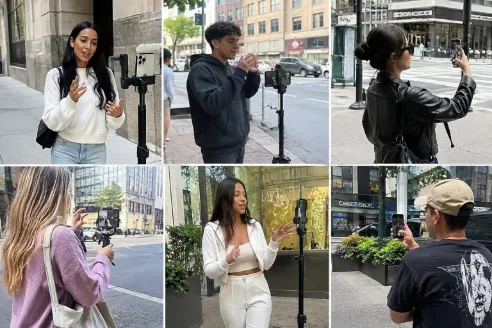
Every script needs a promise written for you, not for the viewer. It's one line: "By the end, the viewer will know, feel or be able to ___."
That line decides what gets cut. A 60-second video can deliver one promise well. Three promises in 60 seconds usually means none of them land.
The title and the first frame come next, before the script itself. On YouTube, the title and thumbnail set the viewer's expectations before they press play.
TikTok and Reels work differently, because the video autoplays in the feed. There, the first frame, its on-screen text and the first spoken line carry the promise. The cover only matters later, on your profile grid and in search.
Whichever platform it is, the opening has to deliver what that promise said. A video that doesn't feels like a bait-and-switch. Viewers leave to find one that does.
The First Three Seconds decide the rest
What earns a viewer's second sentence? Usually, it's a first line that tells them exactly what they're watching.
TikTok's creative research found that more than 63% of its highest click-through ads put the key message or product in the first three seconds. Those are ads, yet the pattern is a reasonable guide for organic posts too.
A hook works because of how curiosity works. In 1994, the psychologist George Loewenstein described curiosity as a reaction to a gap in what you know. Seeing the edge of a gap makes people want it closed.
So the hook opens a gap. The next few seconds start closing it with something real: the result, the product, the first tip. Then the script keeps a smaller gap open until the end.
The power of Hooks
Hooks are essential for making a short form video work. And it is integral part of writing a great script. Virlo's hook library records how often each type of hook produces an outlier, a video that far outperforms the creator's usual numbers. Across all types, about 21.5% of videos become outliers.
The most common openings land below that line:
How-to and bold-claim hooks make up 40% of all hooks tracked but become outliers only about 19% of the time.
Question and story hooks sit near average, at 22%.
Relatable and comparison hooks reach 27%.
Shock hooks reach 27.8%, while POV and cliffhanger hooks come in at about 30%.
Crowding is one likely reason. A how-to opening looks like hundreds of others in the same feed, while a POV line drops the viewer straight into a scene.
A how-to video can still win. It often does better when it opens with a mistake, a result or a scene, then gets to the "here's how."
Sound on, sound off: the hook has to work both ways
TikTok describes itself as a sound-on platform, so most people do hear the first line. The hook still belongs on screen as text too.
On-screen text gives the hook a second chance. It catches people skimming the feed with their eyes before their ears, and anyone who happens to be watching muted. It also makes the first frame readable as a still, which helps on profile grids and in search results.
Six openings from the types that win most
Each of these fill-in lines comes from a hook type with an above-average outlier rate. Each one works with your niche swapped in:
POV: "POV: you just [moment your viewer knows too well]." Best for relatable niches, where the viewer is the main character.
Shock or result: "This [thing] did [unexpected result] in [short time]." Best when the result can be shown in the first frame.
Comparison: "[Option A] vs [option B]: one of them is wasting your [money or time]." Best for products, tools and buying decisions.
Relatable: "If you've ever [small, specific frustration], this is for you." Best for everyday problems with an easy fix.
Before and after: "Before: [state]. After: [result]. One change did it." Best for makeovers, edits and transformations.
Cliffhanger: "I didn't expect what happened when I [action]..." Best for stories and experiments.
Virlo's hook generator turns a topic into dozens of lines in these shapes. The hook-type check in the audit below helps pick between them.
How many words fit in 60 seconds?
A first draft for a 60-second video usually runs long. A comfortable on-camera pace is roughly 130 to 150 words a minute, a little slower with pauses and demonstrations.
Your own rate is easy to measure. Reading a 150-word paragraph to the camera and timing it gives the answer: 150 divided by the minutes it took. That number sets every budget below.
At 130 to 150 words a minute:
15 seconds: about 35 words
30 seconds: about 65 to 75 words
60 seconds: about 130 to 150 words
90 seconds: about 195 to 225 words
2 minutes: about 260 to 300 words
3 minutes, now the longest a YouTube Short can run: about 390 to 450 words
5 minutes: about 650 to 750 words
10 minutes: about 1,300 to 1,500 words
15 minutes: about 1,950 to 2,250 words
A tutorial with long, silent demonstrations can run well under budget, while a fast talker fits more. Either way, the count tells you early whether the script is a Short or a long video in disguise.
Why a good sentence on paper fails out loud
A viewer hears each sentence once, at the speed of the speaker, with no way to glance back at the start of it.
That changes how you build each line. Each sentence carries one idea. Contractions stay in, because people say "don't" and not "do not." Names and numbers go early in a sentence, where the ear catches them.
The breath sets the length. If a sentence can't be said comfortably in one breath, you split it. On paper, that usually means 20 words or fewer.
Eight video script frameworks and where each one wins
A framework is a running order for the beats after the hook, so the script never has to decide what comes next. The goal of the video picks the framework:
Teaching a skill: the Tutorial, or the Ranked List when the items are separate tips.
Fixing a pain or selling a product: Problem-Agitate-Solve.
Showing a transformation: Before-After-Bridge.
Telling what happened: the But/Therefore story under a minute, the Story Circle for longer videos.
Making people laugh or nod: the POV scene.
Explaining something over many minutes: the YouTube retention structure.
These work again and again and have been popular since pre-Tiktok era. However, there are some new ones as well. Let's look into each one of these.
1. The Tutorial (Result-Steps-Mistake)
How-to is the most common hook type, and also one of the least likely to break out. The Tutorial fixes that by opening on the finished result instead of the promise to explain.
After the result come the steps, one per line. Then comes the one mistake that ruins it, often the most useful line in the video. A one-line recap closes it.
Template Result: [the finished thing, on screen in the first frame] Steps: "One: [step]. Two: [step]. Three: [step]." Mistake: "The mistake is [common error]. That's where [bad result] comes from." Recap: [the result again, in one line]
Example (cold brew, about 20 seconds) [Glass of cold brew on screen] "Cold brew that isn't bitter. One: grind coarse, like breadcrumbs. Two: one part coffee to eight parts cold water. Three: 12 to 16 hours in the fridge. The mistake is leaving it two days to be safe. That's where the bitterness comes from."
Once viewers have seen the result, every step becomes skippable. So each step needs a visible change on screen, or the viewer jumps to the end.
2. Problem-Agitate-Solve
Problem-Agitate-Solve is one of copywriting's oldest structures, built for anything that fixes a pain the viewer already feels. The script names the problem, makes it sting with a cost the viewer recognizes, then gives the fix.
Template Problem: "If you [specific frustration]..." Agitate: "...it's costing you [time, money or result], and [what makes it worse]." Solve: "Here's the fix: [steps]." Close: [result, or a reason to follow]
Example (home office, about 30 seconds) "If your back hurts by 3 p.m., it's probably not the chair. It's the screen. When it sits too low, you lean in for eight hours without noticing. That's what turns a stiff neck at three into a headache by six. Raise the top of the screen to eye level, an arm's length away. A stack of books works. Try it tomorrow and check in at three."
Too much agitation reads as fear-mongering, so the middle beat stays short.
AIDA (attention, interest, desire, action) is the ad world's cousin of this structure. In a 30-second script, Problem-Agitate-Solve is tighter, because the agitate beat does the work of "desire" in fewer words.
3. Before-After-Bridge
Why show the result first in a transformation video? The after is the hook. Holding it back turns the video into a slow reveal, which only works when the reveal itself is the payoff.
Before-After-Bridge shows the before, cuts to the after within seconds, then explains the bridge: what changed between the two. It fits makeovers, progress videos and UGC product videos.
Template Before: [the state the viewer is in now, shown] After: [the result, shown within seconds] Bridge: "Here's what changed: [method, product or steps]."
Example (UGC, about 15 seconds) [Shot of a cluttered entryway] "This was our hallway every single morning." [Cut to a clean wall with hooks and a shoe rack] "This is it now." "Two things did it: a $30 rail with six hooks, and a rule that shoes go on the rack before anyone takes their coat off."
The bridge has to be specific. "I just used this product" gives the viewer nothing to copy, while a specific change gives them a reason to save the video.
4. The Ranked List
Three tips, five mistakes, two tools: lists are everywhere in short-form. The list suits anything with separate, parallel items. It also lets the viewer know how far through they are.
Item order does most of the work. The second-best item goes first, so the first payoff is strong. The weakest sits in the middle. The best comes last, flagged early so viewers have a reason to wait for it.
Template Hook: "[Number] [things] that [result], and the last one [matters most]." Second-best item: [tip + one-line proof] Middle items: [tip + one-line proof] Best item: "And the one that matters most: [tip + proof]."
Example (personal finance, about 25 seconds) "Three subscriptions people forget they're paying for, and the last one costs the most. One: the free trial that turned into an annual plan. Your phone's subscription list shows it. Two: cloud storage you upgraded once. Check whether you're using even half of it. And three: the gym you stopped going to in March."
Each item needs its own proof or action. Without one, viewers tend to swipe after item one.
5. The But/Therefore story
Trey Parker and Matt Stone, the creators of South Park, described a simple storytelling test in a 2011 NYU class. When the beats of a story connect with "and then," the story is dull. When they connect with "but" or "therefore," it moves.
That test turns any personal story into a short script. Each beat either complicates the last one (but) or follows from it (therefore).
Template Setup: [what you wanted] But: [what got in the way] Therefore: [what you did about it] But: [the twist or second problem] Therefore: [the outcome or lesson]
Example (small business, about 25 seconds) "I opened a café on a street with three other cafés. But nobody walked past ours, because we were at the quiet end. So I put a chalkboard outside with a new joke every morning. But the jokes were bad. So people started stopping to tell me how bad they were. Half of them came in for a coffee."
A story needs stakes. Without something the teller wants and might not get, "but" and "therefore" turn into a list of events.
6. The POV scene
A POV script drops the viewer into a moment, usually in the second person or acted out. POV hooks have one of the highest outlier rates in the same hook data.
The scene is the whole script. It needs one situation, a few lines of dialogue or reaction, and a turn at the end.
Template On-screen text: "POV: [a specific situation the audience lives through]" Beat 1: [the familiar part] Beat 2: [the escalation] Turn: [the punchline, reveal or product]
Example (barista, about 15 seconds) On screen: "POV: it's 7:58 and your regular walks in" [Already making the drink before they reach the counter] [They open their mouth to order] [Slide the cup across without a word]
The situation has to be narrow enough to feel personal. "POV: you're a student" is too broad. "POV: the group project is due at midnight and you're the only one online" is a scene.
POV entertains well and teaches badly. It rarely carries a how-to on its own.
Ending any Short on a loop
Any of the six short-form frameworks can end on a loop. The final line flows straight back into the hook, so the video seems to restart without a break.
Since March 31, 2025, YouTube counts every replay of a Short as a view. A loop now shows up directly in the view count.
Example (cooking) Hook: "This is why your rice is always sticky." Ending: "Rinse, less water, ten minutes off the heat. Skip any one of those, and now you know..." [cuts back to the hook]
A loop needs a hook that also works as the second half of a sentence. Forcing one onto a topic that doesn't have it makes the ending sound odd.
7. The YouTube retention structure
A YouTube script works under different pressure. The viewer chose the video from a title and thumbnail, so the script has to prove that choice right quickly, then keep giving reasons to stay.
YouTube's analytics treat the first 30 seconds as the intro and report how many viewers are still watching after it. MrBeast's production memo calls the first minute "the most important minute of each video." It also describes a re-engagement, a new turn that fits the story, around minute three and again around minute six.
Both put the weight on the opening. The structure below builds on that:
Hook (first 15 seconds). Restate the title's promise and show a piece of the payoff.
Set the gap (by 30 seconds). Say what most people assume, then hint that the answer is different.
Second-best point first. The first section has to feel like the video is already delivering.
Points as small loops. Each section covers what it is, how to do it and why it matters, then opens the next question.
Re-hooks near minutes three and six. A new question, a reveal or a raised stake.
Strongest point just past halfway. Late enough to reward the people who stayed, early enough that a good share of viewers still reach it.
One call to action. Tied to the problem the video just solved, with no wrap-up. His team's rule is never to signal the end, unless it builds hype for the payoff.
Template (10 minutes at 140 words a minute, about 1,400 words) 0:00 Hook: promise + preview of the payoff (40 words) 0:17 Gap: the common belief, and why it's incomplete (40 words) 0:34 Point 2 (second-best): what, how, why (300 words) 2:43 Re-hook: new question or reveal (50 words) 3:04 Point 3: what, how, why (300 words) 5:13 Point 1 (strongest), with a second re-hook near 6:00: what, how, why (400 words) 8:04 Point 4: what, how, why (220 words) 9:39 Call to action tied to the problem (50 words)
This structure can feel engineered. Real examples, your own voice and transitions that sound like conversation keep it from showing.
8. The Story Circle
Dan Harmon, the creator of Community, adapted the hero's journey into eight steps he calls the Story Circle. It suits vlogs, documentaries, challenges and any video where something changes over time.
The eight beats follow one character. They start in a comfort zone, want something and enter an unfamiliar situation. They adapt, get what they wanted and pay a price for it. Then they return to where they started, changed.
Template
You: [who you are, where things stand]
Need: [what you want or have to do]
Go: [the start of the attempt]
Search: [the struggle, mistakes, first results]
Find: [the breakthrough]
Take: [what it cost]
Return: [back to normal life]
Change: [what's different now, for you and the viewer]
Example (a 30-day challenge video) A creator who has never cooked (1) decides to cook every meal for 30 days (2) and does the first big grocery run (3). Week one is a run of takeout-level disasters (4). By week three, a handful of recipes work every time (5). The price was bigger grocery bills and two hours a day (6). Back on a normal schedule (7), the creator keeps four home-cooked meals a week and shows the viewer exactly which ones (8).
Beats 6 and 8 are the easiest to drop. Without a cost, the story feels like an ad. Without a change, the viewer has nothing to take away.
Video script format: what goes in the second column
A video script is two scripts at once: what's said and what's seen. Writing only the words leaves the edit to chance.
How you film decides the format:
Bullet outline. Key lines and beats instead of full sentences. Confident talkers who sound stiff reading do best with this, especially in talking-head videos.
Full script. Every word written out. Voiceovers, faceless videos, tutorials and teleprompter reads need it.
Two-column (A/V) script. Audio paired with visuals, line by line. Anything with B-roll, product shots or screen recordings belongs here.
In a two-column script, every spoken line has a visual partner:
AUDIO: "Your best moment is buried at the end." VISUAL: Timeline on screen, playhead jumps to the last 10 seconds.
AUDIO: "Move it to the start." VISUAL: Clip dragged to the front. Text: "best moment first"
The visual column is also where pattern interrupts live. A pattern interrupt is any change that resets attention: a cut, a zoom, a graphic, a new location, a question to camera. Long stretches of one shot and one voice are where viewers drift.
The same TikTok research found that 40% of its top ads by view-through rate use text overlays. A third of those top ads break the fourth wall, with the creator speaking or reacting straight to the viewer. Both are cheap to plan in a script and hard to add in the edit.
A master template to copy
Promise: By the end, the viewer will [know, feel or be able to ___]. Title or first-frame text: [the promise, in under 8 words] Target length: [seconds or minutes] = [words] at [your words per minute] Framework: [one of the eight]
AUDIO: [hook, line 1] VISUAL: [first frame + hook as on-screen text]
AUDIO: [beat 1] VISUAL: [cue]
AUDIO: [beat 2] VISUAL: [cue]
AUDIO: [beat 3 or payoff] VISUAL: [cue]
AUDIO: [one call to action, or the loop line] VISUAL: [final frame]
One idea, two scripts
"Three editing mistakes that are killing your views" works as a 30-second Short and as a 10-minute YouTube video. The promise stays the same. Almost everything else changes.
As a 30-second Short (Ranked List with a loop, about 60 words)
[Text: "3 edits killing your views"] "If people swipe before your second sentence, it's probably one of these three edits. [Cut] One: cut the first breath. Start on the word that matters, not 'hey guys.' [Zoom] Two: something on screen should change every few seconds. [Text: "the big one"] And three, the one that hurts: your best moment is at the end. Move it to the start. So the next time you're wondering why..."
The hook is relatable rather than a bold claim, since bold claims break out less often. The best item comes last, flagged as "the one that hurts," so viewers wait for it. The final line loops back into the hook, which completes it.
As a 10-minute YouTube video (outline for about 1,400 words)
Hook: "These three edits show up in almost every video that stalls under a thousand views. You'll see all three fixed on real timelines in the next ten minutes." Gap: "Most creators think views come down to the idea. The idea matters. Editing decides whether anyone sees it." Point (second-best): dead air at the start. A timeline cut live, with the first five seconds compared before and after. Re-hook (about minute three): "The next one is the edit I see most often. It's also the hardest to spot in your own videos." Point: the static shot. Where viewers drift, then cuts, zooms and text added. Strongest point (just past halfway): the buried best moment. A real video restructured on screen, with a second re-hook near minute six as the new version plays. Point 4: captions that cover faces and products. Quick before-and-after examples. Call to action: "Open your last video and find your best moment. If it's after the halfway mark, that's your next edit."
Both versions keep the same promise and the same three core fixes. The Short delivers the fixes. The long video proves them and adds a fourth, which is what earns the extra nine and a half minutes.
Will it hold? 13 checks before you hit record
Most script problems are cheaper to fix on the page than in the edit. The checks run in four passes, each with a pass rule and a fix.
Promise pass
The promise test. Pass: the viewer's takeaway fits in one sentence. Fix: cut topics until one remains.
The match test. Pass: the first line delivers what the title, thumbnail or first-frame text promised. Fix: rewrite the hook to echo that promise.
The cold-read test. Pass: someone who hears only the first 15 seconds can say what the video is about. Fix: rewrite the opening until their answer matches your promise.
Opening pass
The first-line test. Pass: the hook is line one, and it appears as text in the first frame. Fix: delete greetings, names and "so today," and add the text.
The hook-type check. Pass: the hook was chosen against at least one alternative. Fix: if the opener is a how-to or bold claim, write one POV, result, comparison or relatable version, then pick with the cold-read test.
The payoff timer. Pass: in a Short, the first proof starts by about word 12, roughly five seconds in. In a long video, something real is delivered by about word 70, the 30-second mark. Fix: move the first payoff up.
Pace pass
The timed read. Pass: when you read it aloud on camera, the script lands within 10% of the target length with no stumbles. Fix: cut whole sentences rather than trimming words, and rewrite every line you stumbled on.
The breath limit. Pass: no spoken sentence runs over 20 words. Fix: split it.
Structure and screen pass
The delete test. Pass: removing any single line loses something. Fix: delete the lines that lose nothing.
The "and then" test (stories only). Pass: beats connect with "but" or "therefore." Fix: where they connect with "and then," add a complication or a consequence.
The loose-ends test. Pass: every question the script raises is answered, and the ending has exactly one call to action with no wrap-up line. Fix: answer or cut open questions, and delete any line that signals the end.
The re-hook test (long videos only). Pass: a new turn, reveal or question lands near minute three and again near minute six. Fix: move a surprising detail or an unanswered question to those points.
The screen test. Pass: a visual cue at least every two or three sentences in a Short, and a pattern interrupt in every section of a long video. Fix: add cues where the screen would sit still.
Checks 1 to 6 decide whether anyone stays past the opening. The rest decide whether they reach the end.
The retention graph is your second editor
The second audit happens after posting and uses the viewers' own behavior. A retention graph shows the share of viewers still watching at each second. You can trace each drop back to a line.
YouTube's key moments report, as defined in its Help Center, marks these:
Intro: the share still watching after the 30-second mark. A low number points at the opening: a hook that doesn't match the title, or proof that arrives too late.
Dips: moments where viewers abandon or skip. Each one marks a line or section to cut or rework.
Spikes: moments viewers rewatch or share. That can mean a great moment, or one confusing enough to replay.
Top moments: stretches where almost nobody left. When they come late, that material belongs earlier next time.
The report appears for videos at least 60 seconds long with at least 100 views. The data can take a day or two to process.
Shorts need a different first number. YouTube Studio shows "viewed vs. swiped away" for each Short. A low viewed share is a hook problem before anything else. TikTok Studio shows a retention curve, average watch time and the share of viewers who finished. A steep drop in the first two seconds points at the hook, while a steady slide through the middle points at pacing.
Mapping a dip to the script is arithmetic. At 140 words a minute, a dip at 1:30 sits around word 210. Edited videos lose their pauses, though, so the final cut's captions are more exact. A text-based editor such as Descript shows each line with its timestamp, which makes the matching quick.
The line at the dip usually shows the reason: a slow setup, a repeated point or a promise that took too long to pay off.
A simple log turns this into a habit. For each dip, it records the timestamp, the line, the likely cause and the fix. After five videos, any cause that shows up twice becomes a new check in your pre-filming audit.
Can AI write it for you?
AI can write a usable first draft. Left to itself, though, it writes the most typical script for the topic, built from patterns it has seen thousands of times.
A better prompt hands the model real material:
Prompt template Write a [length]-second video script, about [word count] words, using the [framework] structure. Promise: by the end, the viewer will [promise]. Here are three hooks that worked in my niche. Use their shape, not their words: [hook 1], [hook 2], [hook 3]. Here is a transcript of one of my best videos. Match its voice and sentence length: [transcript]. Write spoken lines only, each under 20 words, with a [visual cue] in brackets every two or three lines. Give three hook options before the script.
The draft then goes through the same 13 checks as anything written by hand.
Virlo's content marketing agent does the hook-gathering step for you. It finds outlier videos in your niche and tags each hook by type. Vee, Virlo's copilot, then writes the script in your voice from the hook you pick. If you'd rather not film at all, a script-to-video generator can take the script from there.
FAQ
How long should a YouTube script be?
A YouTube script should run about 130 to 150 words per minute of video, or your own measured rate. That's roughly 650 to 750 words for five minutes and 1,300 to 1,500 for ten. Tutorials with long demonstrations can run shorter.
How many words is a 1-minute or 2-minute video script?
A 1-minute script is about 130 to 150 words at a natural pace. A 2-minute script runs about 260 to 300 words. A 30-second script runs about 65 to 75.
How do you write a script for a YouTube Short?
A YouTube Short script puts the hook in the first line and delivers two or three fast payoffs. It often ends with a line that loops back to the start. Shorts can now run up to three minutes, according to YouTube, though many still aim for 30 to 60 seconds. A Short cut from an existing video still needs its own hook line.
How do you write a script for TikTok or Reels?
A TikTok or Reels script follows the same rules as a Short: the hook as line one, spoken and on screen, with proof within about five seconds. The first frame matters more than the cover, because the video autoplays in the feed. Any of the six short-form frameworks fit.
Do YouTubers use scripts?
Many YouTubers use some kind of script, from a bullet outline to a word-for-word teleprompter read. Talking-head creators often work from outlines to sound natural. Voiceover, faceless and tutorial channels usually write every word.
What is the best format for a video script?
The best video script format depends on how you film. Outlines suit confident talkers, full scripts suit voiceovers, and two-column audio-visual scripts suit anything with B-roll or screen recordings.
How do I write a video script with ChatGPT?
ChatGPT can write a usable draft when the prompt gives it four things. Those are your one-sentence promise, a few hooks that worked in your niche, a transcript of your best video, and the framework with a word count. The prompt template above covers all four.
Is there a free video script template?
Yes. The master template in this guide covers the promise, the title line, a word budget and the framework. Below those, it pairs audio and visual lines from hook to call to action. It works for both Shorts and long videos.
How do you start a video script?
A video script starts with the hook, not a greeting. The first line opens a question, shows a result or drops the viewer into a scene. It's spoken and shown as on-screen text within the first one to three seconds.
How do you end a video script?
A video script ends with one call to action tied to the problem the video solved. Long videos skip the wrap-up, because signaling the end tends to give viewers permission to leave. Shorts often end on a loop line instead.
See What's Trending Right Now
- Social listening for TikTok, Reels & Shorts
- Spot viral trends before they peak
- Turn insights into ads, scripts & briefs
The Signal Newsletter
Weekly trend breakdowns, creator insights, and social listening tips — straight to your inbox.
Subscribe FreeSee Virlo in action
See What's Trending Right Now
- Social listening for TikTok, Reels & Shorts
- Spot viral trends before they peak
- Turn insights into ads, scripts & briefs
The Signal Newsletter
Weekly trend breakdowns, creator insights, and social listening tips — straight to your inbox.
Subscribe FreeRelated Articles
How to Find Trends on TikTok Before They Peak (Virlo Setup Guide)
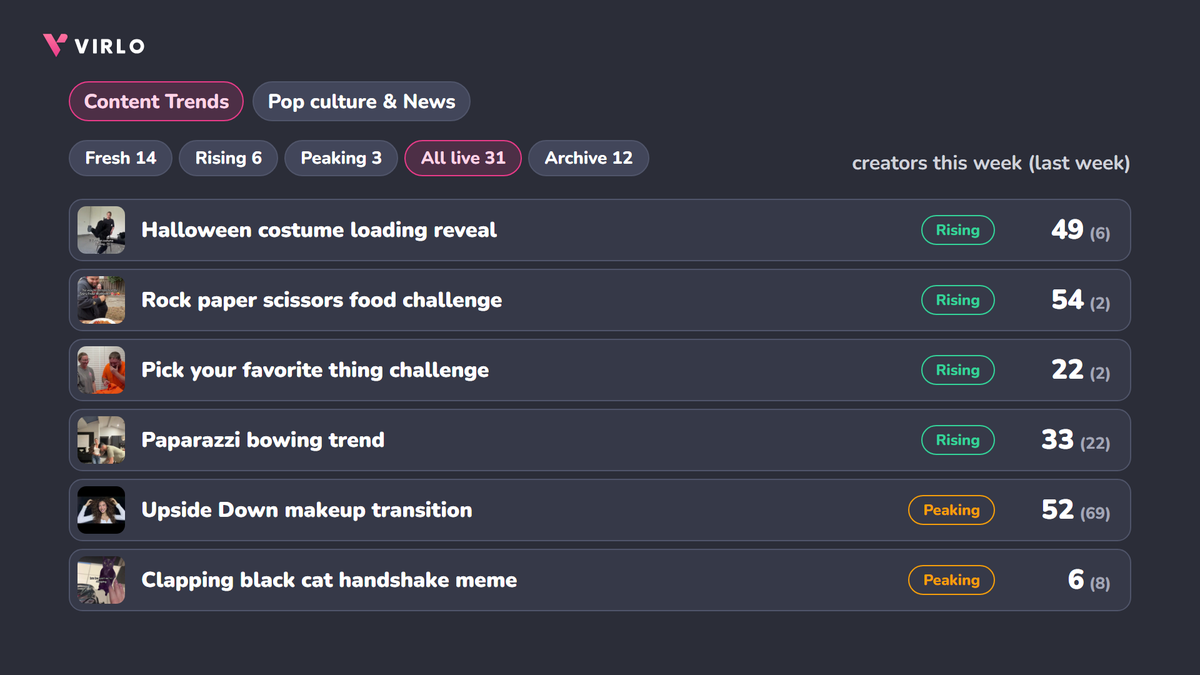
The fastest way to find trends on TikTok is to stop scrolling for them. This guide walks you through Virlo step by step: sign up, open Trends, filter by stage, open a trend for its recipe, and get the best ones by email every week.
How to Make Money on YouTube Without Showing Your Face in 10 Ways
Discover 10 creative ways on how to make money on YouTube without showing your face, perfect for building income while staying behind the scenes.
How to Promote Music on TikTok in 2026: The Sound-First Playbook
TikTok is where songs break. Here's the sound-first playbook for promoting your music on TikTok in 2026 — from finding a trending lane to turning views into streams.
Put this into practice with Virlo
Turn what you just read into real research. These are the tools creators, agencies, and brands use to find what's working on short-form video.
Content Research Agent
Run your short-form research on autopilot — outliers, creators, and sounds across TikTok, Reels, and Shorts.
Tracking Center
Monitor breakout creators, videos, and competitors with daily snapshots and deep AI analysis.
Free Data
Explore free viral hooks, trending niches, breakout products, and more — no account required.
Get The Signal
Join creators, marketers, and agencies getting weekly trend breakdowns and social listening insights delivered free.
Subscribe to the Newsletter
Stop Guessing. Start Knowing.
Join thousands of digital entrepreneurs using data to take the guesswork out of capitalizing on trends.