Ultimate Influencer Rate Card Guide: How Much to Charge for a Sponsored Post (Without Underquoting)
Influencer rates for 2026 by platform and tier, plus a formula to price a sponsored post from your median views, with usage, whitelisting and exclusivity fees with complete template

Himanshu Bisht
Professional Blog Writer
Himanshu Bisht is a digital community and content expert. With the strategies he shares, companies and creators have generated over 10 million dollars in combined sales. His views have been featured in the magazines like Forbes and Authority Magazine. Himanshu writes expert articles for creators on Virlo AI.
Sponsored posts are one of the most direct ways to earn from an audience. A brand pays you to put its product in front of people who already watch you.
And the truth is, You don't need a big account for that deal. Collabstr, an influencer marketing company in the space, analyzed more than 21,000 collaborations on its marketplace in 2025. And they discovered that Four in five of them cost under $300.
If you post regularly, you have probably had the DM by now: "Love your content! What are your rates?"
But the rate charts online are too wide to quote from. One widely used cheat sheet puts an Instagram micro-influencer anywhere from $100 to $500 per post. If you quote the bottom of that range, the brand will expect it next time too. If you quote the top, the thread can go quiet.
So what is the right influencer rate? And is there a template for the "right one"?
Every day, we work with thousands of creators who use Virlo. To discover the optimal price for influencer content, I went through published rate data covering more than 22,000 paid collaborations. Then I turned it into a method you can run on your own numbers.
Influencer rates in 2026: what creators actually get paid
Most paid creator deals are small. In fact, 80% of collaborations cost under $300, 18% cost $301 to $1,000, and 2% went above $1,000.
Asking prices show how far brands negotiate on each platform. YouTube creators listed packages at an average of $311, but brands paid $255, about 18% less. On Instagram the gap was smaller, at $214 asked against $193 paid. TikTok was the exception, with brands paying $186 against a $182 average ask.
But those averages come from different groups of creators, so the gap is only a rough guide. UGC creators, who make videos without posting them, listed at $180 and received $154. There is more to influencer rates than just a statastical data as I will share below
Influencer Rates by follower tier
Median fees for influencers and content creators barely move until about 50,000 followers, then jump. For example, in another study, OpenSponsorship's data on 1,527 paid deliverables, from January 2025 to June 2026, shows the pattern:
nano (under 10K followers): $134
micro (10K to 50K): $150
mid-tier (50K to 250K): $417
macro (250K to 1M): $517
mega (1M and above): $2,727
The median micro fee is only 12% above nano. The mid-tier median is nearly three times the micro median, yet macro sits only about 24% above mid-tier.
Views explain much of that pattern. Dividing each median fee by its median price per view puts the typical deal at roughly 1,000 views for nano and micro creators. Mid-tier deals deliver about 2,200 views, macro about 5,200 and mega about 39,000.
Views also shrink relative to audience size. Nano creators got views equal to 19.9% of their followers per deliverable. That share fell to 4.6% for micro, 2.0% for mid-tier, 1.5% for macro and 1.1% for mega accounts.
This fees span roughly 20 times from nano to mega, while the price per view moved only between $0.07 and $0.19. Brands paid for delivered views far more consistently than for followers.
Brand-side charts sit well above these medians. Influencer Marketing Hub's October 2026 cheat sheet puts an Instagram macro creator (100K to 1M followers) at $5,000 to $10,000. OpenSponsorship's macro median is $517.
Niche changes the rate too
You might think just because someone has a few thousand followers they are getting a lot of deals. However, there are two important factors here: Niche and Location. And Niche is critical for a good rate for your content.
Niche moves average rates by about $100 on marketplaces and by multiples in YouTube sponsorships. Collabstr's highest-paid niches in 2025 were skilled trades ($309 average), education ($307), business ($295), comedy ($292) and outdoors ($274). The lowest included beauty ($210), gaming ($214), fashion ($217) and sports ($233).
On the other hand, Beauty and fashion sit low, probably because so many creators compete for those deals. These niches are very popular among female audience, however, there is a big competition within creator ecosystem itself and fewer brands available.
Why views, not followers, should set your price
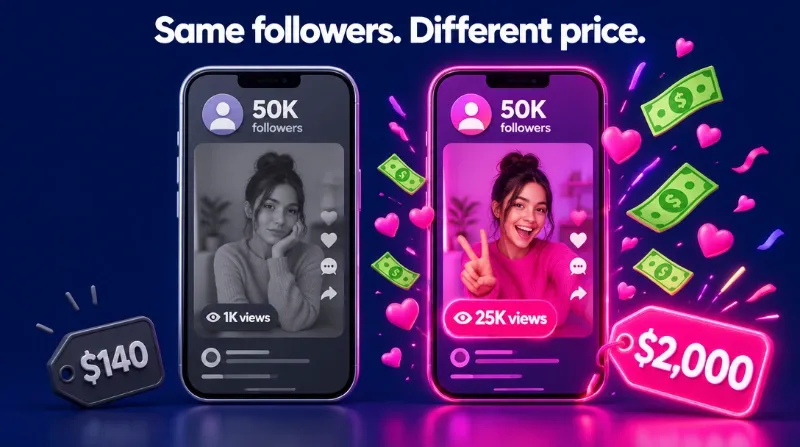
A brand is paying for the people who will see the post. A follower count is a weak estimate of that number. One 50,000-follower account can have a median of 1,000 views per post, while another has a median of 25,000.
Follower formulas price those two accounts the same. Hubfluence's calculator uses about $10 per 1,000 followers on Instagram and $20 to $25 per 1,000 on TikTok. On TikTok, both 50,000-follower accounts come out at $1,000 to $1,250 per video.
Priced on views, the two accounts come apart. The 1,000-view account's reach price is about $140, below a typical production floor, so a floor of a few hundred dollars sets its price. The 25,000-view account's reach price is about $2,000.
The follower formula overprices the low-view account several times over. It underprices the high-view account by roughly 40% to 50%.
Brands can check this before they reply. Creator-vetting tools, Virlo included, show a brand your recent views per video next to your follower count.
Which view number to use
The right number is the median views of your last 10 posts in the format the brand is buying. A Reel deal uses Reel views. A YouTube integration uses long-form views.
The median ignores the one video that went viral and the two that flopped, so it is closer to the views a brand will actually get. Nine TikToks at 4,000 views plus one at 400,000 average 43,600, while the median stays at 4,000. A quote built on the average promises the brand about ten times the views it will likely get.
Stories expire after 24 hours and sell in sets, so the figure to use there is the median views per frame across the last few weeks.
Engagement decides where you sit in the band
Engagement is the tiebreaker once views set the base. Some brands buy on cost per engagement. OpenSponsorship's medians were $3.05 per engagement for micro creators and $7.07 for mid-tier creators, with engagement measured on views.
A creator who beats those numbers has a case for the upper end of their per-view band. A Reel with 3,600 views and 6% engagement draws about 216 likes, comments, shares and saves. At a $504 fee, that is $2.33 per engagement, cheaper for the brand than the micro median.
Virlo's engagement rate benchmarks put micro TikTok accounts (10K to 100K followers) at 5% to 10% of followers. Micro Instagram Reels sit at 3% to 6%.
How much to charge for a sponsored post: the formula
Your base rate for one sponsored post is the higher of your production floor or your reach price. Usage, exclusivity and other extras go on top as separate lines.
Find your median views. Take the last 10 posts in the format being sold, sort them by views and take the middle value.
Set your production floor. Count every hour the post takes, from brief and script to filming, editing, revisions and emails. Multiply by the hourly rate you would accept for freelance work, then add props, travel or paid talent.
Pick a per-view price that matches your view count, not your follower tier. In OpenSponsorship's data, deals delivering roughly 1,000 to 2,000 views paid $0.13 to $0.19 per view. Deals around 5,000 views paid about $0.10. Around 39,000 views, the price fell to about $0.07. Between those points, a price in between is reasonable.
Multiply median views by that price to get your reach price.
Take the higher of floor and reach price as your base rate. OpenSponsorship's per-view figures are all-in fees that already cover production. That makes the floor a check, not an add-on.
Add negotiation room where the platform calls for it. Instagram and YouTube payouts ran 10% to 18% below asking prices, while TikTok payouts ran slightly above. A cushion of 10% to 20% fits the first two. A smaller one may hold on TikTok.
List extras separately. Usage rights, whitelisting, exclusivity and rush fees each get their own line, priced as a percentage of the base rate.
Two caveats apply to the per-view anchors. The mega figure rests on only 53 deliverables. The dataset also leans toward sports, wellness, food and lifestyle creators.
These short-form per-view prices also sit well above YouTube CPMs. That is likely because OpenSponsorship's deals are small, so a minimum fee spread over a few thousand views inflates the per-view figure. Above roughly 40,000 views, a check against the $2,727 mega median keeps a quote grounded.
Below are some of the examples. I have ommitted the names to protect the privacy but it comes from the research itself.
Example 1: an Instagram food creator with 12,000 followers
Her last 10 Reels have a median of 3,600 views. At the micro tier's typical 4.6% view rate, an account her size would draw about 550 views.
A recipe Reel takes her about five hours across planning, cooking, filming and editing, plus an hour of emails. At $40 an hour plus $30 of ingredients, her floor is $270.
At 3,600 views she sits between the mid-tier anchor ($0.19 at about 2,200 views) and the macro anchor ($0.10 at about 5,200). That gives a band of $360 to $684. At $0.14, near the middle, her reach price is $504.
The reach price beats the floor, so her base rate is about $500. A quote of $550 leaves room to settle at $500, more than three times the $150 micro median.
Example 2: TikTok comedy creator with 180,000 followers
His median is 25,000 views per video. A two-person skit takes about eight hours. He also pays a second actor $100, so at $50 an hour his floor is $500.
25,000 views falls between the macro anchor ($0.10 at about 5,200 views) and the mega anchor ($0.07 at about 39,000). Interpolating puts him near $0.08 per view, a reach price of about $2,000.
TikTok payouts in research data ran slightly above asking, so a small cushion is enough. A quote of $2,200 leaves room to settle near $2,000.
The median mid-tier deal pays $417 and delivers about 2% of followers in views. For his account size, that would be around 3,600 views. He delivers about seven times that, so a fee five times the median still prices his views below the mid-tier per-view rate.
Example 3: YouTube tech channel with 40,000 subscribers
YouTube sponsors price integrations on CPM instead. The sponsor buys a 60 to 90 second segment inside a video you were making anyway. 1of10's formula is median views × CPM ÷ 1,000, plus production cost.
Production is added here because 1of10's CPMs cover only the audience, unlike OpenSponsorship's all-in fees. This channel's last 10 videos have a median of 22,000 views. Tech and SaaS sponsors pay $30 to $50 per 1,000 views, so at $35 the reach price is $770.
Adding $150 for scripting and filming the segment gives $920. This is the floor rate, the lowest number worth accepting. A quote of $1,100 gives the creator room to settle near $950 for a 60-second integration.
Sponsored post rates on Instagram, TikTok and YouTube
Instagram and TikTok deals use the per-view method above, while YouTube sponsors price on CPM plus production. Each platform also has its own deliverables and extras.
A Reel is usually the main deliverable. Later's 2026 pricing guide puts Reels 20% to 30% above a feed post and Stories at about half. Instagram now reports views across Reels, posts and Stories, so you can price each format on its own median.
For the food creator's $500 Reel, those ratios put a feed post near $400 and a set of Stories near $200. Stories usually sell as three to five frames with a link sticker. They vanish after 24 hours, so keeping them in a Highlight is an extra worth pricing.
A Collab post shows on both your profile and the brand's profile. The post stays on the brand's grid unless one of you removes it, which is organic usage the quote can name.
TikTok sponsorship rates
TikTok views can swing widely from one video to the next, because the For You feed distributes each video on its own performance. The median gives a steadier number than any single post.
Sponsored videos need TikTok's branded content toggle. TikTok excludes ads, paid promotions and sponsored content from the Creator Rewards Program. A branded video over one minute long earns nothing from Creator Rewards, even if it would otherwise qualify.
Videos made through TikTok One, the platform's own brand-creator marketplace, are also ineligible for Creator Rewards. Either way, the brand's fee is the only money the post earns.
Product brands on TikTok often offer a flat fee plus commission through the TikTok Shop affiliate program. That works when the flat fee covers your floor and the commission is upside.
YouTube shorts and long form content rates
YouTube sponsors usually price on CPM against your expected views, with niche setting the CPM. In 1of10's ranges per 1,000 views, finance, B2B and business channels get $25 to $50 or more. Education, health and beauty sit at $15 to $35, while food, travel, gaming and entertainment sit at $8 to $22.
The spread largely follows the advertiser's value per customer. A software company that earns thousands per signup can pay far more per viewer than a snack brand.
YouTube also has another format aka Community post that sometimes influencers leverage for promotions.
And format moves the price from the integration rate. Applied to the tech channel's $920 integration, 1of10's multipliers give:
a Short at 0.25 to 0.5 times, or $230 to $460
a 30-second mention at 0.5 to 0.7 times, or $460 to $644
a community post at 0.1 to 0.2 times, or $92 to $184
a dedicated video at two to four times, or $1,840 to $3,680
A dedicated video costs more largely because the whole video serves the sponsor, which takes the place of a normal upload. A creator selling both formats can quote the integration first and offer the dedicated video as the larger package.
UGC and LinkedIn deals
UGC has no reach price because nothing goes on your account. Brands pay for the video and the right to run it, so production and usage set the whole fee.
Usage is where a UGC creator's rate can grow. UGC ads can run for months, so a usage line priced by duration can be worth more than the video itself.
On LinkedIn, sponsors are paying for a personal brand that software buyers already follow. Buffer interviewed three creators on its team who sell LinkedIn sponsorships. They charge $500 to $1,000 for a text post and $900 to $4,000 for a short video.
What to charge for usage rights, whitelisting and other add-ons
Each extra a brand asks for is a separate right with its own price, set as a percentage of your base rate. A $500 base becomes $700 to $800 with three months of paid usage and 30 days of exclusivity. It reaches about $900 to $1,000 with 12 months of usage and 90 days of exclusivity.
Influencer Marketing Hub's illustrative example starts with a $2,000 Reel and ends at $4,200. As shares of the base, it adds:
40% for 60 days of paid usage
30% for 60 days of exclusivity
15% for raw footage
10% for an extra revision round
15% for a manager's fee, which goes to the manager rather than the creator
Usage rights
Usage rights decide where the brand can put your content and for how long. Reposting on the brand's own organic accounts is often included in the base rate. Paid usage in ads, on the website, in email or offline is worth pricing separately.
Two pricing models are in use, with very different results. inBeat's usage guide adds a flat uplift to the base rate:
3 months: +20% to 30%
6 months: +25% to 40%
12 months: +30% to 50%
perpetual: +100% to 150%
impact.com charges a monthly fee instead. For micro creators (15K to 75K followers), it runs 25% to 75% of base per month, so three months would cost 75% to 225% of base.
The flat uplift is the safer default for organic-style use, such as a brand posting your video on its website. The monthly fee fits short paid-ad licenses, where the brand spends money to push your content to new viewers. The sample quote later in this article prices 30 days of Meta ads at 30% on that basis.
Creators land in a similar range. The creators Buffer interviewed add about 30% to 60% for usage. One of them charges 35% for 90 days and 50% for six months.
Brands raise usage early: Aspire found that 67% of brands include usage rights in the first contract. A quote that names channels and duration keeps broad wording, such as "all media, in perpetuity", out of the contract unless you price it.
Whitelisting and partnership ads
Whitelisting, also called allowlisting, lets a brand run paid ads through your account. Viewers see your handle on the ad. On Instagram and Facebook, this runs through Meta's partnership ads.
Meta says partnership ads average 19% lower cost per acquisition and 13% higher click-through rates, though it doesn't publish the method. Those gains go to the brand, which is the case for charging for the license. The contract should state how long the brand can run the ads.
Influencer Marketing Hub prices whitelisting at 20% to 25% of the base rate per 30-day flight, with 25% as the common figure. Its sample clause raises the fee by 10% for each further 30-day period. Contracts can also cap how long the brand has to start running the ads, such as 90 days.
Brands with large ad budgets sometimes pay a share of spend instead. impact.com puts that at 5% to 20% of the ad spend behind the post. A flat fee per 30 days is simpler when you can't see the brand's spend.
Spark Ads on TikTok
A Spark Ads code lets a brand boost your existing TikTok post as an ad. The code's authorization window can be 7, 30, 60 or 365 days. That window is the length of the license you are selling.
Influencer Marketing Hub's example charges $500 a month for the code, regardless of spend. Over a full year, that is $6,000. At 25% of base per 30 days, a year comes to about three times the base rate.
That is more than inBeat's range for perpetual usage. A lump sum between the two is a reasonable middle for a 365-day code.
Exclusivity
Exclusivity stops you working with competitors for a set period. 1of10 prices it at 20% to 30% of base for 30 days and 50% or more for 90 days. impact.com's range runs from 20% to 100%, depending on length and brand size.
The category definition matters as much as the length. "Competing protein powders" blocks a few deals, while "food and beverage" can block most of a food creator's income.
The window works best with a fixed end date, such as 30 days after the scheduled post date. Then a delayed post doesn't stretch the lockout.
Rush fees, revisions, raw footage and links
Rush delivery, extra revisions and raw footage each cost you time or give the brand more to use:
Rush delivery. Turnaround under seven days adds 25% to 50%, according to 1of10.
Revisions. One round of edits is standard. A second round ran 10% of base in Influencer Marketing Hub's example. A reshoot counts as new production.
Raw footage. Unedited files let the brand cut its own ads, which is why they ran 15% of base in that example.
Links. 1of10 prices a YouTube description link plus pinned comment at 5% to 10% of base. A link in bio is a similar ask.
If you have a manager, their 10% to 20% usually sits on top of your rate, not inside it. Later puts agency fees in that range.
Bundles, packages and retainers
A bundle can carry a discount while your single-post rate stays the same. A Reel at $500, a feed post at $400 and a set of three Stories at $200 total $1,100 as line items. The package might go out at $950, while the $500 Reel rate stays intact for the next brand.
Package discounts are usually modest. 1of10 puts multi-video YouTube packages at 10% to 20% off per video. In India, upGrowth found that a Reel, Story and feed post combo costs 1.6 to 2 times a single Reel rather than three times.
Retainers trade a similar discount for guaranteed volume. A three-month retainer for three videos a month at 15% off fills nine slots without new pitching. It works best with monthly payment in advance and a minimum term written in.
Gifted, barter and commission-only offers
Unpaid offers make up a large share of what reaches a creator's inbox. In Modash's June 2026 survey of 25 creators, 6 in 10 brand offers were gifting. About a third of creators regularly accept gifted products, while another half accept when they already know and like the brand.
Creators rate the two kinds of unpaid offer very differently. No-strings gifting, where you receive a product with no obligation to post, scored 4.2 out of 5. Barter, where you must post in return, scored 2.4. Among barter offers, 40% also asked for usage rights.
You can value a barter offer against your rate. A $60 product set against a $500 rate is a $440 shortfall. A counter of $440 in cash plus the product is a fair answer, as is a decline.
Granting usage rights for product alone gives away something you would otherwise price at 20% to 50% of your rate.
Commission-only offers
Commission-only deals pay little at normal view counts. Later's benchmarks put click-through on creator links at 0.5% to 2% and conversion at 1% to 3%.
On a post with 10,000 views, a 1% click-through rate and 2% conversion yield two sales. At $40 per order and 15% commission, the post earns $12. Even at 2% click-through, 3% conversion and 20% commission, it earns $48.
The formula prices the same post at roughly $900 to $1,000, about 20 to 80 times the commission. A hybrid closes the gap: a flat fee at or above your floor, plus commission on the sales the post drives.
Payment terms, deposits and the contract
Payment terms change what a rate is worth. Creators interviewed by Digiday described terms from net 30 to net 90, with net 60 the most common. A $1,000 fee paid 60 days after posting is effectively a two-month loan to the brand.
Late payment is common. In a Tipalti survey cited by Digiday, 56% of creators said brands had paid them late.
A deposit, a late fee, a kill fee and a fixed due date protect an agreed fee:
Deposit. The brand pays part of the fee before production starts, with the balance due on posting.
Late fee. One creator in Digiday's report charges a 10% non-compounding late fee that rises each month an invoice stays unpaid.
Kill fee. A kill fee, such as 50% once filming has started, can cover your time if the brand cancels.
Due date. A specific date, or net 30 from posting, written into the contract.
New York State's Freelance Isn't Free Act, in force since August 28, 2024, requires a written contract for freelance work worth $800 or more. That includes contracts with the same client that add up to $800 over 120 days. The contract must list, among other things, services, rate and the payment date. If no date is set, payment is due within 30 days of completion.
The contract should match the quote line by line: deliverables, posting dates, revision rounds, usage scope, exclusivity category and window, and payment terms.
How to answer "What are your rates?"
The best reply asks for the brief before naming a number. A rate depends on deliverables, usage, exclusivity and timing, which change from brand to brand.
Ask for the scope. Ask which deliverables they want, the posting window, whether they plan paid usage or whitelisting, any exclusivity, and their timeline.
Run the formula. Price the base rate from your median views and floor, then add each extra as a line.
Send a quote with line items. Show the base rate, each extra and the total. Line items let the brand remove something instead of asking for a discount.
State the terms. Include payment terms, the deposit and revision rounds in the same message.
A first reply can look like this:
Thanks for reaching out, I'd love to work on this. To send an accurate quote, could you share the deliverables, posting dates, whether you plan to run the content as ads, and any exclusivity you need?
Then the quote:
One 60-second Reel, organic posting on my account, one round of revisions: $550. 30 days of paid usage on Meta: +$165. 30-day exclusivity in plant-based protein: +$140. Total: $855. 50% deposit to book the slot, balance net 30 from posting.
When a brand comes back with a lower budget, scope can move instead of price. If the budget is $600, dropping exclusivity and paid usage brings the quote to $550.
Rate card or custom quote template
A rate card handles inbound volume, while a custom quote suits anything with paid usage. The food creator's card could read:
Instagram Reel: from $500 Feed post: from $400 Story set (3 frames): from $200 Paid ad usage: +30% per 30 days Organic-style usage: +20% to 50% for 3 to 12 months Exclusivity: +25% per 30 days, by named category Rush (under 7 days): +30%
"From" prices tell a brand whether it is in range without locking you to a number. A media kit can carry the same starting prices.
When to raise your rates
Your rate should change when your median views change. Rerunning the formula every quarter on your last 10 posts gives the new number and the size of the increase.
Brands accepting your first quote every time, a full calendar and repeat campaigns all suggest the rate is low. When the first quote never meets pushback, the negotiation cushion can grow too.
Early rates can be temporary on purpose. In Buffer's interviews, one LinkedIn creator priced her first deal low at $150 and was charging $500 within four months.
New rates can apply to new brands immediately. Repeat brands can get one more campaign at the old rate, with notice that it changes after that.
A short recap of a campaign's views, engagement and sales gives a returning brand a reason to accept the new rate. Many brands already track each creator's results that way.
Influencer rates in different markets
Influencer rates depend on where your audience lives. Study notes that brands tend to spend where audiences have high purchasing power, which favors US audiences.
A creator based elsewhere with a mostly US audience has a case for US-level pricing. A creator with a mostly local audience is better served by local benchmarks.
The per-view method still applies in India, with these bands replacing US medians as the market check. Regional-language YouTube channels cost 40% to 60% less than Hindi or English channels, according to upGrowth.
Usage rights, exclusivity and extra formats can push an Indian quote to two to three times the base. Influencer Marketing Hub's US example went from $2,000 to $4,200, about 2.1 times.
FAQ
How much should I charge for a sponsored post with 10k followers?
A creator with 10,000 followers usually earns about $130 to $300 per sponsored post. OpenSponsorship's medians are $134 just under 10K and $150 for 10K to 50K, while 80% of deals cost under $300. On the formula, a 10,000-follower account with median views of 3,000 can justify $390 to $570.
How much do influencers charge per post?
Most influencers charge under $300 per post. Average payouts in 2025 study found that the rates are $186 on TikTok, $193 on Instagram and $255 on YouTube. Mega creators with more than 1 million followers had a median of $2,727 per deliverable in OpenSponsorship's data.
How much should I charge for an Instagram Reel?
An Instagram Reel is best priced at median Reel views × about $0.10 to $0.19 per view, or your production floor if that is higher. A Reel with 3,600 median views comes to about $500. Later puts Reels 20% to 30% above a feed post.
How much should I charge for a sponsored post on TikTok?
You can price a sponsored TikTok at your median views × $0.07 to $0.19 per view, or your production floor if that is higher. TikTok creators in the data were paid slightly more than they asked, so a large cushion isn't needed. Spark Ads codes carry a separate fee, set by authorization window.
How much do micro influencers charge?
Micro influencers with 10,000 to 50,000 followers had a median fee of $150 per deliverable in inBeat's benchmark report, which uses OpenSponsorship data. Micro creators whose views run well above 4.6% of their followers can charge several times that median.
How much should I charge for usage rights?
Usage rights typically add 20% to 30% of your base rate for three months and 30% to 50% for 12 months, according to inBeat. Perpetual usage adds 100% to 150%. Whitelisting carries its own fee, about 20% to 25% of base per 30-day flight, according to Influencer Marketing Hub.
Should I accept gifted products instead of payment?
No-strings gifting is worth accepting from brands you like, since it carries no obligation to post. Barter offers that require posts are best valued against your rate, then countered with cash for the difference or declined. In Modash's survey, 40% of barter offers also asked for usage rights.
What are UGC rates for beginners?
Beginner UGC creators with no portfolio usually start at $50 to $150 per video, based on Virlo's UGC earnings data. UGC creators averaged $180 asking and $154 paid in 2025. UGC rates rise mainly through usage fees, since there is no audience to price.
Is there an influencer rates calculator?
Yes. Follower-based calculators, such as Hubfluence's, multiply followers by a fixed rate, about $10 per 1,000 on Instagram. A views-based number comes from median views × a per-view price, checked against your production floor. Virlo's engagement calculator shows where your engagement sits within that band.
How much do influencers charge in India?
An Instagram Reel in India costs ₹2,000 to ₹8,000 from a nano creator and ₹8,000 to ₹80,000 from a micro creator, according to upGrowth. Mid-tier creators charge ₹50,000 to ₹3.5 lakh. Regional-language YouTube channels cost 40% to 60% less than Hindi or English ones.
How much is a YouTube sponsorship worth per 1,000 views?
A YouTube integration is typically worth $8 to $50 or more per 1,000 expected views, according to 1of10. Finance channels sit at the top and entertainment at the bottom. A dedicated video runs two to four times the integration rate.
What payment terms should a creator ask for?
Net 30 from posting, with a deposit before production, protects most creators. Creators interviewed by Digiday most often see net 60. In a Tipalti survey, 56% of creators had been paid late. New York State's Freelance Isn't Free Act sets a 30-day default when a freelance contract names no payment date.
See What's Trending Right Now
- Social listening for TikTok, Reels & Shorts
- Spot viral trends before they peak
- Turn insights into ads, scripts & briefs
The Signal Newsletter
Weekly trend breakdowns, creator insights, and social listening tips — straight to your inbox.
Subscribe FreeSee Virlo in action
See What's Trending Right Now
- Social listening for TikTok, Reels & Shorts
- Spot viral trends before they peak
- Turn insights into ads, scripts & briefs
The Signal Newsletter
Weekly trend breakdowns, creator insights, and social listening tips — straight to your inbox.
Subscribe FreeRelated Articles
20 Tips on How to Make a Video Go Viral on TikTok
Learn 20 practical tips on how to make a video go viral on TikTok. Boost views, engage your audience, and create trending content with ease!
How to Promote Music on TikTok in 2026: The Sound-First Playbook
TikTok is where songs break. Here's the sound-first playbook for promoting your music on TikTok in 2026 — from finding a trending lane to turning views into streams.
How Many Hashtags Should I Use on YouTube Shorts + How to Find Them
Wondering how many hashtags you should use on YouTube Shorts? Discover the perfect number to boost your visibility and reach your audience effectively.
Put this into practice with Virlo
Turn what you just read into real research. These are the tools creators, agencies, and brands use to find what's working on short-form video.
Content Research Agent
Run your short-form research on autopilot — outliers, creators, and sounds across TikTok, Reels, and Shorts.
Tracking Center
Monitor breakout creators, videos, and competitors with daily snapshots and deep AI analysis.
Free Data
Explore free viral hooks, trending niches, breakout products, and more — no account required.
Get The Signal
Join creators, marketers, and agencies getting weekly trend breakdowns and social listening insights delivered free.
Subscribe to the Newsletter
Stop Guessing. Start Knowing.
Join thousands of digital entrepreneurs using data to take the guesswork out of capitalizing on trends.