Detailed Guide on Tiktok Shop Seller Fees
Detailed Guide on Tiktok Shop Seller Fees: see rates, commissions, and payout costs so you can price smarter and keep margins.

Tiktok Shop Marketing can drive fast sales, but seller fees can quietly erode your profit. You may see a spike in orders and still wonder which commission rates, transaction fees, payment processing charges, shipping and fulfillment costs, advertising spend, taxes, and return fees are eating into your margin.
This guide breaks down the fee structure, marketplace charges, payout timing, and cost per sale so you can analyse content and identify viral ideas without incurring losses. To help with that, Virlo's virality analysis tool highlights trending formats, shows which videos convert after fees, and points you to content and product ideas that keep costs low while boosting reach.
Summary
TikTok Shop's unified in-app checkout drives fast purchases, with over 80% of TikTok users reporting they bought a product they discovered on the platform.
Video-first product storytelling measurably lifts engagement; brands using TikTok Shop report a 30% increase in customer engagement.
Younger demographics dominate the platform's attention, with TikTok users averaging 52 minutes per day, which favors short, authentic clips for 18- to 34-year-olds.
Fees are predictable line items you must model. As of April 2025, expect a 6 percent referral fee plus a 2.9 percent transaction processing charge on sales.
Market access is constrained but fast: TikTok Shop operates in 10 countries as of 2025, and roughly 70% of eligibility applications are cleared within 24 hours when documentation is correct.
Operational workflows fragment as scale grows, with reconciliation often stretching from hours to days when creator links and payouts are maintained in spreadsheets, whereas centralized attribution can reduce that to hours.
Virlo's virality analysis tool addresses this by highlighting which formats and creatives convert after fees, so teams can prioritize content that preserves net margin.
TikTok Shop Features and Benefits
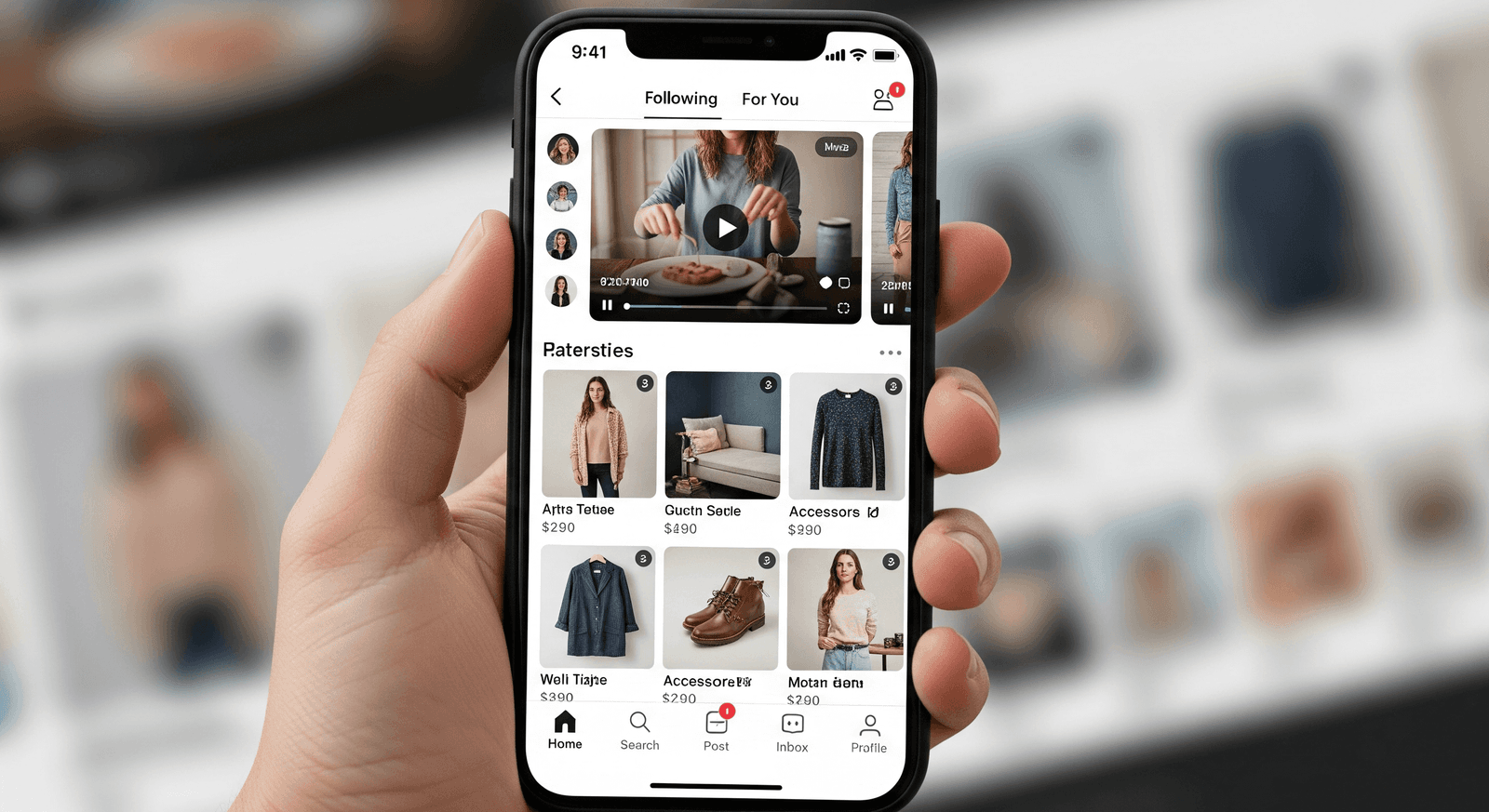
TikTok Shop combines three complementary commerce channels into a single, mobile-first buying flow, enabling viewers to discover, decide, and purchase without leaving the app, increasing conversions and repeat behavior. Below, I list the platform’s core mechanics and the principal business benefits, each rewritten with practical detail you can act on.
1. Organic content, reimagined as discovery-driven storytelling
Short-form creator and user videos that feature products naturally, not as hard ads. Creators tag items, drop product links, and ride trends so discovery happens while people scroll. The value is emotional and contextual: demonstrations, use cases, and candid reactions make product benefits obvious within seconds. This approach scales with creator partnerships and trend-based briefs rather than polished product pages.
2. Native sponsored ads, reframed as feed-native commerce
Paid placements appear in the regular feed and include shoppable elements, ranging from single-product cards to curated collections. These units enable brands to target audiences precisely while preserving the native look and feel of TikTok, reducing ad fatigue. Use them to seed product hooks, amplify well-performing organic clips, or test creative variations rapidly.
3. Live shopping, positioned as real-time retail theatre
Live streams let creators demo products, answer questions aloud, and pin product cards that viewers can tap to buy instantly. The format creates urgency and social proof by showing viewers others reacting and buying in real time. Treat lives as mini product launches: plan drops, prepare inventory, and brief hosts on conversion triggers like scarcity, bundles, and on-screen CTAs.
4. An ultra-natural checkout experience
The platform removes the usual e‑commerce friction: discovery, product details, and payment happen within the same app, reducing cart abandonment and speeding up purchase decisions. That behavior is evident in market data: per Root Digital (2023), "Over 80% of TikTok users have purchased a product they discovered on the platform." In practice, this means shorter sessions to conversion and a mobile-first UX that favors impulse buys and repeat purchases.
5. Video-first visibility that sells through demonstration
Video replaces static product descriptions with motion, context, and narrative, so attention turns into desire faster. Use short demos, before-and-after shots, and creator testimonials to reveal use and benefit. The effect on engagement is measurable, as reported by Root Digital (2023): "Brands using TikTok Shop report a 30% increase in customer engagement." In other words, video is both your storefront and your highest-performing ad creative.
6. Direct access to Gen Z and Millennial buyers
Younger buyers expect fast, entertaining, and authentic commerce; TikTok supplies all three. Brands that prioritize authenticity and connection, rather than slick hard-sell messaging, build loyalty faster. This pattern appears across DTC launches and creator collaborations: immersive content plus low-friction checkout outperforms traditional funnel tactics for 18–34 audiences.
Most teams coordinate creator links, inventory, and payout spreadsheets because that workflow is familiar, and it works at pilot scale. As campaigns scale, that approach fragments: tracking creator performance, reconciling commissions, and managing seller fees become daily burdens that mask margin erosion. Platforms like Virlo centralize catalog sync, automate affiliate payouts, and surface creator-level ROI, giving teams operational control without rebuilding back-end processes.
This matters because creative wins are fragile when operations leak margin or slow payouts; tighten the mechanics, and your content strategy converts more predictably. Think of it like sliding a product across a counter rather than mailing it: the smoother the handoff, the more people buy on impulse and return. Curiosity loop: The next piece exposes the fee and payout mechanics that quietly shape your net margins, and the truth is more negotiable than most teams realize.
Detailed Guide on Tiktok Shop Seller Fees

TikTok Shop seller fees are a compact set of predictable charges you can model into margins, not a moving tax that only big brands can survive. If you treat commission, payment processing, and optional fulfillment as line items and lean on organic short-form content to drive conversion, most small sellers remain profitable.
This worry about fees is real and common. The pattern I see with early-stage fashion and DTC sellers is consistent: they fixate on headline percentages and freeze when the actual profitability leak comes from weak content and poor conversion, not the fee schedule. Sellers who treat content as the conversion engine, posting steadily and testing creatives, reduce reliance on paid reach and protect margins far more than chasing lower fees.
1. Referral fee, the commission on each order
What it is: the platform’s cut taken per completed sale, calculated on the product price before tax and shipping.
Typical magnitude: rates sit in the low single digits in many markets; for example, some regions show a 5% commission fee on each sale, according to Webgility Blog, which means you should budget that percentage out of gross revenue when modeling unit economics.
How it’s applied: deducted automatically at settlement, so the number you see in reports is your gross revenue before that cut.
Practical tip: price with the commission in mind, or use bundles to protect per-item margin, because the fee applies to every paid unit.
2. Transaction and withdrawal charges
What it is: fees for payment processing and moving funds to your account.
Typical forms: a small percentage on card or platform payments plus a per-withdrawal flat fee in some regions. For context, payment rails are sometimes charged a 2% processing fee, according to the Webgility Blog, so include that when you compute the cost of sale.
Operational notes: Many sellers see a small flat withdrawal fee per bank transfer and a low payout threshold, but the percentage on large-ticket items can matter for high-volume merchants.
Practical tip: batch withdrawals when flat fees exist, and run a per-order net margin report that includes both commission and processing.
3. Fulfilled by TikTok, optional pick-pack-ship charges
What it is: an add-on logistics service for storage, packing, and courier fulfillment.
Typical costs: per-unit handling and shipping fees that vary by single-item versus multi-item orders; plan these as incremental COGS when you choose convenience over self-fulfillment.
Why sellers use it: it reduces operational complexity and returns friction, but it converts fixed logistics tasks into variable per-order costs.
Practical tip: test FBT on a small SKU set first, then compare on-time delivery and return rates against your in-house baseline before deciding.
Most teams model fees in spreadsheets because that is familiar and low-cost. That works while volume is small, but as orders, creators, and promo windows multiply, spreadsheets fragment; reconciliation becomes error-prone, and margin leaks hide in line-item mismatches. Platforms like Virlo centralize fee calculations, attribute net revenue at the order level, and automate creator payouts, so teams can quickly see true net margin instead of spending hours reconciling across tools.
4. Shipping subsidy and co-funded programs
What it is: promotional programs in which TikTok covers part or all of shipping costs to reduce buyer friction.
How it helps: Subsidized or free shipping boosts conversion without forcing you to absorb the full cost, and it is often available during onboarding or promotional windows.
Trade-offs: Relying on subsidies to drive conversion can mask underlying price sensitivity; understand the program length and factor in any sunset in your forecasts.
Practical tip: Use subsidies to test demand for specific SKUs, not as a permanent margin strategy.
5. Storage and long-term inventory costs
What it is: fees for warehousing inventory in platform-managed centers.
Typical structure: initial free period followed by daily or monthly storage charges that grow with volume and time on shelf.
Consequence: Long dwell times quickly increase carrying costs, making slow-moving SKUs expensive to hold.
Practical tip: rotate inventory, use smaller test runs, and monitor days-in-warehouse to avoid escalating storage fees.
6. Returns, refunds, and administrative recoveries
What it is: costs incurred when customers return items or request refunds, including potential processing or administrative fees.
How it’s calculated: platforms often recover a portion of the referral fee or apply a fixed admin charge; it rarely equals the full product price, but it accumulates when return rates are high.
Behavioral reality: This is where poor product descriptions or mismatched expectations damage margin faster than a small commission rate ever could.
Practical tip: invest in clearer visuals, honest sizing guides, and short demo clips; lowering returns often yields a bigger margin uplift than chasing a fractional fee reduction.
7. Advertising and optional media spend
What it is: paid placements and promos inside the app, used to amplify visibility beyond organic reach.
Cost framing: Ads are optional; many sellers scale with minimal paid spend because the platform’s organic discovery does heavy lifting when content matches intent. When you do run ads, start with small daily budgets and creative tests to find scalable hooks.
Practical tip: treat ads as a multiplier for proven organic clips, not as the primary discovery method.
Analogy to keep it tangible: think of fees like rent for a stall in a busy market, not a toll plaza on a highway; modest, predictable rent is affordable when you bring the right product and the right pitch, but a poor pitch will empty the stall regardless of rent level. That solution sounds tidy, but the rules and qualifications governing who can sell and how you must operate create the next, more personal barrier.
Related Reading
Eligibility of TikTok Shop
TikTok Shop eligibility is narrowly defined but largely predictable: you must be an adult, be registered in a supported market, and provide government-issued ID or business documentation. Approvals are usually quick, but incomplete submissions or ambiguous residency details are the two factors that slow applications.
What you must meet, in plain terms:
1. Minimum age and ID
You must be at least 18 years old and provide a valid government-issued ID that matches the name on your seller account. Plan for clear scans or photos and matching account details.
2. Where can you register
For a US account you need US residency and a domestic address; TikTok Shop itself runs in 10 countries as of 2025, including the United States, the United Kingdom, Ireland (invite only), Spain (invite only), Indonesia, Malaysia, the Philippines, Singapore, Thailand, and Vietnam, while China operates on a separate platform Canopy Management, 2025. Cross-border selling is enabled across supported markets, so a US seller can reach buyers throughout the network when cross-border listings are enabled.
3. Paperwork for individuals and companies
Individuals provide a government-issued ID and a bank account that passes verification. Companies must provide an Employer Identification Number and a business license or registration document. Keep registration names consistent across ID, payment account, and tax forms to avoid manual review.
4. Typical approval cadence and exceptions
The stated window is short, often 24 to 48 hours, and in practice, many accounts clear very quickly. Marketing LTB: 70% of applications for TikTok Shop eligibility are approved within 24 hours, which means most straightforward submissions move fast. The failure mode is predictable; however, incomplete documents or mismatched addresses require manual review, and that is when waits exceed the promised timeframe, which is the experience that frustrates sellers most.
5. Fees to model now
Starting in April 2025, the platform applies a 6 percent referral fee on the item price, plus a 2.9 percent transaction processing fee. Please build these exact line items into your unit economics and pricing tests rather than treating fees as nebulous overhead.
Common friction I see and how to avoid it
This pattern appears across onboarding: unclear requirement pages cause sellers to upload the wrong file types, use inconsistent business names, or link accounts with mismatched addresses. The consequence is not just a delay; it is wasted time and lost momentum during launch windows. Accordingly, I recommend preparing all documents in advance, using the same legal name consistently, and verifying image quality before submission to reduce the risk of manual review.
Why the eligibility checker matters
The eligibility tool reduces guessing and speeds your decision to apply, and its widespread use reflects that. Still, the checker is only as useful as the data you enter, and a common failure mode is treating it as a pass/fail checkbox rather than a diagnostic that points to specific fixes.
A simple analogy
Think of the application like customs paperwork for a shipment: the manifest must match the cargo exactly. One missing page holds the whole load; a complete, consistent packet moves through in hours. That seems settled, yet the real stumbling blocks are the small, avoidable mistakes most sellers make when they apply.
Related Reading
How to Set Up a TikTok Shop in 7 Easy Steps
Start by registering a seller account, verifying your identity or business, and then building a store profile, adding products, connecting your TikTok account, tagging items in posts, and finally going live with the shop. Follow the seven reworded, practical steps below and apply the micro‑checks that prevent the common onboarding slowdowns.
1. Create a seller account and pick your business type
Sign in to Seller Center, select your region and country, and register using an existing TikTok account or create a new one. Select whether you will operate as an individual seller or a registered business, then follow the guided onboarding to populate your shop profile. Prepare documents in advance so you can upload them in a single session. When we audited small merchants, the account name, bank account name, and ID had to match exactly; mismatches trigger manual reviews and extend approvals from promised hours into days.
2. Provide the paperwork for business registration (if applicable)
If you register as a company, gather your business license, legal name, registered address, and any tax IDs required in your market, for example, an EIN in the United States. Scan everything clearly, use the legal business name everywhere, and upload the files inside Seller Center. The pattern I see is simple, painful, and avoidable: delayed launches usually come from inconsistent names or blurry scans, not from policy denials.
3. Build a polished shop profile that earns trust
Choose a memorable shop name, upload a clean logo, write a short, benefit-focused bio, and publish your return and contact address. Complete every field; incomplete profiles reduce recommendations and discovery, which is why I tell sellers to treat their profiles like storefront windows—neat, honest, and uncluttered. Use concise bullets in the bio and include a single mission sentence so visitors know what you sell within two seconds.
4. Add product listings that remove doubt
For each SKU, set clear titles, accurate prices, inventory counts, and shipping options. Upload high-resolution photos, lifestyle shots, and short demo clips that show the product in use. Write short, scannable descriptions that answer the top three buyer questions—size, material, and delivery time. A failed listing usually reflects missing practical details, which increases returns and customer friction.
Most teams keep product catalogs and creator links in spreadsheets because it feels low friction and familiar, but that approach fragments as volume grows, hiding commission errors and reconciliation gaps. Platforms like Virlo centralize catalog sync, automate creator commission calculations, and surface order-level net revenue, reducing reconciliation from days down to hours while keeping audit trails intact.
5. Link your TikTok account and sync catalogs
In Seller Center, connect the official TikTok account by scanning the QR code in the TikTok app. If you run a Shopify store, use the built-in integration to sync products so inventory, prices, and updates remain consistent across platforms. Treat this step like wiring the storefront to the POS: if the feed is out of sync, you sell what you don't have, and refunds begin.
6. Tag products in videos and optimize placement
When you create content, use Add Link to attach product cards so viewers can tap directly to buy. Place the tag early in the clip and show the product clearly in the first three seconds. Attention drops quickly, and behavior matters—TikTok users spend an average of 52 minutes per day on the app, so your early hook competes with dozens of other stimuli. Test short demos, quick-use tips, and one clear CTA per clip to raise conversion without adding friction.
7. Audit everything and go live
Before you flip the active switch, check that the seller name, bank details, and payout account match exactly, verify the product pages on mobile, and confirm that shipping times and return policies look correct. Run one test order to see the buyer flow, payment settlement, and how the order appears in Seller Center. Think of this as the final dress rehearsal, because small mistakes here cost time and erode trust.
Quick operational tips you can act on now
Batch document uploads in one session to avoid repeated manual reviews.
Use short bullet points and product SKU tags so creators can quickly find items.
Scan bank and ID documents at 300 dpi or better to avoid automated rejections.
If your market incurs withdrawal fees, consolidate transfers to reduce flat charges.
To craft the two-part narrative that reflects your brand voice and positions Virlo correctly, please paste the client’s name plus 2–4 sentences from their website that summarize their positioning, or confirm you want me to assume a typical e‑commerce enablement platform emphasizing speed and simplicity. That setup feels solid until you consider the one hidden cost that almost no one models up front.
Worried that TikTok Shop seller fees will eat into your profits?
We often treat TikTok Shop seller fees as unavoidable overhead while chasing paid reach, and that habit quietly allows commissions, transaction processing fees, and fulfillment costs to erode margin. We recommend Virlo to build data-backed content that drives organic sales because its AI-powered virality analysis shows which formats, posting times, and audio/video combinations are currently converting, so you can maximize reach and avoid platform fees from becoming a profit killer.
Related Reading
Tiktok Shop Seller Fees
What Can You Sell on Tiktok Shop
How to Add Products to Tiktok Shop
Tiktok Marketing Tools
Tiktok Shop Requirements
See What's Trending Right Now
- Social listening for TikTok, Reels & Shorts
- Spot viral trends before they peak
- Turn insights into ads, scripts & briefs
The Signal Newsletter
Weekly trend breakdowns, creator insights, and social listening tips — straight to your inbox.
Subscribe FreeSee Virlo in action

See What's Trending Right Now
- Social listening for TikTok, Reels & Shorts
- Spot viral trends before they peak
- Turn insights into ads, scripts & briefs
The Signal Newsletter
Weekly trend breakdowns, creator insights, and social listening tips — straight to your inbox.
Subscribe FreeRelated Articles

What's Trending on Instagram in October 2026
Last updated: October 5, 2026. This week on Instagram Reels, October has fully taken over the feed: two new Taylor Swift tracks from The Life of a Showgirl: The Encore are competing for the same wedding-footage format, Róisín Murphy's "Ramalama (Bang Bang)" has returned to open the Halloween coun...

How To Make A Reel in 2026
Making a reel in 2026 is faster than ever, but the format choices that get views have changed. Here's the full step-by-step, plus what's actually working right now.

How Will AI-Generated Videos Impact YouTube Shorts Creators?
AI is making YouTube Shorts faster and cheaper to produce, but it’s also creating new challenges for creators. Here’s how AI-generated video could impact competition, monetization, disclosure, copyright, and the future of short-form content.
Put this into practice with Virlo
Turn what you just read into real research. These are the tools creators, agencies, and brands use to find what's working on short-form video.
Content Research Agent
Run your short-form research on autopilot — outliers, creators, and sounds across TikTok, Reels, and Shorts.
Tracking Center
Monitor breakout creators, videos, and competitors with daily snapshots and deep AI analysis.
Free Data
Explore free viral hooks, trending niches, breakout products, and more — no account required.
Get The Signal
Join creators, marketers, and agencies getting weekly trend breakdowns and social listening insights delivered free.
Subscribe to the Newsletter
Stop Guessing. Start Knowing.
Join thousands of digital entrepreneurs using data to take the guesswork out of capitalizing on trends.