Claude marketing for social media: the 20-lesson path from first prompt to daily agent
Updated
The fastest way to learn Claude for marketing is in order: 10 modules, 2 lessons each, across 3 levels. Level 1 covers model choice, a brand brief, hook prompts and connecting Claude to a database of 23.3M viral videos. Level 2 turns proven hooks into scripts in your voice and sets up Projects and Skills. Level 3 adds agents that watch your niche daily, a Monday brief and 3 weekly content systems that take under an hour a week.
- 20 lessons in 10 modules, each with a prompt to copy and the result to expect
- Viral video research, scripts in your voice, Projects and Skills
- Agents, a Monday brief and a weekly rhythm that takes under an hour
What should you learn first when using Claude for marketing?
Start with model choice and a brand brief, then hooks, then live video data. Most marketers use Claude for captions and the odd rewrite, and leave the parts that matter most for social media (viral video data, Projects, Skills, agents) unused because nobody lays out the order. Start at Level 1 even if you use Claude daily: Module 03 connects Claude to video data, and every later lesson builds on that connection.
| Level | Module | Lessons | Time |
|---|---|---|---|
| 1. Getting started | 01 Claude fundamentals | Picking the model; your brand brief | 6 min |
| 1. Getting started | 02 Prompting for hooks | The hook prompt; testing 10 hooks | 8 min |
| 1. Getting started | 03 Research with viral video data | Connecting Virlo; finding outlier videos | 8 min |
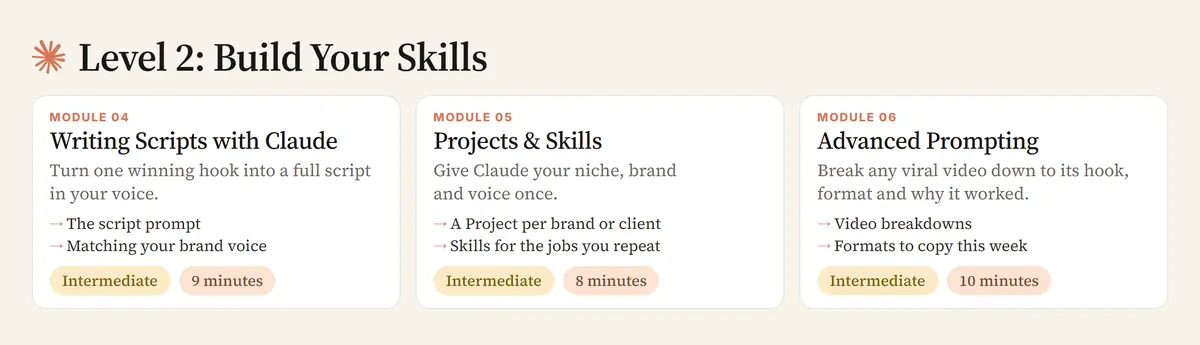
| 2. Build your skills | 04 Writing scripts | The script prompt; matching your voice | 9 min |
| 2. Build your skills | 05 Projects and Skills | A Project per brand; Skills for repeat jobs | 8 min |
| 2. Build your skills | 06 Advanced prompting | Video breakdowns; formats to copy | 10 min |
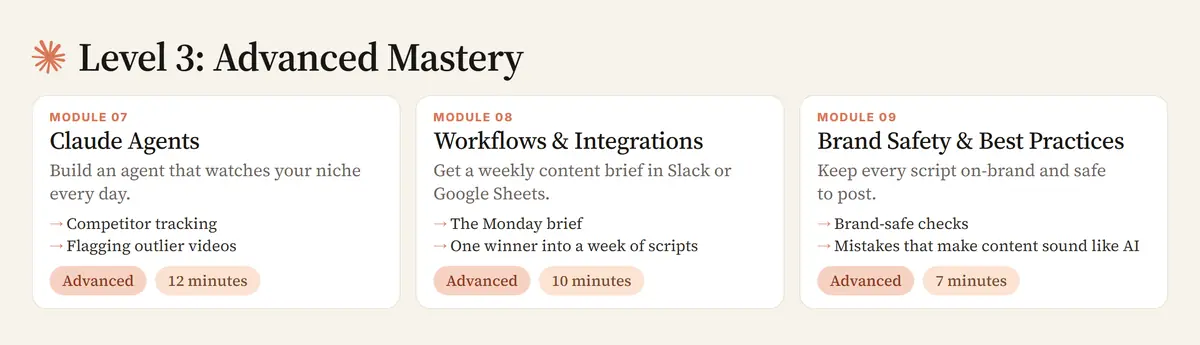
| 3. Advanced mastery | 07 Claude agents | Competitor tracking; flagging outliers | 12 min |
| 3. Advanced mastery | 08 Workflows and integrations | The Monday brief; one winner into a week of scripts | 10 min |
| 3. Advanced mastery | 09 Brand safety | Brand-safe checks; removing AI tells | 7 min |
| 3. Advanced mastery | 10 Content systems | The 3 systems; running your week | 12 min |
Which Claude model should marketers use for each job?
Marketers should use Opus for research and strategy, Sonnet for hooks and scripts, and Haiku for fast rewrites and variations. You switch in the model picker under the chat box. Leaving it on one model is why research can feel shallow or hook writing slow.
| Job | Model |
|---|---|
| Research across hundreds of videos, strategy, your Monday brief | Opus (the deepest) |
| Hooks, scripts, captions, everyday writing | Sonnet (the all-rounder) |
| Quick rewrites, 50 variations of one line, cleanup | Haiku (the fastest) |
Lesson 1.2 is a brand brief. Claude writes generic copy when it has to guess who you are, so fill this in once, save it as brand-brief.md and paste it at the top of any chat until Module 05 moves it into a Project.
BRAND BRIEF

What I sell: [one line]
My audience: [one line, as specific as you can]
The 3 problems they talk about: [1] [2] [3]
Where I post: [TikTok / Instagram]
Competitors and creators in my space: [3-5 names or handles]
How I talk (3 words): [e.g. casual, blunt, funny]
Words I never use: [list them]
What a win looks like this quarter: [one line]

Rules: never invent a number or a claim about my product.
If something isn't in this brief, ask me.How do you prompt Claude to write better hooks?
Claude writes better hooks when you hand it a structure that already worked and ask it to fill that structure with your topic. Paste 3 hooks (the first line said on camera) from videos that took off in your niche.
Here's my brand brief: [paste brand-brief.md]

Here are 3 hooks from videos that took off in my niche,
word for word:
1. [hook]
2. [hook]
3. [hook]

For each one, write the structure underneath it as a
fill-in-the-blank template, e.g. "I tried [thing] for
[time] so you don't have to".

Then use those structures to write 5 hooks for my next
video about [topic]. Each hook is the first line said on
camera, under 12 words, in my voice. Label the structure
each one uses.
Lesson 2.2 gets 10 hooks at once, scored on 4 criteria, with the top 3 marked to film. Claude's scores are a first filter; the real test is the post.
Write 10 hooks for a video about [topic] for [my
audience], using at least 5 different structures.

Score each one from 1 to 5 on:
- Stops the scroll in the first 2 seconds
- Clear who the video is for
- Makes a promise the video can keep
- Sounds like a person said it out loud

Return a table sorted by total score. Mark the top 3 to
film. Then rewrite the bottom 3 using the structure of
the top one.
For hook structures that already pulled views, browse the viral hooks data.
How do you connect Claude to viral video data?
Claude connects to viral video data through the Virlo connector, which lets it search 23.3M viral TikTok and Instagram videos and read each one's hook, format and transcript. On its own, Claude cannot open TikTok.
- Create your Virlo account; you sign in with it in the next step.
- On claude.ai open Settings, then Connectors, then "Add custom connector". Name it Virlo, paste the URL below, connect and sign in.
- In each new chat, click + then Connectors and switch Virlo on. Full walkthrough: Virlo for Claude.
https://dev.virlo.ai/api/mcp/mcpIn Claude Code, one line does the same job. Run it, then type /mcp and sign in:
claude mcp add --transport http virlo https://dev.virlo.ai/api/mcp/mcpTest the connection with this week's top hooks in a category (beauty, fashion, fitness, food_beverage, health_wellness, business_career, finance, tech, education, lifestyle, home_garden, parenting_family, pets, travel, entertainment and a few more):
Using Virlo, run get_trending_hooks for the [category]
category on [tiktok / instagram], last 7 days,
sorted by weighted_score. Show me the top 10 hooks word
for word, with the video link and views.
Lesson 3.2 finds outlier videos: ones that pulled far more views than anything around them, so the idea itself did the work. The prompt sets up a one-time agent on your niche. See outlier videos for how Virlo ranks them.
Using Virlo, find outlier videos for my niche:
[your niche in one line, e.g. "protein snacks for busy
women in their 20s"].

1. Write one sentence of intent: what I want, my niche,
   the type of video, and what to leave out. Run
   suggest_keywords with it. If quality doesn't pass,
   sharpen the intent and run it again.
2. Run search_keywords with the same intent, the
   suggested keywords, platforms tiktok and instagram,
   and data_intelligence_enabled true. Drop any
   exclude word that belongs to my own niche.
3. Tell me to check back in 15-20 minutes. The run is
   done only when get_keyword_search_results says
finalized.Check my agent. Read get_keyword_search_results
with data_type "summary" first, then data_type "videos"
with intent_match true, ordered by views.
Give me the top 10 as a table: link, the hook word for
word (from the hook field, never the caption), format,
views, date posted.
Then 3 patterns the winners share, each backed by 2+
videos from different creators. Never invent a number.How do you write social media scripts with Claude?
Write scripts with Claude by keeping the structure of a video that already worked and swapping in your topic. Pick a hook from your Module 03 table and Claude maps the script beat for beat to the source.
Take hook #[N] from my outlier table: "[hook]".
Pull the source video's transcript with
get_keyword_search_results, data_type "videos",
include_transcript true, and study how it's built.

Write a 30-45 second talking-head script about
[my product or topic] that keeps the source's structure:
- 0-3s: the hook, with my topic swapped in
- 3-10s: the problem it solves for [my audience]
- 10-35s: 3 beats, one idea each
- last 5s: one line that pays off the hook

Return two columns: what I say | what's on screen.
Cite the source video link.
Lesson 4.2 turns your brand voice into rules Claude can follow. Show it 3 pieces that sound exactly like you, then save the result as voice-rules.md next to your brand brief.
Here are 3 things I wrote that sound exactly like me
(captions, scripts or posts):
1. [paste]
2. [paste]
3. [paste]

List the 8 rules of my voice: sentence length, words I
use a lot, how I open, how I end, how I use humor, what I
never do. Call the list voice-rules.

Then rewrite the script above using those rules, and show
me every line you changed and why.How do Claude Projects and Skills help marketing teams?
A Claude Project keeps one brand's files and instructions for every chat inside it, and a Skill makes Claude run a repeated job the same way every time. One Project per brand or client keeps voices and niches apart. The deeper version is in Claude Projects for marketing.
- In claude.ai, open Projects, then New project, and name it after the brand.
- Add
brand-brief.mdandvoice-rules.mdto the project knowledge. - Paste the instructions below.
You are the content strategist for [brand].

Before answering, read brand-brief.md and voice-rules.md.
When I ask for research, use the Virlo connector and cite
every video: link, views, date posted.
Hooks come from each video's hook field, never the caption.
Never invent a number. If it isn't in the results, say so.
Write in my voice rules. No emojis or hashtags unless I
ask for them.
Lesson 5.2 covers Skills: a small folder with a SKILL.md file that teaches Claude one job, loaded on its own when your request matches. The quick route asks Virlo to build your personal skill:
Using Virlo, run build_virlo_skill with everything you
know about me from this chat: my niche, audience,
competitors, voice, platforms, handles and region. Give
me the download link and the setup steps.
Upload it in Claude under Customize, then Skills, then + and "Upload a skill" (code execution must be on under Settings, Capabilities). The custom route: make a folder called script-from-hook, save this as SKILL.md inside it, compress the folder and upload it the same way. More examples: Claude skills for marketing.
---
name: script-from-hook
description: Turns a proven hook into a 30-45 second
  talking-head script in my brand voice. Use when I ask
  for a script, a video, or "script this hook".
---

# Script from hook

1. Read brand-brief.md and voice-rules.md.
2. If I gave a video link, pull its transcript through
   Virlo first and keep its structure.
3. Write: hook (0-3s), the problem it solves (3-10s), 3 beats
   (10-35s), payoff line (last 5s).
4. Two columns: what I say | what's on screen.
5. Cite the source video. Never invent numbers or claims
about my product.How do you break down a viral video with Claude?
Paste any viral video link and Claude checks whether it is an outlier for that creator, pulls the transcript and returns the hook, format, timestamped beats, why it worked and how to remake it for your niche. A longer method is in viral video analysis.
Break down this video: [link]

1. Run analyze_video on it to see whether it's an outlier
   for that creator.
2. Pull what's said with raw_transcript (TikTok).

Then give me:
- The hook, word for word, and what's on screen in the
  first 2 seconds
- The format (tutorial, listicle, storytime, review...)
  and how it's filmed (talking head, green screen...)
- The beats, in order, with timestamps
- Why it worked, in 3 lines, each tied to a moment in
  the video
- How I'd remake it for [my niche], in 5 lines
Lesson 6.2 covers formats, which go stale as fast as hooks. Virlo's team reviews the formats many creators are copying right now and writes the recipe for each: what stays the same and what you make yours. Browse them on trends or pull them into Claude:
Using Virlo, run get_content_trends with brand_safety
"safe", sort "creators_7d" and examples 3. If one fits
me, add client_fit [consumer_brand / b2b_saas /
clinic_healthcare / local_business].

For the top 5 formats give me: the name, its stage (new,
rising, peaking, fading), creators posting it this week
vs last week, the recipe (what stays the same, what I
swap) and one example link.

Then pick the 2 that fit [my niche] best and write a
20-second script for each.How do Claude agents track competitors and outlier videos?
Claude agents watch competitors two ways: tracking their accounts, and running a recurring agent on everything people post about them. Use both. A recurring agent on your own niche runs daily and, on autopilot, rewords its searches and adds keywords after each run without removing yours. In the Virlo web app this is the marketing agent.
Set up competitor tracking for me with Virlo:

1. Run track_creator for each of these accounts:
   [platform] [@handle]
   [platform] [@handle]
   [platform] [@handle]

2. Set up a recurring agent with create_niche_monitor on
   what people post about them. Intent: "Find videos
   about [competitor], its products, reviews and
   comparisons, for content ideas." Keywords from
   suggest_keywords with that intent (keep the brand and
   product names). Platforms tiktok, instagram.
   Cadence "daily". data_intelligence_enabled true.

Confirm both, then tell me when the first results are in.What did my competitors post this week? Use
get_tracking_signals and list_creator_posts for each
tracked account, plus the newest videos from my
competitor agent (get_niche_monitor_data, data_type
"videos").
For each competitor: their best new video (link, hook
word for word, views), the hooks and formats getting them
views, and one
angle they haven't covered that I could post this week.Set up an agent that watches my niche every day:
run create_niche_monitor with my intent from Module 03
(or a new one-sentence intent for [niche]), the keywords
from suggest_keywords, platforms tiktok and instagram,
cadence "daily" and data_intelligence_enabled
true. Leave autopilot on.Check my niche agent. Read get_niche_monitor_data with
data_type "summary", then data_type "videos" with
intent_match true and start_date [2 days ago]. Also run
get_agent_hooks sorted by weighted_score.
Flag every outlier video from the last 48 hours: link,
hook word for word, format, views, and one line on why it
popped. If nothing new popped, say so in one line.For a full competitor method, see competitor content analysis.
How do you get a weekly marketing brief from Claude?
Claude writes a Monday brief under 300 words from the past 7 days of your niche agent: 3 things to do more of, 2 to stop, 1 to test, each citing a video, plus the 5 hooks to film.
Write my Monday brief from the past 7 days of my niche
agent: get_niche_monitor_data, data_type "videos",
intent_match true, start_date [7 days ago], plus
get_agent_hooks sorted by weighted_score.

Under 300 words:
- 3 things to do more of
- 2 things to stop
- 1 thing to test
Each line cites one video (link, views).
Then the 5 hooks to film this week.- Slack from Claude: if Slack is connected to Claude (Settings, Connectors), add "Post it to #[channel]" to the prompt.
- Slack or Google Sheets on autopilot: in the Virlo web app, open Automations, pick what you want (post ideas, hooks that work, a script to shoot) and send it to Slack or a Google Sheets ledger. It only sends when there is something new.
Lesson 8.2 turns one winning video into Monday to Friday scripts that keep its hook structure and format, with a new angle each day.
Take this winning video: [link] (or the top video in my
Monday brief).

Break down its hook structure and format in 3 lines.

Then write 5 scripts, one for each weekday, 20-30 seconds
each. Keep the same hook structure and format, with a new
angle each day for [what I sell]:
1. the problem
2. a mistake people make
3. a quick how-to
4. a myth and the truth behind it
5. a result or a story

Each script: hook, 3 beats, payoff line, in my voice
rules.How do you keep Claude marketing content brand safe?
Every video in Virlo carries a brand-safety rating and flags for paid partnerships, so Claude can filter out unsafe, NSFW and sponsored videos before you copy anything, then check your script against your brand brief.
Before I copy any of these videos, check them using the
fields in my agent's videos data:
- Drop anything that isn't rated brand safe, or is
  flagged NSFW.
- Drop paid or sponsored posts (is_paid, is_sponsored),
  so I only copy organic winners.
- List any brands mentioned, so I don't copy a
  competitor's ad by accident.

Then check my script against brand-brief.md: claims I
can't prove, words on my never-use list, and anything a
platform could flag (health, money or before-and-after
claims). Return a pass / fix list.
Lesson 9.2 removes the patterns that make a script sound like AI, which viewers spot and scroll past. Run it on every script before you film.
Check this script for the patterns that make writing
sound like AI, and fix each one:

1. Long dashes. Replace with commas or full stops.
2. Fake contrasts set up before the real point. Just
   say the point.
3. Every sentence the same length. Mix short and long.
4. Lists of three in every line.
5. Hype words and buzzwords people never use when they talk. Swap
   them for plain words.
6. Vague hooks. Add a number, a name or a place.
7. A question at the end nobody asked.

Show the old line and the new line for every change.
Keep my voice rules. Keep it the same length or shorter.

Script: [paste]What does a weekly Claude marketing system look like?

A weekly Claude marketing system is three prompts that run inside your brand's Project on top of the Module 07 agents: a Monday content brief, a competitor watch and a hook bank.
Build my Monday content brief:
1. From my niche agent's past 7 days (get_niche_monitor_data,
   data_type "videos", intent_match true), the 3 things
   to do more of, 2 to stop, 1 to test, each citing
   a video.
2. From get_content_trends (brand_safety "safe", sort
   "creators_7d"), the 2 formats that fit my niche.
3. From get_agent_hooks (sorted by weighted_score), the
   5 hooks to film.
4. A 30-second script for each of the 5 hooks, in my
   voice rules.
Under 600 words plus the scripts. Never invent a number.Run my competitor watch for the past 7 days:
1. get_tracking_signals and list_creator_posts for every
tracked competitor account.
2. The newest videos from my competitor agent.
For each competitor: their best new video (link, hook
word for word, views), the pattern behind it, and the
angle they're missing. End with the 2 videos I should
post this week to answer them.Build my hook bank from Virlo:
1. get_agent_hooks on my niche agent, sorted by
weighted_score, limit 50.
2. get_trending_hooks for the [category] category, days
30, limit 20, to fill gaps.
Group every hook by its structure (the fill-in-the-blank
template underneath), never by topic. For each structure:
a short name, the template, how many videos use it, and
2 example hooks word for word with links and views.
Put the 3 strongest structures at the top. Save it as
hook-bank.md.Add hook-bank.md to the Project knowledge so every Module 02 hook prompt can start from it. Then run the systems on a rhythm:
| Day | What runs | Time |
|---|---|---|
| Monday | System 1: the Monday content brief. Pick your 5 videos. | 10 minutes |
| Tuesday | Lesson 8.2 on Monday's top video, then Lesson 9.2 on every script. | 15 minutes |
| Wednesday | System 2: the competitor watch. Swap in an answer video if they posted something big. | 5 minutes |
| Every morning | Lesson 7.2: the outlier flag from your niche agent. | 2 minutes |
| Friday | System 3: refresh the hook bank with the week's new hooks. | 5 minutes |
Once a system runs the same way 3 weeks in a row, turn it into a Skill (Lesson 5.2) so "run my Monday brief" is all you type. For the team version of this playbook, see Claude for marketers.
Rather skip Claude? Run the same niche research, hooks and competitor watch inside the Virlo web app.
How this resource was made
- Source
- The original Virlo resource "How to Master Claude for Social Media Marketing in 2026" (20 lessons in 10 modules).
- How this page is made
- Written by the Virlo team from the original resource; prompts kept word for word apart from the platform list (TikTok and Instagram), the database count and the current connector setup.
- Limitations
- Tool behavior and model names reflect Claude and Virlo as of November 2026.
- As of
- (first published October 21, 2026)
Source: Virlo, Claude marketing for social media: the 20-lesson path from first prompt to daily agent, November 2026, virlo.ai/resources/claude-for-marketing
Want the full list?
Connect Claude to 23.3M viral TikTok and Instagram videos and start Module 03 today. Virlo is social listening for TikTok and Instagram Reels: start a 7-day free trial at app.virlo.ai and see real videos from your niche before you pay.
Frequently asked questions
How do I use Claude for marketing?
Learn it in order: pick the right model, write a brand brief, prompt hooks from proven structures, connect Claude to viral video data, then add scripts, Projects, Skills and agents.
Which Claude model is best for marketing?
Opus for research and strategy, Sonnet for hooks, scripts and captions, and Haiku for quick rewrites and many variations of one line.
Can Claude do social media marketing research?
Yes, once it is connected to video data. With the Virlo connector it searches 23.3M viral TikTok and Instagram videos and reads each one's hook, format and transcript.
How long does the Claude marketing path take?
The 20 lessons add up to about 90 minutes of reading and setup. After that the weekly rhythm takes under an hour.
What is a brand brief for Claude?
A one-page file with what you sell, your audience, their 3 problems, where you post, competitors, your voice, banned words and this quarter's goal. Claude reads it before writing anything.
What is the difference between a Claude Project and a Skill?
A Project holds one brand's files and instructions for every chat inside it. A Skill is a folder with a SKILL.md file that teaches Claude one repeatable job, like turning a hook into a script.
What is an outlier video?
A video that pulled far more views than anything around it, so the idea itself did the work. Those are the videos worth studying and remaking.
Can Claude track my competitors on TikTok and Instagram?
Yes. With Virlo it tracks competitor accounts and runs a daily agent on what people post about them, then reports their best new video and the angle they missed.
How do I stop Claude scripts sounding like AI?
Run Lesson 9.2's check on every script: remove long dashes, fake contrasts, same-length sentences, constant lists of three, hype words, vague hooks and closing questions nobody asked.
Related free resources
- Claude for marketers: the 5 plays a marketing team runs every week
- Claude Projects for marketing: build a social media marketing exper...
- Claude skills for marketing: 50 social media skills for the whole c...
- Claude for social media: the prompts and daily routine for every ac...
- Viral video analysis with Jev, Virlo and Claude: a content engine t...
- Competitor content analysis: find the brands your size posting outl...
- All Virlo resources
- TikTok trends this week
Run this on your own niche
Connect Claude to 23.3M viral TikTok and Instagram videos and start Module 03 today.
7-day free trial, easy to cancel.