Social media audit template: a 7-section TikTok and Instagram audit from one Claude prompt
Updated
A social media audit template should measure every post against your own median, not your follower count. This one is a single Claude prompt connected to Virlo that returns a 7-section TikTok and Instagram audit: outlier sweep, hook audit, format and length, competitor benchmark, trend opportunities, an impact/effort/confidence fix matrix and a 30/60/90-day roadmap, plus a PDF, an .xlsx fix tracker and a content calendar.
- The 7 sections a TikTok and Instagram audit needs, as a checklist
- The full audit prompt, word for word, ready to paste into Claude
- A worked example on WHOOP: outliers, a cross-app gap and 3 scored fixes
What should a social media audit template include?
A social media audit template should include 7 sections, each measured against your own account's median views on that platform. Paid audits often hand back follower counts; this template reads your videos from the last year and compares them with your own baseline, your competitors and what's winning in your category now.
| # | Section | What it answers |
|---|---|---|
| 1 | Outlier sweep | Each platform's median, then every video at 3 times its median or more |
| 2 | Hook audit | Your hook types against your median, plus 10 trending hooks you aren't using |
| 3 | Format and length | What you post most vs what pulls the most views, per platform; videos that hit on one app and died on the other |
| 4 | Competitor benchmark | Each competitor's median, top 3 outliers, and the hooks and formats they win with that you don't use |
| 5 | Trend opportunities | 3 live formats that fit your brand, with the recipe and an example each |
| 6 | Impact/Effort/Confidence matrix | Every fix scored 1 to 5 and sorted by (impact x confidence) / effort |
| 7 | 30/60/90-day roadmap | What to post each month, and how many |
Agencies quote $2,500 to $5,000 for a social media audit (Webtonic, 2026) and 2 to 4 weeks to deliver one (Giraffe Social Media, Volume Nine). This template runs in a few minutes. For the outlier logic behind section 1, see outlier videos.
How do you measure posts fairly in a social media audit?
Measure each post against that account's own median views on that platform, never against follower count. A video at 3 times your median is an outlier worth studying; raw views mostly reflect account size.
| Rule | Why |
|---|---|
| Compare every video only to its own account's median on that platform | Followers don't predict views; your median does |
| Skip posts with no views when working out a median | They drag the baseline down |
| Take hooks from the hook field, never the caption | The caption is often not what's said or shown first |
| Treat length and hashtags as differences, not proven causes | A pattern in a small set can be chance |
| Never invent a number | If it isn't in the results, the report says so |
The same own-median rule powers Virlo's Outliers and the TikTok analytics and Instagram analytics views.
How do you set up Claude to run a social media audit?
Set up Claude for the audit in about 5 minutes: connect it to Virlo's database of 23.3M viral videos and switch on file creation so it can hand you the PDF and the tracker.
- Create your Virlo account. Start your 7-day free trial.
- Add the connector. In claude.ai open Customize, then Connectors, then Add custom connector. Name it Virlo, paste the URL below and sign in. In a new chat, click + then Connectors and turn Virlo on. Full walkthrough: Virlo for Claude.
- Turn on file creation. In Settings, then Capabilities, switch on "Code execution and file creation".
https://dev.virlo.ai/api/mcp/mcp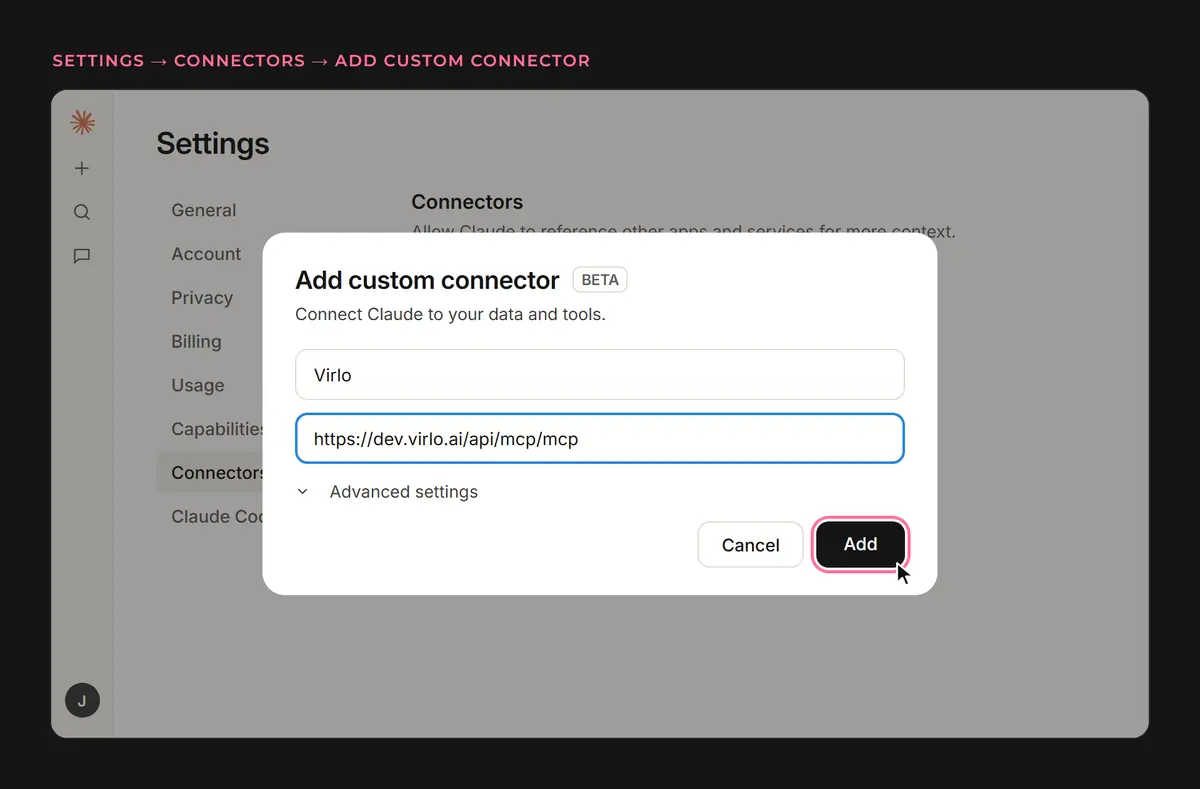
In Claude Code, run this, then type /mcp and sign in:
claude mcp add --transport http virlo https://dev.virlo.ai/api/mcp/mcpWhat is the social media audit prompt?
The social media audit prompt below is the whole template. Fill in the brackets (your brand, handles, niche, hook category and 3 competitors) and leave everything else as it is.
Using Virlo: run a full TikTok + Instagram audit on [BRAND]
and give it to me as a report.

My accounts: TikTok [TIKTOK HANDLE], Instagram [INSTAGRAM HANDLE].
My niche: [NICHE, e.g. "protein snacks" or "budgeting app"].
Hook category: [ONE OF: fitness, food_beverage, beauty, fashion,
tech, finance, health_wellness, lifestyle, education, other].
My 3 competitors: [COMPETITOR 1], [COMPETITOR 2], [COMPETITOR 3]
(TikTok or Instagram handles, say which).

PULL THE DATA
1. Run lookup_creator on each of my accounts (platform tiktok,
   then instagram) with include "videos,outliers", max_videos 100,
   trend_analysis true and data_intelligence true. Context: "which
   hooks, formats and lengths drive this brand's most-viewed
   videos". The hook, format and visual fields land a few minutes
   after the lookup, so read the saved run with get_satellite_run
   once it says ready.
2. Run lookup_creator on each competitor with include
   "videos,outliers" and max_videos 50.
3. Run get_trending_hooks with category [HOOK CATEGORY], days 14,
   sort weighted_score, limit 30.
4. Run get_content_trends with examples 3 and limit 20. Keep only
   the formats that fit [BRAND].

RULES
- Compare every video only to that account's own median views on
  that platform, never to its follower count.
- Skip posts with no views when you work out a median.
- Take hooks from the hook field, never from the caption.
- Length and hashtags are differences, not proven causes. Say so.
- Never invent a number. If it isn't in the results, say so.

WRITE THE AUDIT IN 7 SECTIONS
1. Outlier sweep: each platform's median, then every video at 3 times
   its median or more, biggest first (link, views, multiple, date,
   hook).
2. Hook audit: my hook types against my median, then the 10 hooks
   from step 3 I'm not using yet, word for word, with links.
3. Format and length: what I post most against what pulls the
   most views, per platform. Flag any video that hit on one app
   and died on the other.
4. Competitor benchmark: each competitor's median and top 3
   outliers, and the hooks and formats they win with that I never
   use.
5. Trend opportunities: the 3 formats from step 4 that fit
   [BRAND], with the recipe and one example video each.
6. Impact/Effort/Confidence matrix: every fix you found, scored
   1-5 on each, sorted by (impact x confidence) / effort.
   Confidence = how many videos back it: 1-2 low, 3-5 medium,
   6+ high.
7. 30/60/90-day content roadmap built from the top fixes: what to
   post each month and how many.

THEN MAKE 3 FILES
- A PDF report of the 7 sections, with the 3 fixes that matter
  most on page 1.
- An .xlsx tracker, one row per fix: section, fix, impact, effort,
  confidence, score, video links, status. Sorted by score.
- The roadmap as a one-page content calendar.
It takes a few minutes while the hook and format fields land, then the report comes back section by section. For more prompts in the same style, see the best Claude prompts for social media.
What does a finished social media audit look like?
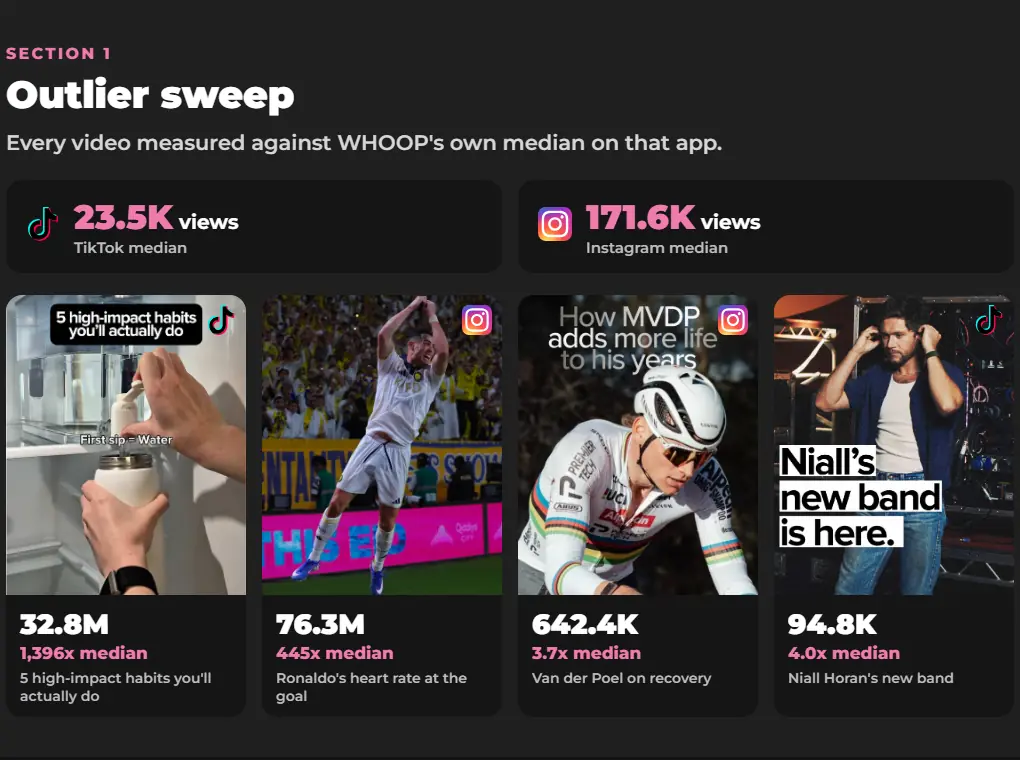
Here is the template run on WHOOP, the fitness band and app, with every count pulled live on 17 November 2026 across 53 TikToks and 53 Reels from the past year. WHOOP's TikTok median is 23.5K views and its Instagram median is 171.6K.
| Video | Platform | Views | Times its median |
|---|---|---|---|
| "5 high-impact habits you'll actually do" (hands only, 8 seconds) | TikTok | 32.8M | 1,396x |
| Ronaldo's heart rate at the goal | 76.3M | 445x | |
| Van der Poel on recovery | 642.4K | 3.7x | |
| Niall Horan's new band | TikTok | 94.8K | 4.0x |
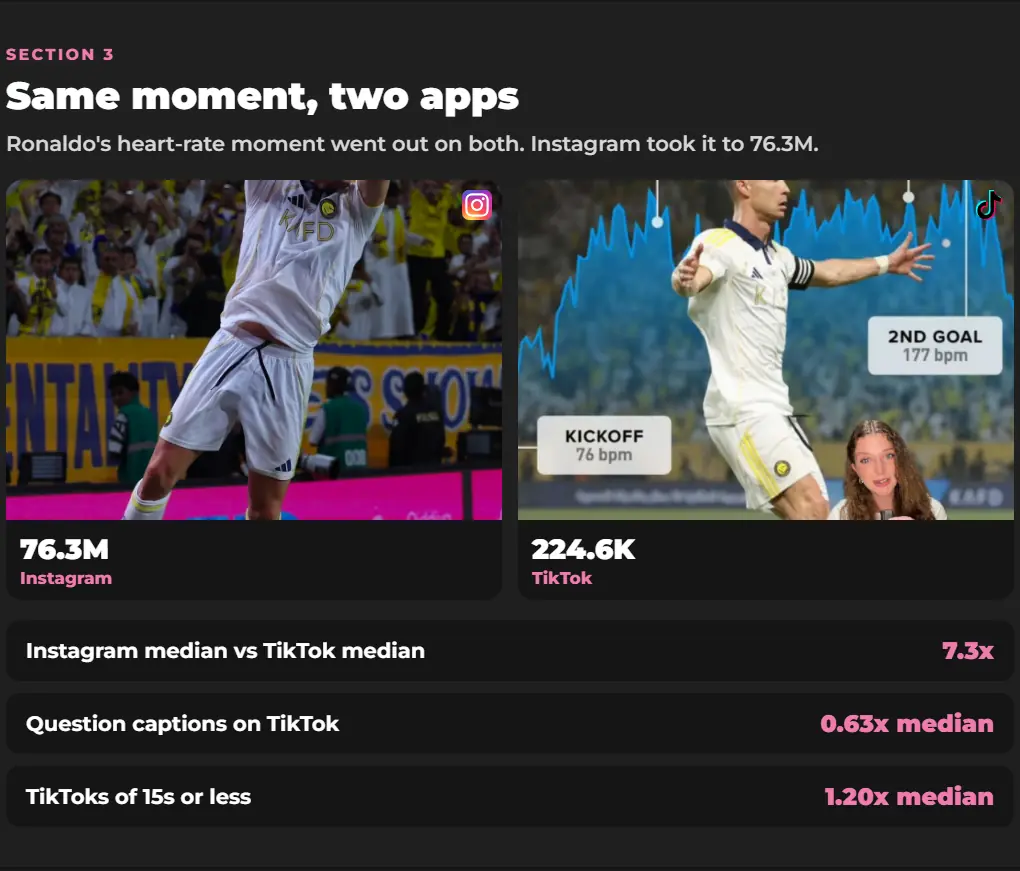
Section 3 caught a gap between the apps: the Ronaldo heart-rate moment did 76.3M on Instagram and 224.6K as a TikTok. On TikTok, question captions ran at 0.63x the median and videos of 15 seconds or less at 1.20x (a difference, not a proven cause).
How do you prioritise fixes after a social media audit?
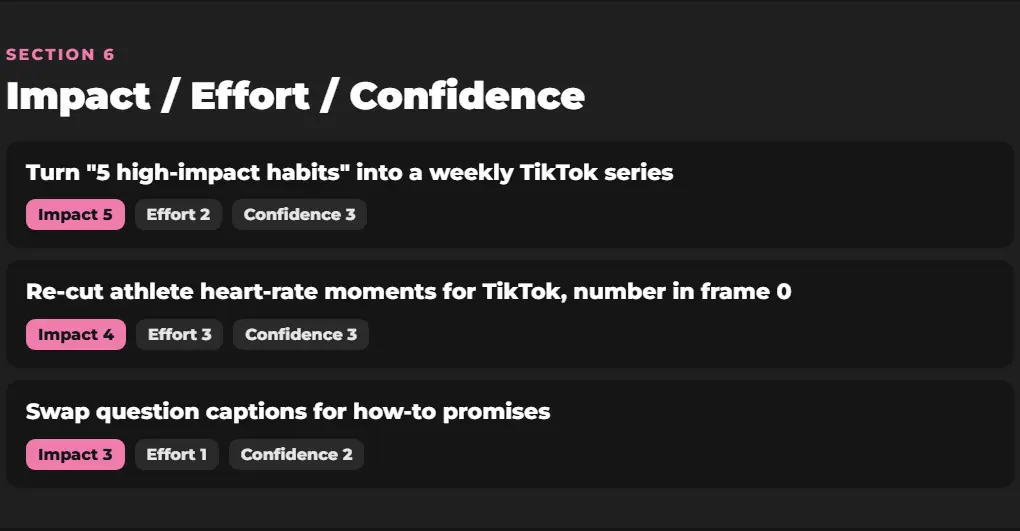
Prioritise audit fixes by (impact x confidence) / effort, with confidence set by how many videos back each fix: 1 to 2 is low, 3 to 5 medium, 6 or more high. The WHOOP sample produced these 3, scored as judgement calls on the real data above:
| Fix | Impact | Effort | Confidence | Backed by |
|---|---|---|---|---|
| Turn "5 high-impact habits" into a weekly TikTok series | 5 | 2 | 3 | The 32.8M outlier plus 4 tutorial-promise TikToks at 1.44x the median |
| Re-cut athlete heart-rate moments for TikTok, number in frame 0 | 4 | 3 | 3 | The 76.3M vs 224.6K pair |
| Swap question captions for how-to promises | 3 | 1 | 2 | 6 question-caption TikToks at 0.63x vs 1.14x for the rest |
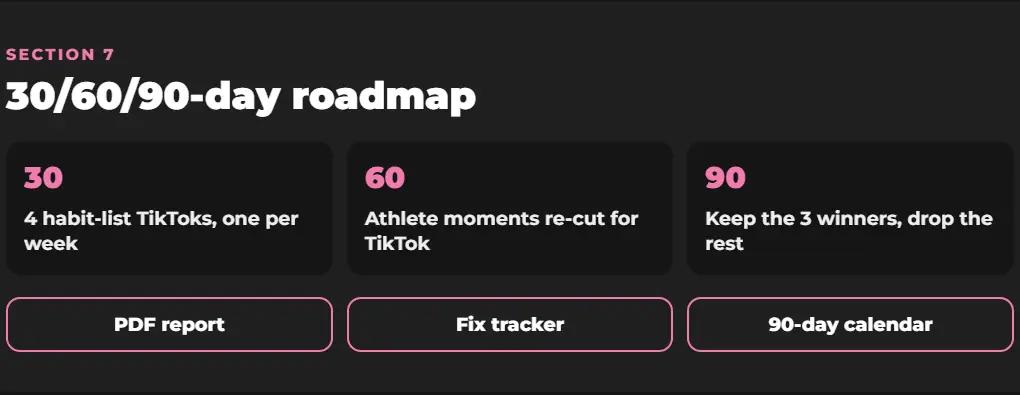
Then open the tracker, sort by score and do the top 3 for 30 days. Run the same prompt again at day 30 and see which fixes moved your median. To dig into competitors beyond section 4, use the competitor content analysis or the Instagram competitor analysis.
Rather skip Claude? Look up your account, your competitors and your niche inside the Virlo web app.
How this resource was made
- Source
- Virlo: WHOOP's TikTok and Instagram videos from 17 November 2025 onwards (53 TikToks, 53 Reels), live view counts pulled 17 November 2026; each multiple is live views divided by the median of the same account on that platform. Audit pricing from Webtonic (2026) and SocialRails; turnaround from Giraffe Social Media and Volume Nine.
- How this page is made
- Written by the Virlo team from the original One-Prompt Social Media Audit resource. The prompt is unchanged.
- Limitations
- The WHOOP fix scores are judgement calls on real data, shown as a sample. Length and caption patterns are differences, not proven causes.
- As of
- (first published November 17, 2026)
Source: Virlo, Social media audit template: a 7-section TikTok and Instagram audit from one Claude prompt, November 2026, virlo.ai/resources/social-media-audit-template
Want the full list?
Run a 7-section TikTok and Instagram audit on your own account, measured against your own median. Virlo is social listening for TikTok and Instagram Reels: start a 7-day free trial at app.virlo.ai and see real videos from your niche before you pay.
Frequently asked questions
What is a social media audit?
A review of an account's posts to find what works, what doesn't and what to change. A useful one measures each post against the account's own median views and ends with a ranked list of fixes.
What should a social media audit template include?
An outlier sweep, a hook audit, format and length, a competitor benchmark, trend opportunities, a scored fix matrix and a 30/60/90-day roadmap.
How do you do a social media audit on TikTok and Instagram?
Pull your videos from the last year on each platform, work out each platform's median views, flag videos at 3x the median or more, then compare hooks, formats, competitors and trends. The prompt on this page does it in one run.
How much does a social media audit cost?
Agencies quote $2,500 to $5,000 (Webtonic, 2026), and some list $500 to $2,500 (SocialRails), usually with 2 to 4 weeks to deliver.
Why compare posts to your own median instead of followers?
Follower count doesn't predict views. Your median shows what's normal for your account, so a 3x video is a real outlier.
What is an impact/effort/confidence matrix?
Each fix is scored 1 to 5 on impact, effort and confidence, then sorted by (impact x confidence) / effort so the cheap, likely wins come first.
Can I audit my competitors too?
Yes. Section 4 pulls each competitor's median, top 3 outliers and the hooks and formats they win with that you don't use.
What files does the audit produce?
A PDF report with the 3 top fixes on page 1, an .xlsx fix tracker sorted by score, and a one-page 90-day content calendar.
How often should I run a social media audit?
Every 30 days: do the top 3 fixes, rerun the prompt and check which ones moved your median.
Related free resources
- Competitor content analysis: find the brands your size posting outl...
- Instagram competitor analysis with Claude: outliers, hooks, Meta ad...
- Outlier videos for every client, found and briefed every Monday
- TikTok content strategy for a brand with zero videos, built from co...
- Best Claude prompts for social media: 25 questions to ask 23.3M vir...
- Claude for social media: the prompts and daily routine for every ac...
- All Virlo resources
- TikTok trends this week
Run this on your own niche
Run a 7-section TikTok and Instagram audit on your own account, measured against your own median.
7-day free trial, easy to cancel.