Static ads: 35 styles from 132 Meta ads, mapped to every stage of the funnel
Updated
Static ads work best when the style matches what the buyer already knows: native screenshots and memes for unaware buyers, us-vs-them tables and data cards for solution-aware buyers, discounts and bundles for buyers ready to purchase. Virlo sorted 132 static Meta ads from 85 brands into 35 styles; the longest-running, Suavecito's bundle ad, had been live 1,157 days.
- 35 static ad styles, each mapped to the buyer stage it's built for
- The longest-running statics and the creatives brands copied most
- A Claude prompt that writes your next 10 static ad briefs
Which static ad style should you use for each funnel stage?
Pick the static ad style by what your buyer already knows. A great bottom-of-funnel static fails on cold traffic because it answers a question nobody has asked yet, so start from the buyer's awareness level, then choose from the styles built for it.
| What they know | Styles to start with |
|---|---|
| Unaware | Native screenshot, Meme, POV or one-line story, Loud or surreal visual |
| Problem aware | Problem question headline, Warning headline, Post screenshot, Report or guide cover |
| Solution aware | Us vs them table, One-line mechanism, Expert quote, Chart or data card |
| Product aware | Customer quote card, Review screenshot, Theirs vs ours price, Award or ranking |
| Most aware | Big discount, One huge price, Deadline |
Don't test static ads across levels. Unaware ads win on click-through almost every time, so a mixed test tells you nothing; compare like with like. For the same awareness logic applied to hooks, see the types of hooks.
What do top, middle and bottom of funnel static ads look like?
One static ad style from each stage shows how differently they work. All three are real Meta ads from the swipe file.
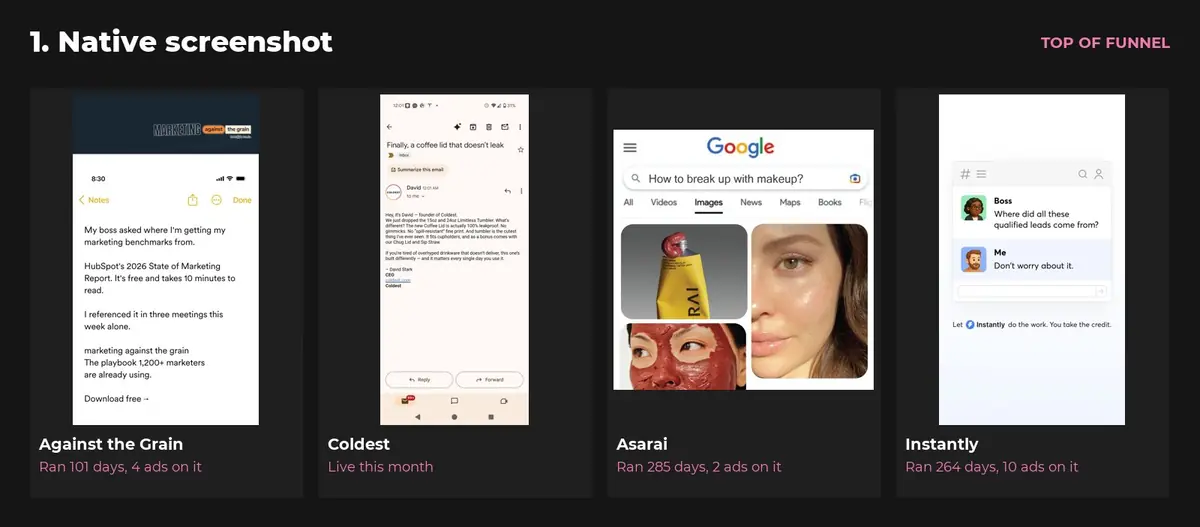
Top of funnel: native screenshot. It reads like something a friend sent you, so the ad filter stays off until the brand turns up. Asarai's Google-search static ran 285 days; Against the Grain's Notes-app static ran 101 days on 4 ads.
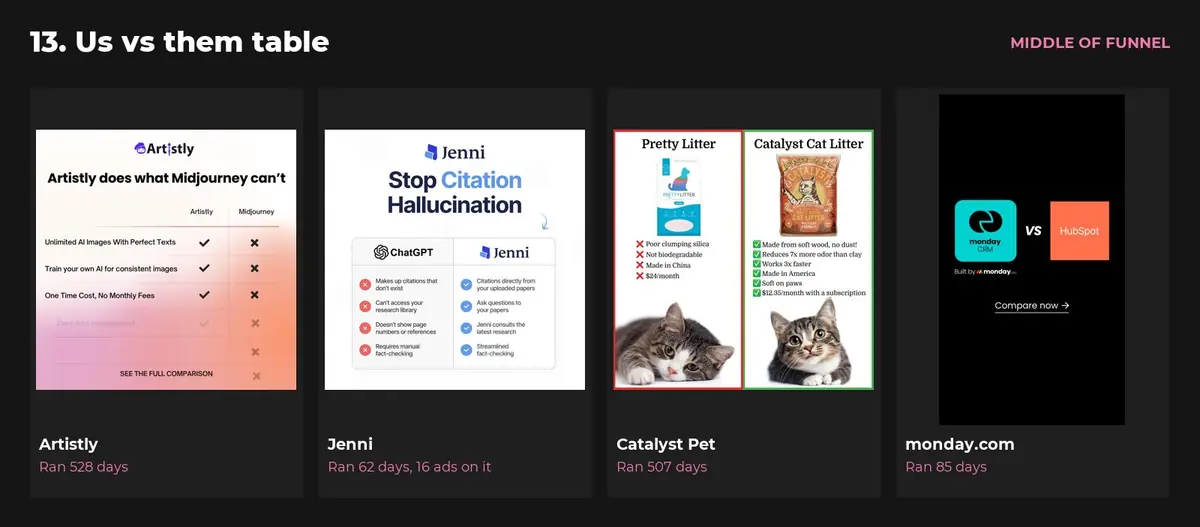
Middle of funnel: us vs them table. Buyers compare anyway, so the table lets you set the rows. Artistly's ran 528 days, Catalyst Pet's 507 days, and Jenni put the same table on 16 ads.
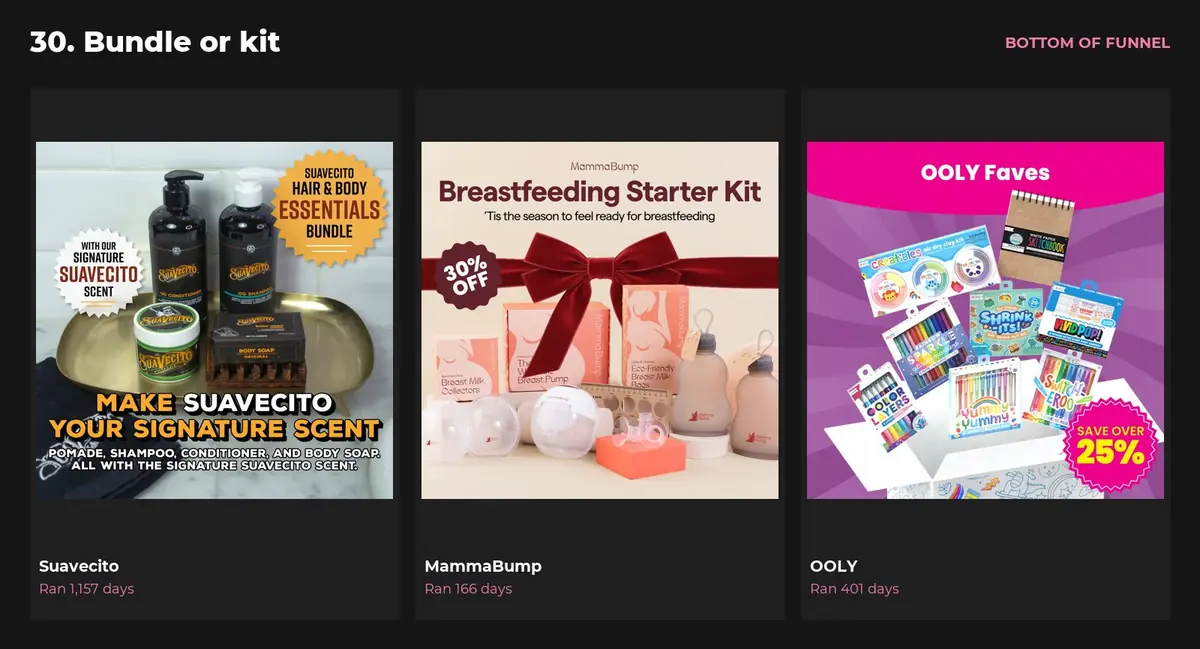
Bottom of funnel: bundle or kit. More stuff for the money, and the choice is made for the buyer. Suavecito's hair and body bundle is the longest-running static in the file at 1,157 days.
Which static ads have run the longest on Meta?
Suavecito's bundle static had run 1,157 days when the Meta Ad Library was pulled on 1 October 2026, the longest in the file. Meta doesn't show spend, so how long a static ad stays live and how many ads share one creative are the signals to go on.
| Brand | Style | Funnel stage | Days running | Ad |
|---|---|---|---|---|
| Suavecito | Bundle or kit | Bottom | 1,157 | See it |
| Artistly | Loud or surreal visual | Top | 528 | See it |
| Catalyst Pet | Loud or surreal visual | Top | 507 | See it |
| Catalyst Pet | Benefit checklist | Middle | 424 | See it |
| OOLY | Bundle or kit | Bottom | 401 | See it |
| J.J. Sorel | Customer quote card | Middle | 384 | See it |
| Natural Catch | Aesthetic lifestyle shot | Top | 380 | See it |
| Foreplay | Meme | Top | 315 | See it |
| Brand | Style | Ads on one creative | Ad |
|---|---|---|---|
| Neil Patel | Chart or data card | 57 | See it |
| HighLevel | Launch or new drop | 30 | See it |
| MicroPerfumes | UGC-style phone photo | 27 | See it |
| Jenni | Us vs them table | 16 | See it |
| Zapier | Product UI shot | 13 | See it |
The same two signals, days live and copy reuse, rank the video ads in the supplement Facebook ads swipe file and the seasonal ones in the Black Friday ads swipe file.
What are the 35 static ad styles?
The 35 static ad styles split into 12 for the top of the funnel, 15 for the middle and 8 for the bottom. The swipe file holds 43 top, 54 middle and 35 bottom-of-funnel ads. Each style's build rules are in the brief prompt below.
| Stage | Styles |
|---|---|
| Top of funnel (1 to 12) | Native screenshot, Post screenshot, Advertorial headline, Meme, POV or one-line story, Warning headline, Big stat, Problem question headline, Loud or surreal visual, Founder or face photo, Aesthetic lifestyle shot, UGC-style phone photo |
| Middle of funnel (13 to 27) | Us vs them table, Before and after, Theirs vs ours price, Customer quote card, Review screenshot, Expert quote, Annotated product, Benefit checklist, Chart or data card, Product UI shot, Integration card, One-line mechanism, Education card, Award or ranking, Report or guide cover |
| Bottom of funnel (28 to 35) | Big discount, One huge price, Bundle or kit, Free gift for a demo, Free product offer, Deadline, Where to buy it, Launch or new drop |
If your product runs on creators instead of designers, the video equivalent is in the UGC ad examples.
How do you write static ad briefs with Claude?
Fill in the first five lines of this prompt and paste the whole thing into Claude. It picks 10 static ad styles for your product, writes a complete designer brief for each, checks them and ranks which to make first. No Virlo connection is needed for this step.
You are a senior Meta ads creative strategist. Write static ad briefs for my product, using only the 35 styles listed at the bottom.

MY PRODUCT: [what it is, who buys it, what it costs]
MY OFFER: [the current offer, deadline if there's a true one]
PROOF I CAN USE: [reviews, customer quotes, numbers, press, awards. Only true ones]
ASSETS I HAVE: [product photos, customer photos, screenshots, founder photos]
STYLES ALREADY LIVE: [the styles I'm running now]

Do this in order:

1. If any input is missing or vague, ask me for it before writing.
2. Pick 10 styles. Default mix: 6 for unaware and problem aware buyers, 4 for solution aware and product aware buyers. If I spend under about $2,000 a day, leave out pure unaware styles and start at problem aware. Make at least 2 of the 10 wild bets: an angle nobody in my market is using. Skip any style my proof or assets can't support, and skip the styles I'm already running. Group the 10 by buyer stage, because ads at different levels shouldn't be judged against each other in one test.
3. For each one, write a complete brief using this template:

STATIC AD BRIEF

Style (from the 35):
Funnel stage (top / middle / bottom):
Target buyer (one specific person):
What they believe right now:
The one thing this ad must say:

ON THE IMAGE
Headline (under 8 words):
Supporting line (optional, under 12 words):
Proof element (review, number, logo, press):
Offer (bottom of funnel only):
Logo position and size:

THE PICTURE
Format (1:1, 4:5 or 9:16):
Main visual, described so a designer can shoot or build it:
What it should look like (brand ad, Notes app, Gmail, post, photo from a phone):
Reference ad from the swipe file:

AROUND THE IMAGE
Primary text, first line:
Primary text, rest:
Headline field:
CTA button:
Landing page:

CHECKS
Two-second test: show it for two seconds. Can they say who it targets and what it says?
Squint test: zoom out on this ad next to your live statics. Does it look different?
Is every claim and number on it true and sourced?

4. Write the words exactly as they should appear on the image. Short lines, plain words, the way my buyer talks.
5. For each ad, write the headline to match the buyer stage in brackets next to the style: curiosity for unaware, the problem in the buyer's own words for problem aware, why the old ways fail for solution aware, proof for product aware, the offer for most aware.
6. Add one image-generation prompt per brief for anything that can be generated (backgrounds, scenes, product settings). Leave product packaging, logos, reviews and interface screens for me to add from real assets.
7. Run the two-second test and the squint test on your own briefs. Rewrite any that fail, then rank all 10 by which I should make first and say why in one line each.

Rules: never invent a review, number, award, customer or result. If a style needs proof I don't have, drop it and pick another. Don't name a competitor unless I ask you to.

THE 35 STYLES

TOP OF FUNNEL
1. Native screenshot [Unaware to problem aware]: Screenshot an app your buyer opens every day (Notes, Gmail, Google, Slack). Keep the top bar and the buttons so it looks untouched. Write one message in plain words and put the brand in the last line.
2. Post screenshot [Problem aware]: Use a post a customer wrote, with their permission. Blur the name if you need to. Keep the likes on it as they are. Add one framing line above it.
3. Advertorial headline [Problem aware to solution aware]: Serif type on a white ground, first person or reported tone, one specific result, product shots underneath. Skip the logo until the bottom corner.
4. Meme [Unaware to problem aware]: Pick a format your buyer already knows. Make the joke about their problem, let the product be the punchline, and keep the logo small at the bottom.
5. POV or one-line story [Unaware]: Moody product photo, one sentence in the middle, no claim and no offer. Good for brands with a story behind the product.
6. Warning headline [Problem aware to solution aware]: Huge block headline, then the qualifier in smaller type, then the product and three proof chips.
7. Big stat [Problem aware to solution aware]: One giant number, one line of context, the logo. Say where the number came from in the fine print or the primary text.
8. Problem question headline [Problem aware]: The question goes at the top in the reader's own words, with one image of the problem or the product under it. Save the offer for later.
9. Loud or surreal visual [Unaware]: One impossible or exaggerated image. Keep the copy to one short line and make the joke about the product's main job.
10. Founder or face photo [Problem aware to product aware]: Phone photo of a founder, expert or host looking at the camera. Keep text on the image to a line at most and let the primary text carry the pitch.
11. Aesthetic lifestyle shot [Product aware]: Editorial photo with the product in use, one short line at most, and a quiet logo. Test it against the same product on a plain ground.
12. UGC-style phone photo [Problem aware to product aware]: Phone camera, an everyday location, product in a hand or a bag, and one white caption box like a story sticker.

MIDDLE OF FUNNEL
13. Us vs them table [Solution aware]: Two columns, you on the side with the ticks, four rows at most, and every row is something the buyer already cares about. Name a competitor only if your legal team is happy.
14. Before and after [Solution aware to product aware]: Two panels, same framing, one clear change, both labelled. Check Meta's rules first in health and beauty, and only show results that happened.
15. Theirs vs ours price [Product aware]: Two products side by side, one price under each, and one word to label the difference.
16. Customer quote card [Solution aware to product aware]: Stars, one quote with the key phrase in bold, first name, and the product in shot.
17. Review screenshot [Product aware]: Screenshot a review from Trustpilot or the App Store, with the person's name and role showing. One review per ad.
18. Expert quote [Solution aware]: Name, title, face and one sentence. Use someone who has agreed to it, and keep their credential on the ad.
19. Annotated product [Solution aware to product aware]: Product on a plain ground, three or four callouts, each one a feature in two to four words.
20. Benefit checklist [Solution aware to product aware]: Hero image plus three to five ticks. Keep each tick under six words.
21. Chart or data card [Solution aware]: One finding as the headline, one simple chart, and the source on the ad.
22. Product UI shot [Solution aware to product aware]: A true screen in a phone or browser frame, with a headline that names the job it does.
23. Integration card [Solution aware]: Two logos and an arrow, with a headline that says what now happens by itself.
24. One-line mechanism [Solution aware]: Macro shot of the product or ingredient, plus one plain sentence on how it works.
25. Education card [Unaware to problem aware]: A title like "101" or "Quick tip", one idea per image, small logo.
26. Award or ranking [Product aware]: Put yourself at the top of the list, and keep the source and date on the ad.
27. Report or guide cover [Problem aware to solution aware]: Mock up the cover, make the title say what's inside, and use a Download button.

BOTTOM OF FUNNEL
28. Big discount [Most aware]: Discount in the largest type on the ad, product in a real room, one line on how long it lasts.
29. One huge price [Most aware]: One price in huge type, the product, and little else competing with it.
30. Bundle or kit [Product aware to most aware]: Everything in the kit in one shot with a bow, a badge or a tray. Say what's included.
31. Free gift for a demo [Solution aware to product aware]: Headline says book a demo, get a [gift]. Clean photo of the gift. Terms in the fine print.
32. Free product offer [Product aware to most aware]: Say exactly what's free and put a dollar value on it. Add the code on the ad.
33. Deadline [Most aware]: FINAL HOURS or ENDS AT MIDNIGHT in a black bar. Only run it when the deadline is true.
34. Where to buy it [Product aware to most aware]: Retailer logo or store address, product on the shelf or in a basket.
35. Launch or new drop [Product aware]: One word on the news, a hero shot, and a sign of scarcity if it's true.
The prompt never invents reviews or numbers and leaves packaging, logos and reviews for you to add from real assets. For hook lines to put on the image, browse Virlo's viral hooks data.
How do you see your competitors' static ads?
These 132 static ads come from someone else's market. To see the image ads your own competitors are running, connect Claude to Virlo's live Meta Ads data and filter to ads with no video.
- Sign up with the 7-day free trial.
- Add Virlo to Claude as a custom connector using the URL below; switch it on in each chat. Steps: Virlo for Claude.
- Paste the static ads prompt with three brands you compete with.
https://dev.virlo.ai/api/mcp/mcpUse Virlo to pull the live Meta ads from [BRAND 1], [BRAND 2] and [BRAND 3]. Run search_keywords with enable_meta_ads set to true and the brand names plus their product names as keywords. When it's finished, read get_keyword_search_results with data_type "ads" (all pages) and keep only ads from those brands that are images (ads with no video). For each ad give me the days running, how many of the brand's ads share the same copy, the headline, the CTA, the landing page and the Ad Library link. Then sort by days running and tell me which brand has kept which offer live longest, which copy each brand duplicates most, and which funnel stage each ad is aimed at. Never invent a number.A pull with Meta ads on can take up to about 45 minutes; ask "is it done?" to check. Then pick the 3 longest-running ads from your pull, match each to a style above and hand the briefs to your designer. Lock the headline and test the image. More ways to read rivals: competitor ads ranked by days live, or Virlo's Meta Ads Library feature.
Want this on your own competitors without Claude? Search live Meta ads inside the Virlo web app.
How this resource was made
- Source
- Virlo: 132 static Meta ads from 85 brands, pulled from the Meta Ad Library on 1 October 2026; some rechecked as still live in November 2026. Days running = days live at the 1 October pull.
- How this page is made
- Written by the Virlo team from the original Static Ad Swipe File; every ad was sorted into its style by hand.
- Limitations
- Meta does not publish spend, so days live and ads per creative are proxies. Some ads have no day count because they were only seen live in November.
- As of
- (first published November 9, 2026)
Source: Virlo, Static ads: 35 styles from 132 Meta ads, mapped to every stage of the funnel, November 2026, virlo.ai/resources/static-ads
Want the full list?
Pull any brand's live Meta image ads ranked by days running and copy reuse, from Virlo's database of Meta Ad Library ads. Virlo is social listening for TikTok and Instagram Reels: start a 7-day free trial at app.virlo.ai and see real videos from your niche before you pay.
Frequently asked questions
What is a static ad?
A single-image ad with no video, such as a screenshot, a comparison table, a quote card or a discount graphic.
Do static ads still work on Meta?
Brands keep paying for them: in this file Suavecito's bundle static ran 1,157 days and Neil Patel put one data-card static on 57 ads.
Which static ad style works best for cold traffic?
Styles that don't look like ads: native screenshots, memes, one-line stories and loud or surreal visuals, aimed at unaware buyers.
Which static ad style works best for retargeting?
Bottom-of-funnel styles for most-aware buyers: big discount, one huge price, deadline, and bundle or kit.
How many static ads should I test at once?
The brief prompt writes 10: about 6 for unaware and problem-aware buyers and 4 for solution and product-aware buyers, with at least 2 wild bets, grouped by stage.
What size should a Meta static ad be?
The brief template uses 1:1, 4:5 or 9:16.
Can AI make static ads?
AI can make backgrounds and scenes. The prompt leaves product packaging, logos, reviews and interface screens for you to add from real assets, and you should check every word on the image.
How do I find my competitors' static ads?
Search them in the Meta Ad Library, or connect Claude to Virlo and ask for their image ads with no video, sorted by days running.
Where does this static ad data come from?
From the Meta Ad Library, pulled through Virlo on 1 October 2026, with some ads rechecked as live in November 2026.
Related free resources
- Supplement Facebook ads: what RYZE, Huel and IM8 keep paying for
- Competitor ads: find the Meta ads your rivals keep paying for, then...
- UGC ad examples: 619 Meta ads 28 ecom brands run under creators' names
- Black Friday ads: 33 ecom brands and the 5 plays they started runni...
- How to use the Meta Ad Library with Claude to find the ads a brand ...
- Beauty TikTok examples: 239 winning videos from Rare Beauty, rhode ...
- All Virlo resources
- TikTok trends this week
Run this on your own niche
Pull any brand's live Meta image ads ranked by days running and copy reuse, from Virlo's database of Meta Ad Library ads.
7-day free trial, easy to cancel.