Hook Inflation: Why the Most-Copied Hooks Stop Working
We looked into our library of hooks and creators to find out why most used hooks stop working.

Himanshu Bisht
Professional Blog Writer
Himanshu Bisht is a digital community and content expert. With the strategies he shares, companies and creators have generated over 10 million dollars in combined sales. His views have been featured in the magazines like Forbes and Authority Magazine. Himanshu writes expert articles for creators on Virlo AI.
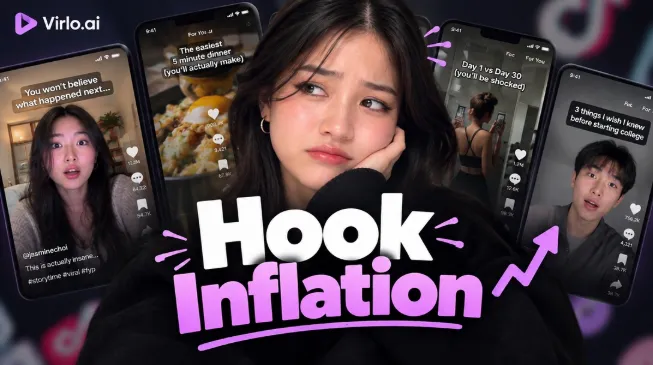
TikTok creators often use bold claim and the "here's how to" as their opening hooks. In fact, together they start 44% of the hooks in Virlo's data. But overusing hooks is the exact reason why they start losing value and lose the novelty that hooks are made more. This can be known as what I call "Hook Inflation."
Thousands of creators use Virlo every day to decide how their next video should open. Virlo tags the opening of every video it analyzes and counts how many creators reuse each hook from week to week. I went through that data on hundreds of tagged hooks, one week's 13 most-copied hooks and 74 copied formats and I was blown away.
How do you lose to a video with no hook?
Hook is important for a video to perform well. It ensures people understand the payoff early and stick to the end if the video is relevant. Virlo sorts the opening of every video into a hook type, then tracks how often each type produces a strong hit. A strong hit is a video that far outperformed its creator's usual views, so a big account doesn't win by default.
Across 1,365,774 TikToks, the four strongest and four weakest hook types hit at these rates:
Cliffhanger: 33.5% (a small sample of 813 videos)
POV: 32.9%
Mystery: 31.9%
Shock: 31.8%
No spoken or written hook: 28%
Bold claim: 22%
Stat: 21.8%
Call-out: 21%
How-to: 19.3%
Bold claims and how-tos open more than half a million of those videos between them. Question hooks come a distant third. And know that the five most-used types hold three quarters of all hooks and hit 22.3% of the time between them.
"No hook" here means nothing said or written in the opening. Many of those videos open on a strong image instead. And we have two types of hooks here: Text on screen, which is the most common first frame and hits 24.2%. But creators also use a shocking image which hits 39.5% and is a great opening format.
Most of the losing openings tell the viewer something up front: a claim, a lesson, a statistic. Most of the winners put the viewer inside a situation first, through a point of view, a cliffhanger or a surprise.
What is hook inflation?
Hook inflation is my name for what I think is happening: a hook loses pull as more creators copy it.
A hook is a claim on attention. It asks a stranger for the next few seconds on the promise that the video will repay them. Every copy prints more of that claim, while the viewer's seconds stay where they were.
And Hook Inflation has two parts, dilution and recognition.
Dilution works through the audience. Videos that share an opening usually share a topic, so they are candidates for the same feeds. A viewer who has just watched one version has less reason to watch the next.
I think recognition does more damage. A hook works by opening a question the viewer wants answered. A viewer who has heard "Stop doing this if you want to grow" many times already knows the shape of what follows.
Recognition can also help, which would explain the two popular types that stay strong.
A relatable or shock hook can't be reused as it is. Each one needs a new scene or a new surprise, so the type repeats while the content doesn't. Viewers who recognize the frame can still stay for your version of it.
A bold claim or a "here's how to" repeats the promise itself. Once the promise is familiar, the viewer can guess the payoff and leave.
Under this idea, a well-made line loses value the way a sound currency does, through quantity. And this creates inflation.
Why does everyone end up with the same hook?
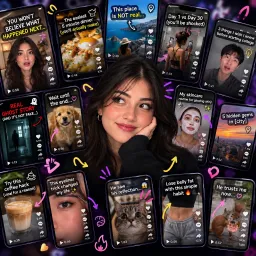
Borrowing a hook is a sensible decision every time one creator makes it. The winning video's opening is right there to study. Reusing it costs nothing.
What reaches your feed is already filtered, though. You see the version that won. The versions that went nowhere rarely show up, so the opening looks more reliable than it is.
Then the tools multiply it. A list of "hooks that still work" hands the same lines to every reader. A hook generator can write a batch of openers from a single topic.
Each of these tools does what it says. Together they put a proven opening in everyone's hands at the same moment. An opening that everyone can use at once gives no creator an edge over the others.
That makes a popular hook a shared resource. Each creator who borrows it gains a little and takes a little from everyone already using it.
How long does a viral hook last?
A copied hook can go from rising to fading in about a week. Wider copied formats, mostly built on a sound, largely ran their course within three months.
Virlo's hook library lists the hooks creators reused most each week. Each hook carries a stage, based on how many creators used it this week against last week:
Fresh: first seen in the last seven days.
Rising: ten or more creators, up 30% on last week.
Fading: down 30%.
Peaking: the rest.
For videos posted from November 13 to 20, the library listed 13 hooks reused by 792 creators. Seven of the 13 were Fading. Three were Peaking, two were Fresh and one was Rising.
The seven fading hooks had lost between 30% and 88% of their creators in a week. One story hook went from 178 creators to 22.
The single Rising hook was also the week's most-copied: "While they're out partying btw," with 297 creators, up from 114.
The TikTok trends pages track that hook day by day. About 84 creators a day posted it in the week of November 9, with a peak of 115 on November 14. The week of November 16 averaged 31 a day.
The week that made it the most-copied hook therefore included its peak day and the start of its slide. By November 28 its page showed 148 creators in seven days, against 325 the week before, with the stage at Fading.
"Maybe how-to videos just don't go viral"
Often times we start complaining about the formats. And that could be true. The type numbers can't rule it out, because tutorials may travel less than entertainment whatever the opening.
Skill could explain the gap too. Experienced creators may reach for a scene or a cliffhanger while beginners default to "here's how to." So could effort, if "here's how to" is the opener people use on a video they made quickly.
The numbers are also a snapshot. They show the most-used hooks underperforming today, without showing that those hooks got worse as they got popular.
The first ten copies of a hook against copies 91 to 100, each measured against its creator's usual views. If the late copies do worse, inflation is real. If they do just as well, genre or skill explains the gap and this idea is wrong.
Although, I must say, there are hooks that work in season. And you can always reuse the hooks after the trend dies. For example, popular Indian Tiktok started becoming popular on US Instagram after 4 yrs of ban. Whichever explanation wins, the conclusion for a tutorial creator is the same. "Here's how to" is the weakest opening in the data.
What does 3 million views prove about a hook?
A hook gets copied because of the number next to it. That number has at least three sources: the size of the account, luck and the opening. Only the opening can be borrowed.
The opening's own record is modest. Even the strongest hook type in the data misses about two times in three. A how-to misses four times in five.
One hit therefore says as little about a hook as one flop does.
Copied formats show how unevenly the views fall. The median format in the set has about 315 videos. Its top video holds a median 11.7% of all the views.
In 13 of the 74 formats, the top video holds a quarter or more. The median top video has about 11 million views, while the other videos average about 263,000 each.
Even that average flatters a normal copy, because a few large videos lift it.
The "0 to 100 percent loading transformation" format has 878 videos and 69.2 million views. Its top video has 21.2 million. The next video on its page has 350,000.
Some of that gap is also the account size, which a borrowed hook leaves behind. Some of it may be luck.
A 2006 experiment published in Science shows how luck enters. Matthew Salganik, Peter Dodds and Duncan Watts let 14,341 people download unknown songs. Some groups could see what earlier listeners had chosen, while others chose blind.
Where people could see earlier choices, success became more unequal and harder to predict. Quality set the limits, since the best songs rarely flopped and the worst rarely won. Between those limits, a song could land almost anywhere.
A feed that shows view counts and promotes what people already watch resembles the first kind of market. The video you want to copy owes part of its number to that process.
So 3 million views proves less about the opening than it appears to. The account and the luck stay with the original.
Why would viewers skip a hook they recognize?
Web users learned to do exactly that with ads.
Nielsen Norman Group first documented banner blindness; people ignoring whatever looks like an ad, in 1997. Its 2018 eye-tracking study found the same habit on phones.
People in that research also skipped content that only resembled an ad or sat where ads usually sit. The researchers described ignoring ads as learned behavior.
I read copied hooks the same way. Once an opening signals "this is one of those," a viewer can skip it without weighing what's inside.
An opening that doesn't sound like a hook has nothing familiar to skip, which may be part of the no-hook result.
Attention is also turning over faster. A 2019 study in Nature Communications tracked how long a hashtag stayed in Twitter's global top 50. The average fell from 17.5 hours in 2013 to 11.9 hours in 2016.
The authors found similar speed-ups in several other places, including Google searches, Reddit comments and movie ticket sales. They put it down to more content competing for the same limited attention.
Neither study looked at TikTok hooks. Both describe habits viewers bring to any feed.
How to survive the hook copycats?
A copied hook has three layers: the words, the template and the mechanism.
The words. "While they're out partying btw."
The template. The library prints one under every hook. This one reads "While they are out partying btw [you practising a skill from your job]."
The mechanism. A contrast between what everyone else is doing and what you're doing instead.
The trend page for this format says to keep the on-screen text and the audio, then swap the activity. That fits a rising trend, where recognizing the joke is part of the fun.
Once a hook is peaking or fading, I'd go one step further and change the wording too. Exact wording is the layer viewers are likely to recognize first, while the mechanism can be rebuilt in new words.
That contrast could be rebuilt like this:
A baker: "Everyone's asleep. But we are cooking"
A developer: "The team's at happy hour. I'm on take nine."
A runner: "Group chat says brunch. My watch says mile nine."
The type numbers hint at which mechanisms hold up. Hooks that drop the viewer into a scene or an open question beat hooks that announce a lesson.
Can a tutorial open without "here's how to"?
How-to ranks last of the 16 types. For teachers, coaches and product accounts, it's also the most natural opening.
Those accounts can keep teaching and move the lesson out of the first line. An opener like "Here's how to get more views on your videos" could become any of these:
A scene: "Me rewatching my own video to find the second everyone left."
An open question: "I posted the same video twice. Watch what the second one did."
A first frame: the finished result on screen for a second, before any words.
Each starts the viewer inside a situation with a question still open, before the lesson begins.
The first frame carries as much weight as the line. Text on screen hits 24.2%, below every other first-frame type Virlo publishes. Motion or action in the first frame hits 34.4%.
After the opening, a tutorial can follow a result, steps, mistake structure, one of eight script frameworks for short video.
Which hooks still work? Three checks before you borrow one
Borrowing still makes sense when the timing and the wording hold up.
1. How crowded is it?
A how-to, bold claim, question, story or call-out puts you in the five types that hold three quarters of TikTok hooks.
For a specific line, the hook library shows how many creators reused it in the past week. Most lines from a list won't be there. A TikTok search for the exact line, filtered to the past week, shows roughly how many versions exist.
No number marks the point where a hook becomes too crowded. The count works best as a comparison between two hooks you're choosing from.
2. Which way is it moving?
A count of 148 creators can describe a hook on the way up or one that had 325 a week earlier.
Each trend page attaches a call to its stage:
Fresh: "early, worth jumping on now"
Rising: "early enough to ride it"
Peaking: "post your version now, before it turns"
Fading: "late, only worth it if it fits you really well"
A stage can flip inside a week, as the partying hook's did. The label is worth rechecking on the day you post.
By the time a hook reaches a weekly list it may have peaked, which is the argument for finding TikTok trends early.
3. After posting: was the hook even the problem?
The opening is only one possible cause of a flop. Your analytics for the first seconds separate it from the others.
On YouTube Shorts, "viewed vs. swiped away" shows the share of people who stayed past the opening.
On TikTok, the retention graph shows how many viewers left in the first seconds.
Those numbers mean something only against your account's usual ones.
If the opening held as well as usual and the video still underperformed, the hook did its job. The cause sits in the topic, the rest of the video or ordinary variance.
If the opening lost more viewers than usual, the hook is the suspect. A crowded or fading hook is worth ruling out first.
The same check works on your own repeated openers. Followers see your videos more often than strangers do, so they may be the first to tire of a line you reuse.
If the early numbers slip each time, the opener is ready to retire. If they hold, it is working as a signature your regulars recognize.
Old hooks can come back. The trend page traces the partying caption to a December 2025 TikTok, ten months before the current run began.
What should a brand brief say instead of "use the trending hook"?
The partying hook went from Rising to Fading in eight days. A brief that takes longer than that to approve can ship a hook in decline.
The same clock applies to clipping campaigns, which put cuts of one source video on many accounts at once.
Paid ads add repetition, since the same audience sees the same ad many times. TikTok's ads blog says performance "can soften as audiences see the same assets repeatedly."
A brief could change in four ways:
Brief the mechanism and leave the wording open. For example: "Open on the customer's problem as a scene. No voiceover in the first second. Write your own line."
Check the stage at sign-off and again on posting day. The trend page or the hook library shows it.
Order several openings for one video body. For UGC ads, a second and third hook give the ad a replacement when the first one tires.
Review creators on openings they wrote. A creator who can turn a mechanism into a new line keeps delivering after a template fades.
So what is a hook library for?
We have published a hook library and a hook generator, which can look like the cause of the problem described here.
Used as a list of lines to post this week, the library would feed it. Hundreds of creators would pick the same line at the same time.
Used as a price board, it does a different job. The creator count and the stage show how many copies are in circulation and which way the number is heading. The template exposes the mechanism underneath.
The generator belongs at the last step, turning that mechanism into wording that isn't in circulation yet.
If hook inflation is real, the scarce thing is a reason to keep watching, delivered in words your viewers haven't learned to skip.
FAQ
What is hook inflation?
Hook inflation means a hook loses pull as more creators copy it. Viewers split their attention across the copies and learn to recognize the opening. Virlo's data points that way, though the loss hasn't yet been measured copy by copy.
Do hooks still work in 2026?
Hooks still work in 2026, though the types differ widely. On TikTok, POV, mystery and shock hooks produce strong hits about 32% of the time. Bold claims and how-tos, the two most-used types, hit 22% and 19.3%, below the 28% for videos with no hook.
What are the best TikTok hooks in 2026?
By type, cliffhanger, POV, mystery, shock and relatable hooks win most often in Virlo's data. By specific line, the list changes weekly. A hook's stage on posting day deserves more attention than its place on a list.
How long does a viral hook last?
A copied hook can go from rising to fading in about a week. The most-copied hook of the week to November 20 was marked Rising then and Fading eight days later. Of 74 wider copied formats, 76% were fading or archived within 89 days of being first seen.
Should I copy viral hooks?
Copying is reasonable when the hook is fresh or rising and not crowded. For a hook that's peaking or fading, keeping the mechanism and changing the wording avoids a line viewers have already seen many times.
Why did my hook stop working?
Possible causes include ordinary variance, a crowded or fading hook, and an audience that has seen you use the line too often. First-seconds retention against your usual numbers shows whether the opening was the weak point.
Are hook templates bad?
Hook templates are a sound starting structure, especially for a hook that's still rising. The risk comes from using one unchanged after it has peaked. Keeping the mechanism and writing your own words keeps the benefit.
Does this apply to Instagram Reels?
The numbers in this article are TikTok data. On Instagram Reels the order of hook types is similar and every rate is lower, with comparison, POV and mystery hooks near the top on both. Cliffhanger hooks hit 33.5% on TikTok and 18.7% on Reels.
See What's Trending Right Now
- Social listening for TikTok, Reels & Shorts
- Spot viral trends before they peak
- Turn insights into ads, scripts & briefs
The Signal Newsletter
Weekly trend breakdowns, creator insights, and social listening tips — straight to your inbox.
Subscribe FreeSee Virlo in action
See What's Trending Right Now
- Social listening for TikTok, Reels & Shorts
- Spot viral trends before they peak
- Turn insights into ads, scripts & briefs
The Signal Newsletter
Weekly trend breakdowns, creator insights, and social listening tips — straight to your inbox.
Subscribe FreeRelated Articles
Fandom or Friendship? How TikTok & YouTube Blur the Lines
Have you ever stumbled upon a TikTok creator during your daily scroll and instantly felt like they just get you? Someone whose content feels like a safe space, prehaps a comfort creator, offering advice, laughs, or just a glimpse into a life that feels like an escape from yours? You’re not alone.
The Best Time To Post On Instagram (2026)
Generic best-time charts average everyone together and miss your audience. Here's the real data by day, plus how to find the exact windows that work for your niche.
9 Best Video Engagement Analytics Tools for Agencies in 2026
Agency analytics work is different from in-house brand analytics. The questions change. Instead of "how did our content perform this week," the question becomes "how do I show three different clients, with three different content strategies, that what we are doing is working — and back it up with...
Put this into practice with Virlo
Turn what you just read into real research. These are the tools creators, agencies, and brands use to find what's working on short-form video.
Content Research Agent
Run your short-form research on autopilot — outliers, creators, and sounds across TikTok, Reels, and Shorts.
Tracking Center
Monitor breakout creators, videos, and competitors with daily snapshots and deep AI analysis.
Free Data
Explore free viral hooks, trending niches, breakout products, and more — no account required.
Get The Signal
Join creators, marketers, and agencies getting weekly trend breakdowns and social listening insights delivered free.
Subscribe to the Newsletter
Stop Guessing. Start Knowing.
Join thousands of digital entrepreneurs using data to take the guesswork out of capitalizing on trends.